10 Reasons Georgia Parents Choose Professional Driver’s Education
Learning to drive is one of the biggest milestones in a teenager’s life – and one of the most important responsibilities parents help them prepare for.
While parents play an essential role in teaching their teens to drive, many Georgia families also choose professional driver’s education to provide structured instruction, objective feedback, and experience with a trained driving instructor.
For Georgia teens, driver education is also an important part of the licensing process. Under Joshua’s Law, 16- and 17-year-olds applying for a Class D license must satisfy Georgia’s driver education requirements. Depending on the approved method selected, that may include 30 hours of classroom or online instruction, behind-the-wheel training, and supervised driving practice.
But meeting a legal requirement is only part of the reason families enroll.
Reasons Why Georgia Parents Choose Professional Driver’s Education
 1. Teens Learn from a Trained Driving Instructor
 1. Teens Learn from a Trained Driving Instructor
Parents know their teenagers better than anyone, but that doesn’t necessarily make teaching them to drive easy.
Professional driving instructors are specifically trained to teach new drivers. Rather than simply telling a teen what to do, an instructor can break driving skills into manageable steps and explain why each skill matters.
During behind-the-wheel driving lessons, teens can work on important skills such as:
- Steering and vehicle control
- Lane positioning
- Turning and intersections
- Speed management
- Following distance
- Mirror and blind-spot checks
- Parking and backing
- Lane changes
- Hazard recognition
- Defensive driving techniques
A structured approach can help teens develop good driving habits from the beginning instead of having to correct poor habits later.
2. Professional Instruction Takes Some Pressure Off Parents
Teaching your own teen to drive can be stressful.
Even patient parents may find themselves gripping the passenger seat, reacting quickly to mistakes, or giving instructions differently from one practice session to the next. Teens can become frustrated, too – especially when they feel nervous or believe they are receiving too much direction.
Professional driver’s education adds another teacher to the process.
An instructor can work on technical driving skills while parents continue providing valuable, supervised practice between lessons. Instead of replacing the parent’s role, professional driving lessons for teens can complement it.
That combination can make the learning process more productive for everyone.
3. Teens Receive Objective Feedback
Parents naturally want their children to succeed. That emotional connection, however, can sometimes make it difficult to judge driving skills objectively.
A professional instructor evaluates the teen from the perspective of driving performance and safety.
For example, a teen may feel comfortable driving around the neighborhood but still need more practice with lane changes, maintaining following distance, scanning intersections, or making independent decisions in heavier traffic.
Objective feedback helps identify both strengths and areas that require additional practice. It can also give parents a clearer understanding of what their teen should work on before driving independently.
4. Professional Driver’s Education Helps Build Safer Driving Habits
Getting a driver’s license and becoming a safe driver are not the same thing.
A teen may learn enough to perform individual driving maneuvers but still need practice developing the good habits that make those skills automatic.
Professional instruction emphasizes repeatable safety routines such as checking mirrors, scanning ahead, maintaining space around the vehicle, controlling speed, checking blind spots, and anticipating the actions of other road users.
These routines matter because teens eventually need to perform them without constant reminders from a parent or instructor.
The goal of Georgia teen driver education should not simply be passing the road test. It should be developing habits that continue long after the test is over.
5. Teens Learn Defensive Driving Skills
New drivers often concentrate primarily on controlling their own vehicle. Experienced drivers learn to pay attention to much more.
Professional instructors can teach teens to watch for changing traffic conditions and recognize potential hazards before they become immediate problems.
Defensive driving instruction may include learning to:
- Scan farther down the road
- Maintain adequate following distance
- Identify possible escape routes
- Anticipate sudden stops
- Watch carefully at intersections
- Adjust for traffic and weather
- Avoid driving in another vehicle’s blind spot
- Recognize distracted or unpredictable drivers
Learning to think ahead is an important step toward becoming an independent driver.
6. Driver’s Education Helps Georgia Teens Meet Joshua’s Law Requirements
For many Georgia families, professional driver’s education is also part of satisfying Joshua’s Law requirements.
The Georgia Department of Driver Services states that 16- and 17-year-olds applying for a Class D license must complete approved driver education requirements. Georgia offers multiple approved methods, including classroom or online instruction paired with professional behind-the-wheel training or completion of the Parent/Teen Driving Guide.
One common option includes:
30 hours of classroom instruction + 6 hours of professional behind-the-wheel training + 40 hours of supervised driving with a parent or guardian.
At least six of those supervised driving hours must take place at night.
Parents should always verify that the program they select meets current Georgia DDS requirements. DDS specifically recommends confirming that a driver training school is certified before enrolling.
7. Professional Lessons Expose Teens to More Driving Situations
It is easy for practice driving to become repetitive. Families may use the same neighborhood streets, routes to school, or familiar shopping areas because those locations feel comfortable.
Professional instructors can gradually introduce students to a broader variety of driving environments based on their skill level. That can include multi-lane roads, busy intersections, different speed limits, lane changes, traffic signals, parking situations, and other real-world conditions.
Experiencing different situations helps teens learn that driving decisions change depending on the road, traffic, visibility, and surrounding vehicles. The greater the variety of appropriate supervised experience a teen receives, the better prepared they can become for independent driving.
8. Driving Lessons Can Help Teens Build Confidence
Confidence matters behind the wheel – but it needs to come from competence rather than simply feeling comfortable.
Some new drivers are extremely nervous. They may hesitate at intersections, worry about changing lanes, or become overwhelmed when several things happen at once. Other teens may feel confident before their skills are fully developed.
A professional instructor can help with both situations.
By practicing skills progressively and receiving immediate feedback, nervous drivers can gain confidence as their abilities improve. Overconfident drivers can receive objective reminders about areas that still need work.
The goal is safe driving confidence: feeling capable behind the wheel while continuing to recognize risks and make careful decisions.
9. Professional Instruction Can Help Prepare Teens for the Georgia Road Test
For most teens, the Georgia road test is the final hurdle before earning a Class D provisional license.
Georgia DDS requires applicants for a Class D license to meet eligibility requirements that include holding a valid learner’s permit for at least one year and one day, completing Joshua’s Law requirements, completing ADAP and passing the required road skills test.
Professional instruction can help teens strengthen many of the fundamental skills they will need when demonstrating that they can safely operate a vehicle. Just as importantly, instructors can identify areas where additional practice may be needed before the test.
Parents should remember that being eligible to take the road test does not automatically mean a teen is ready. A student should consistently demonstrate safe driving habits without requiring constant coaching before attempting the test or beginning to drive independently.
10. Parents Gain Greater Peace of Mind
Eventually, every parent of a teen driver faces a difficult moment: watching their teenager drive away without them.
No driver education program can eliminate every risk. However, knowing that a teen has received structured instruction, practiced with a trained instructor, completed extensive supervised driving, and demonstrated safe habits can give parents greater confidence in their preparation.
Professional instruction also gives parents another knowledgeable adult who can help answer an important question:
Is my teen truly ready to drive alone?
That additional perspective can be extremely valuable.
Professional Driver’s Education Works Best with Parent Practice
Professional instruction is not a substitute for driving with a parent or guardian. It works best as part of a larger learning process.
Georgia requires supervised driving experience as part of its licensing requirements, and parents have an important opportunity to reinforce what teens learn during professional lessons.
After a lesson, parents can ask what the instructor covered and spend future practice sessions reinforcing those skills.
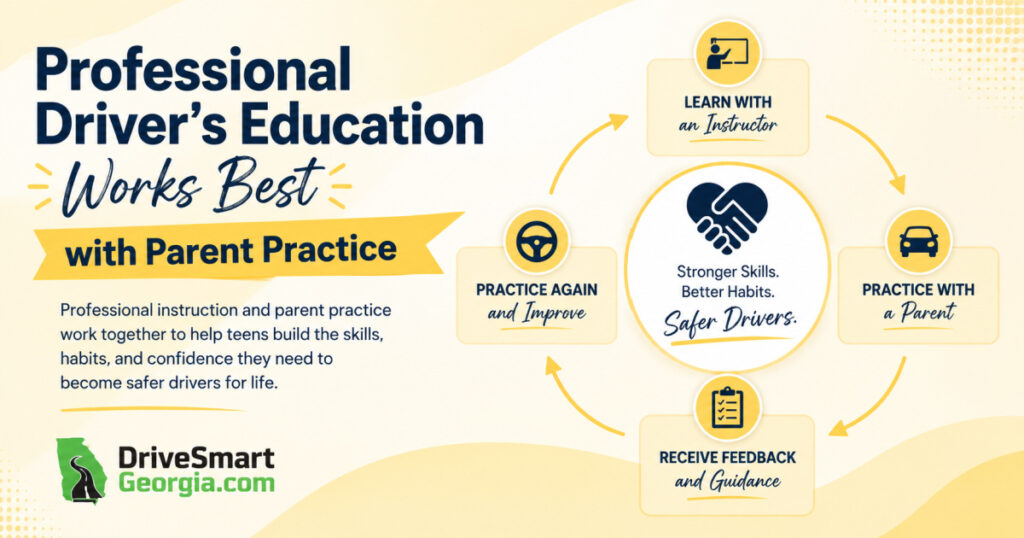
That creates a powerful cycle:
Learn with an instructor. Practice with a parent. Receive feedback. Practice again.
Over time, skills that once required constant reminders can become consistent habits.
Choosing a Professional Driving School in Georgia
Not every driving program is the same.
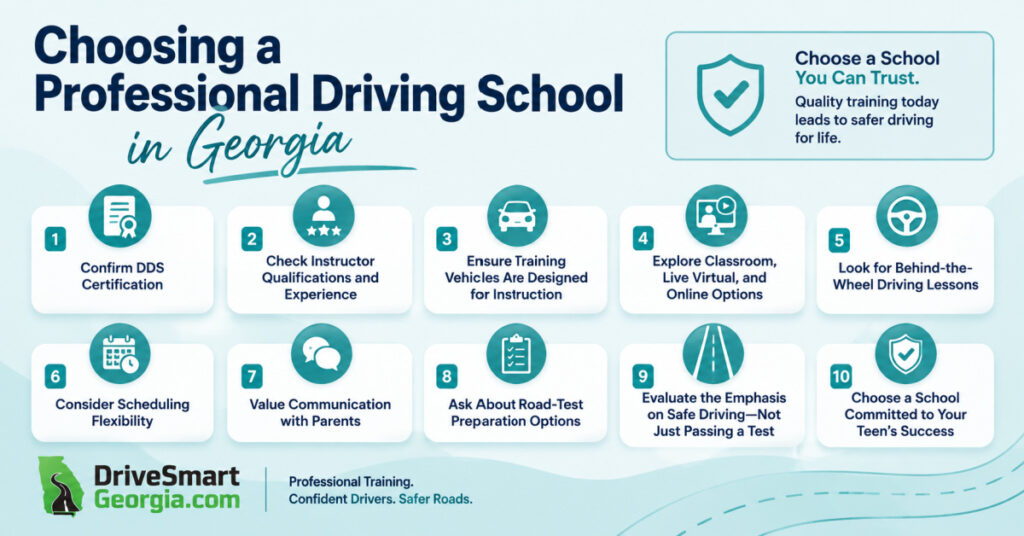
When researching a Georgia driving school, parents should consider:
- Whether the school is certified by the Georgia DDS
- The qualifications and experience of its instructors
- Whether vehicles are designed for professional driver training
- Classroom, live virtual, or online course options
- Availability of behind-the-wheel driving lessons
- Scheduling flexibility
- Communication with parents
- Road-test preparation options
- Overall emphasis on safe driving rather than simply passing a test
Georgia DDS states that only certified driving schools are approved for state driver education programs, so certification should be one of the first things parents verify. Drive Smart Georgia is certified by Georgia DDS>
Help Your Teen Become a Safer, More Confident Driver
Learning to drive takes time.
The strongest teen drivers are not created by one class, six hours of lessons, or a few trips around the neighborhood. They develop through education, professional instruction, parent involvement, repeated practice, and experience in a variety of driving situations.
At Drive Smart Georgia, our professional driving instructors and classroom teachers help Georgia teens develop the skills, habits, and confidence they need behind the wheel. Families can choose from Joshua’s Law Driver’s Ed programs, professional driving lessons, road-test preparation, and convenient road-testing options at select North Atlanta locations.
Professional driver’s education gives teens something that is difficult to get from practice alone: structured training combined with objective feedback.
For parents, that can mean greater confidence that their teen is learning not simply how to pass a road test – but how to become a safer driver for life.
Ready to get started? Explore Drive Smart Georgia’s Driver’s Ed programs and professional driving lessons to find the right training option for your teen. Head to:
drivesmartgeorgia.com.
Drive Smart Georgia locations:
- Milton: 850 Mayfield Rd., Suite L-9, Milton, GA 30009. (770) 628-7540
- Johns Creek: 11380 Southbridge Pkwy., Alpharetta, GA 30022. (770) 232-0903
- Alpharetta: 5354 McGinnis Ferry Rd., Suite 226B, Alpharetta, GA 30005. (770) 232-0900
- Cumming: 1790 Peachtree Pkwy., Suite 202, Cumming, Ga. (770) 239-4294
- Suwanee: 970 Peachtree Industrial Blvd., Suwanee, GA 30024. (770) 741-0455
- Roswell: 590 W. Crossville Rd., Suite 204, Roswell, GA 30075. (770) 741-0405
Related articles:
- Night Driving Tips for Georgia Teen Drivers
- 10 Signs Your Teen is Ready to Take the Georgia Road Test
- Joshua’s Law FAQs: Answers to Parents’ Most Common Questions
- How to Overcome Driving Anxiety