Night Driving Tips for Georgia Teen Drivers
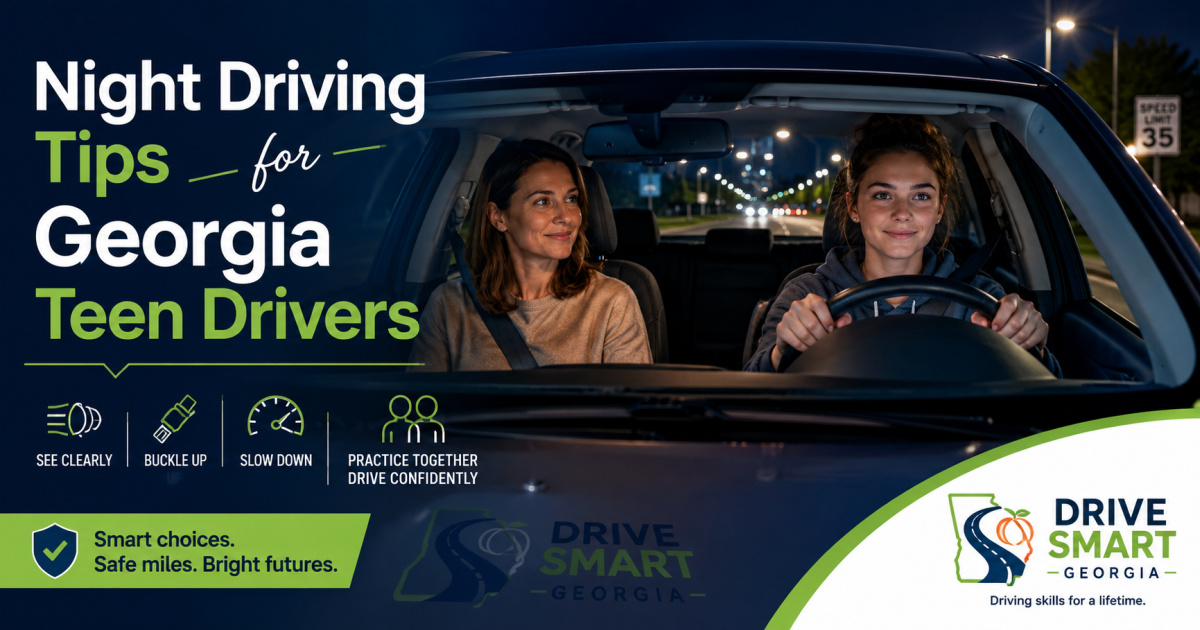
Driving at night is an important skill for every new driver to develop. However, darkness introduces challenges that teens may not experience during daytime driving. Reduced visibility, glare from headlights, fatigue, animals crossing the road, and difficulty judging distance can make nighttime trips more demanding.
For Georgia teen drivers, nighttime practice is also part of the licensing process. Joshua’s Law requires teens to complete supervised driving experience before earning a Class D license, including at least six hours of nighttime driving. These practice hours should help teens gradually build confidence while a parent, guardian, or other qualified adult is in the passenger seat.
The following night driving tips for Georgia teen drivers can help families make nighttime practice safer, calmer, and more productive.
Why Is Night Driving More Difficult for Teen Drivers?
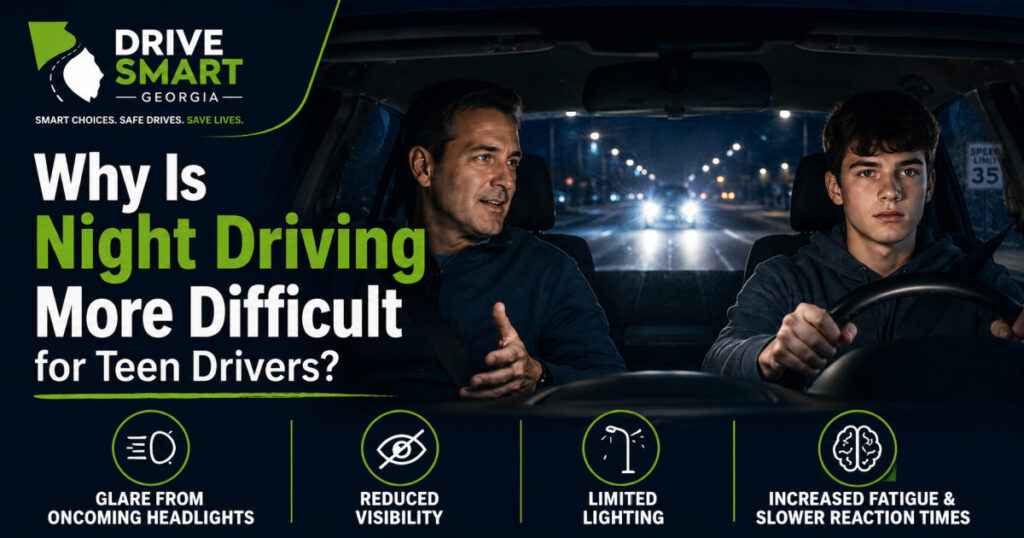
Driving after dark is more challenging for drivers of every age, but inexperienced drivers face additional risks. Teen drivers are still learning how to identify hazards, judge closing distances, control their speed, and respond to unexpected situations.
At night, drivers cannot see as far ahead or as clearly as they can during the day. Headlight glare can temporarily affect vision, and familiar roads may look completely different in the dark. Fatigue and distractions can also make it harder to remain focused.
The CDC reports that nighttime driving is especially dangerous for teen drivers. Per mile driven, the nighttime fatal crash rate for drivers ages 16–19 is approximately three times the rate for adult drivers ages 30–59.
That does not mean teens should avoid all nighttime driving practice. Instead, they should learn gradually in low-risk conditions with an experienced adult.
Understand Georgia’s Night Driving Requirements and Restrictions
Georgia teens must follow different rules depending on whether they have a learner’s permit or a Class D provisional license.
Under Joshua’s Law, 16- and 17-year-olds must complete 40 hours of supervised driving, including at least six hours at night, before applying for a Class D license. A parent or guardian must verify that these hours were completed.
Once a teen receives a Georgia Class D license, the teen may not drive between midnight and 5:00 a.m. Georgia DDS states that there are no exceptions to this restriction. The restriction is based on the driver’s license class, not simply the driver’s age.
Families should plan nighttime practice sessions that end well before midnight and always follow the restrictions associated with the teen’s permit or license.
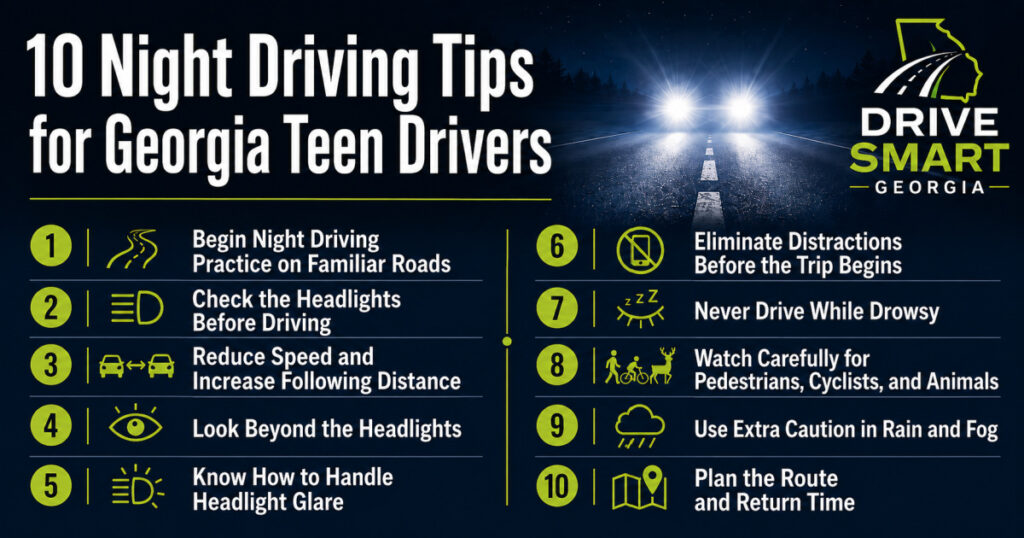
1. Begin Night Driving Practice on Familiar Roads
A teen’s first nighttime drive should not take place on a busy interstate, unfamiliar highway, or crowded entertainment district.
Start in a familiar neighborhood with low traffic, lower speed limits, and clearly marked streets. Once the teen becomes comfortable, gradually introduce more challenging conditions, including:
- Two-lane roads
- Busier intersections
- Roads without streetlights
- Moderate highway driving
- Light rain after dark
Gradual exposure allows teens to focus on one new skill at a time instead of becoming overwhelmed.
2. Check the Headlights Before Driving
Before leaving, make sure the headlights, brake lights, turn signals, and taillights are working properly. Teens should also understand the difference between daytime running lights, low beams, and high beams.
Some vehicles illuminate the dashboard even when the full headlights are not turned on. That can cause an inexperienced driver to mistakenly believe the headlights and taillights are operating.
Encourage your teen to confirm the headlight setting every time the vehicle is started at night.
High beams can improve visibility on dark, open roads, but they must be dimmed when approaching another vehicle or following one closely. Teens should practice switching between high and low beams without looking away from the road.
3. Reduce Speed and Increase Following Distance
Headlights illuminate only a limited area ahead of the vehicle. Driving too fast can prevent a driver from stopping within the visible distance.
Teach your teen to reduce speed when visibility is limited, even when the posted speed limit allows faster travel. Speed limits are intended for favorable conditions and may be too fast for darkness, rain, fog, or heavy traffic.
Teens should also leave extra space between their vehicle and the vehicle ahead. A larger following distance provides more time to recognize brake lights, understand what traffic is doing, and respond smoothly.
4. Look Beyond the Headlights
New drivers often focus directly in front of the hood. This habit can make it harder to detect hazards early.
Encourage your teen to scan farther down the road while continuing to check the mirrors and surrounding areas. Look for:
- Brake lights in the distance
- Traffic signals
- Curves and hills
- Pedestrians near crosswalks
- Cyclists without reflective clothing
- Animals near the shoulder
- Disabled vehicles
- Construction signs or lane changes
Scanning ahead gives the driver more time to make a safe decision instead of reacting at the last moment.
5. Know How to Handle Headlight Glare
Bright headlights from an approaching vehicle can temporarily make it difficult to see. Teens should avoid staring directly into the lights.
Instead, look slightly toward the right side of the lane and use the road’s edge line as a guide until the vehicle passes. Continue monitoring the road ahead without turning the head too far away from traffic.
The rearview mirror’s nighttime or automatic-dimming setting can also reduce glare from vehicles approaching from behind.
6. Eliminate Distractions Before the Trip Begins
Distractions are dangerous at any time, but nighttime driving leaves less room for error.
Phones should be silenced and placed out of reach before the vehicle moves. Navigation, music, climate controls, and seat positions should also be adjusted before leaving.
Teen passengers can create another major distraction. Georgia’s Class D passenger restrictions limit the number of young passengers a newly licensed teen may carry. During the first six months after receiving a Class D license, only immediate family members may ride with the teen. Additional passenger limits apply during the following months.
Even when a passenger is legally permitted, the driver must remain focused on the road.
7. Never Drive While Drowsy
Fatigue can reduce attention, slow reaction time, and interfere with decision-making. A teen who has attended school, participated in sports, worked a shift, or studied late may not be alert enough to drive safely.
Common warning signs include:
- Frequent yawning
- Heavy eyelids
- Difficulty maintaining speed
- Missing signs or turns
- Drifting within the lane
- Forgetting the last few miles driven
Opening a window, increasing the music volume, or drinking caffeine is not a dependable solution. A tired teen should not begin or continue driving. Arrange for a rested adult to drive instead.
8. Watch Carefully for Pedestrians, Cyclists, and Animals
Pedestrians and cyclists can be difficult to see at night, especially when they wear dark clothing or travel outside well-lit areas.
Teens should slow down near crosswalks, neighborhoods, shopping areas, schools, and event venues. They should check carefully before turning, even when they have a green light.
Deer and other animals are also common on many Georgia roads. Remind your teen to scan both shoulders, especially on wooded or rural routes. When an animal appears, slow down while maintaining control of the vehicle. Avoid making a sudden, unsafe swerve into another lane.
9. Use Extra Caution in Rain and Fog
Rain can make nighttime driving especially difficult because wet pavement reflects headlights, streetlights, and traffic signals. It also reduces traction and increases stopping distance.
Teens should slow down, leave additional following space, and use low-beam headlights. High beams can reflect off fog or heavy rain and make visibility worse.
If conditions become too difficult, pull into a safe location away from traffic. Do not stop in an active travel lane or on a narrow shoulder unless there is an emergency.
10. Plan the Route and Return Time
Before a nighttime trip, teens should know where they are going, how long the drive should take, and where they can safely stop if necessary.
Parents and teens should also confirm the expected return time. For Class D drivers, the trip must be planned so the teen is not driving between midnight and 5:00 a.m.
Whenever possible, choose well-lit roads and avoid routes with complicated intersections, heavy construction, or unfamiliar rural areas until the teen has more experience.
How Parents Can Help Teens Practice Night Driving
Parents play an important role in helping new drivers become comfortable after dark. Stay calm, give instructions early, and avoid correcting several things at once.
Begin with short practice sessions and focus on specific skills, such as maintaining a safe following distance or using high beams correctly. After the drive, discuss what went well and choose one or two skills to improve during the next session.
Parents should also model the behavior they expect from their teen. Wear a seat belt, put the phone away, follow speed limits, and avoid aggressive driving.
Build Night Driving Confidence with Professional Lessons
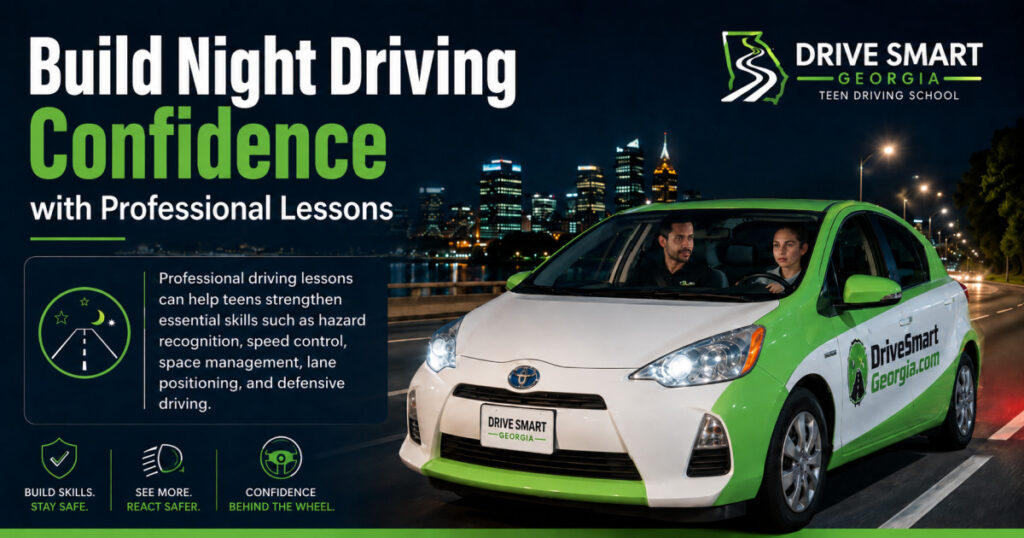
Night driving confidence develops through education, supervised practice, and experience in different conditions. Professional driving lessons can help teens strengthen essential skills such as hazard recognition, speed control, space management, lane positioning, and defensive driving.
At Drive Smart Georgia, our professional instructors help teens become safer and more confident behind the wheel. Our late-model training vehicles have an additional brake and accelerator on the instructor’s side, providing an added level of control during lessons.
We offer Joshua’s Law Driver’s Ed, professional driving lessons, convenient on-site road testing at select North Atlanta locations, and defensive driving courses.
Help your teen prepare for daytime and nighttime driving with patient practice and professional instruction. Select a Drive Smart Georgia location to explore available Driver’s Ed and driving lesson packages.
Drive Smart Georgia locations:
- Milton: 850 Mayfield Rd., Suite L-9, Milton, GA 30009. (770) 628-7540
- Johns Creek: 11380 Southbridge Pkwy., Alpharetta, GA 30022. (770) 232-0903
- Alpharetta: 5354 McGinnis Ferry Rd., Suite 226B, Alpharetta, GA 30005. (770) 232-0900
- Cumming: 1790 Peachtree Pkwy., Suite 202, Cumming, Ga. (770) 239-4294
- Suwanee: 970 Peachtree Industrial Blvd., Suwanee, GA 30024. (770) 741-0455
- Roswell: 590 W. Crossville Rd., Suite 204, Roswell, GA 30075. (770) 741-0405
Related articles:
- Back-to-School Driving Safety Tips for Georgia Teens
- What is a Georgia Driver’s Ed scholarship?
- Georgia Class D License Requirements Explained
- Defensive Driving Tips that Could Help Prevent Crashes