Back-to-School Driving Safety Tips for Georgia Teens
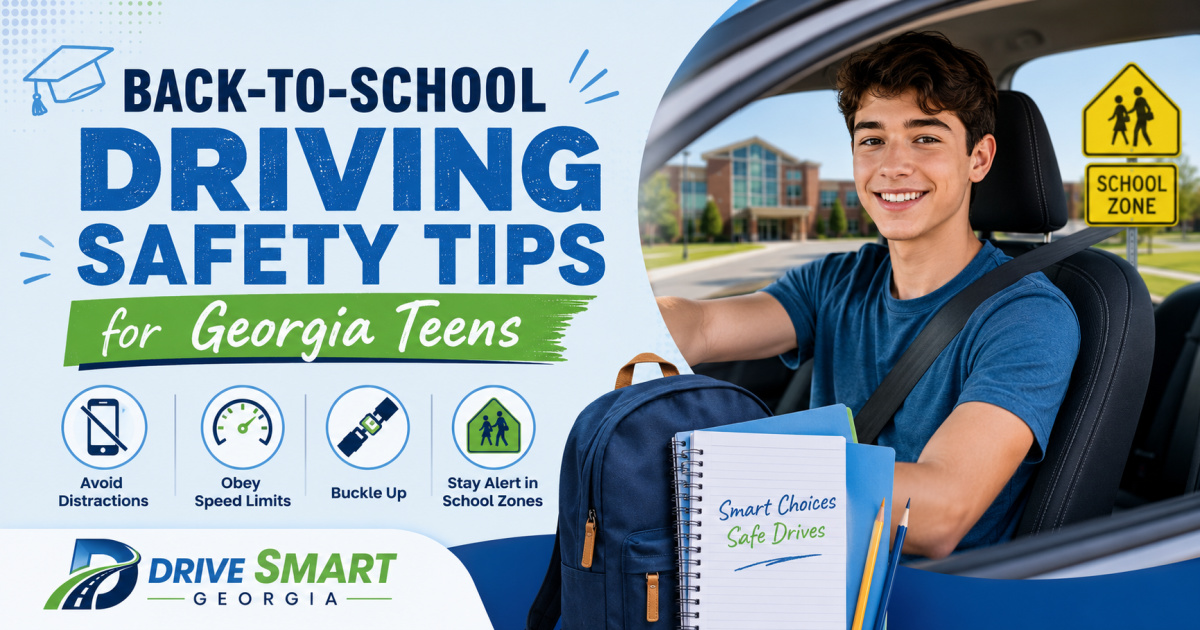
A new school year brings earlier mornings, busier schedules, crowded parking lots, after-school activities, and more traffic on Georgia roads. For teen drivers, the transition from summer break to the school routine can be especially challenging.
New drivers may be navigating heavy traffic, unfamiliar routes, school buses, pedestrians, cyclists, and long carpool lines—all while trying to arrive before the first bell. Add an early alarm, a distracting phone, or a car full of friends, and the risk of a mistake can quickly increase.
Whether your teen recently earned a learner’s permit or already has a Georgia Class D license, these back-to-school driving safety tips can help them start the year safely and confidently.
Back-to-School Driving Safety Tips for Georgia Teens
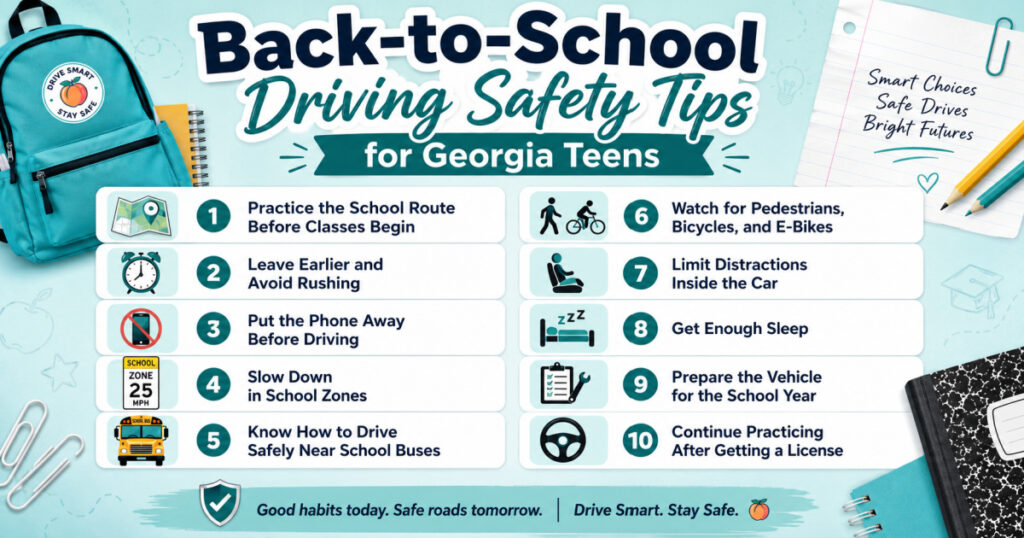
1. Practice the School Route Before Classes Begin
Do not wait until the first day of school for your teen to drive the route for the first time. Take several practice drives together before classes begin.
Practice during the same time of day your teen will normally travel so they can become familiar with:
- Busy intersections and turning lanes
- School-zone speed limits
- Carpool entrances and exits
- Bus stops and crosswalks
- Construction zones
- Areas where traffic regularly backs up
- Safe places to turn around after a missed turn
Have your teen practice the route in both directions. The afternoon drive home may involve different traffic patterns, sun glare, pedestrians, or turning restrictions than the morning commute.
Knowing the route ahead of time allows a new driver to concentrate on traffic instead of relying on last-second directions.
2. Leave Earlier and Avoid Rushing
Running late is one of the easiest ways for a teen driver to make an unsafe decision. A rushed driver may speed, follow too closely, roll through a stop sign, or make an aggressive lane change.
Encourage your teen to leave at least 10 to 15 minutes earlier than necessary, especially during the first few weeks of school. Traffic is often heavier as families adjust to new schedules and carpool procedures.
AAA recommends allowing additional travel time during the back-to-school period because rushing can contribute to speeding and other dangerous driving behaviors.
Help your teen prepare the night before by packing their backpack, charging their phone, choosing clothes, and placing their keys in a consistent location. A calmer morning can lead to a safer drive.
3. Put the Phone Away Before Driving
Phones are not the only source of driver distraction, but they are among the most tempting. Text messages, navigation alerts, music selections, social media notifications, and calls can all take a driver’s attention away from the road.
Georgia traffic-safety data shows that young drivers ages 15 to 24 are overrepresented in distraction-related crashes and distracted-driving citations.
Before moving the car, teens should:
- Set the destination
- Select music or a podcast
- Silence notifications
- Place the phone out of reach
- Ask a passenger to handle navigation when appropriate
Teens should never try to read or answer a message while stopped at a traffic light. Their attention needs to remain on surrounding vehicles, pedestrians, cyclists, and changing signals.
Parents can reinforce this rule by modeling the same behavior whenever they drive.
4. Slow Down in School Zones
School zones require a driver’s full attention. Children may cross unexpectedly, buses may stop frequently, crossing guards may enter the roadway, and vehicles may pull in and out of carpool lanes.
Teens should watch carefully for flashing school-zone signals and reduced speed limits. They should also be prepared to stop quickly without following the vehicle ahead too closely.
Remind your teen that the posted limit is a maximum, not a required speed. Rain, congestion, poor visibility, or heavy pedestrian activity may require driving even slower.
Drivers should also follow the directions of crossing guards and school personnel, even when those directions differ temporarily from the normal traffic pattern.
5. Know How to Drive Safely Near School Buses
A school bus can stop with little warning, especially on neighborhood roads. Teen drivers should maintain a generous following distance, so they have enough time to respond when a bus slows down.
When a school bus activates its flashing red lights and extends its stop arm, drivers must stop as required by Georgia law. They should remain stopped until the warning signals are deactivated and it is safe to continue.
Teens should never attempt to rush around a bus or assume that every child has already crossed. Students may enter the roadway from in front of the bus, behind it, or between parked vehicles.
Extra caution is important near bus stops even when a bus is not present.
6. Watch for Pedestrians, Bicycles, and E-Bikes
Back-to-school traffic includes more than cars and buses. Teen drivers may encounter students walking, riding bicycles, using scooters, or traveling on e-bikes.
Drivers should scan sidewalks, crosswalks, driveways, and the spaces between parked vehicles. They should make eye contact with pedestrians when possible and yield whenever required.
Extra care is needed during the afternoon. Students may be talking with friends, wearing headphones, or looking at phones as they leave school. AAA notes that the hours following the school day can be particularly dangerous for young pedestrians.
Teen drivers should never wave a pedestrian across multiple traffic lanes unless they are certain every lane is stopping. Another driver may not see the person crossing.
7. Limit Distractions Inside the Car
A phone is not the only distraction a teen may face. Eating breakfast, adjusting the radio, searching through a backpack, applying makeup, or talking with passengers can also reduce attention.
Friends can be an especially powerful distraction for inexperienced drivers. Georgia’s Class D passenger restrictions are designed to reduce that risk.
For the first six months after receiving a Class D license, only immediate family members may ride with the teen. During the second six months, the driver may carry only one passenger under age 21 who is not an immediate family member. After one year, the driver may carry up to three passengers under 21 who are not immediate family members.
These restrictions apply to the Class D license – not simply the driver’s age.
8. Get Enough Sleep
Back-to-school schedules can be exhausting. Early classes, homework, sports, clubs, jobs, and social activities may leave teens with too little sleep.
Drowsy driving can slow reaction time, reduce awareness, and make it harder to make safe decisions. A teen who is struggling to stay awake should not drive.
Parents should help teens create realistic schedules and discuss backup transportation options. Asking for a ride is always safer than driving while exhausted.
Teens should also understand that opening a window, increasing the music volume, or drinking caffeine does not make a dangerously tired driver safe.
9. Prepare the Vehicle for the School Year
A reliable vehicle is an important part of driving safety. Before school begins, families should check:
- Tire pressure and tread
- Headlights, brake lights, and turn signals
- Windshield wipers
- Fluid levels
- Brakes
- Mirrors
- Emergency supplies
- Fuel or battery charge
The driver’s seat, steering wheel, head restraint, and mirrors should be adjusted before the vehicle moves.
Teens should also keep loose sports equipment, water bottles, books, and backpacks secured. An unsecured item can roll near the pedals or become a dangerous distraction.
10. Continue Practicing After Getting a License
Passing the Georgia road test is an important achievement, but it does not mean a teen has encountered every driving situation.
Parents should continue supervised practice after licensing, particularly in:
- Heavy traffic
- Rain
- Nighttime conditions
- Highway merging
- School parking lots
- Construction zones
- Unfamiliar areas
Georgia’s Joshua’s Law requirements help teens build an important foundation. Drivers ages 16 and 17 seeking a Class D license must complete an approved driver-education option and 40 hours of supervised driving, including six hours at night. They must also hold a learner’s permit for at least one year and one day.
Those hours should be viewed as a starting point – not the end of the learning process.
A Back-to-School Safety Checklist for Parents
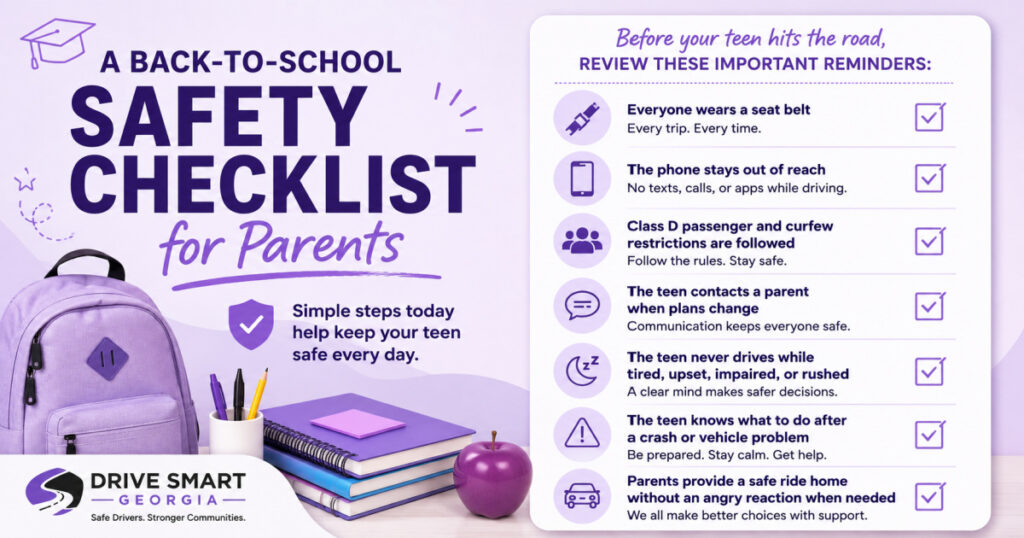
Before your teen begins driving to school independently, review a few clear family expectations:
- Everyone wears a seat belt on every trip.
- The phone stays out of reach.
- Class D passenger and curfew restrictions are followed.
- The teen contacts a parent when plans change.
- The teen never drives while tired, upset, impaired, or rushed.
- The teen knows what to do after a crash or vehicle problem.
- Parents provide a safe ride home without an angry reaction when needed.
Consider creating a written parent-teen driving agreement. Clear expectations and consistent consequences can prevent confusion and encourage responsible decisions.
Build Safer Driving Skills with Drive Smart Georgia
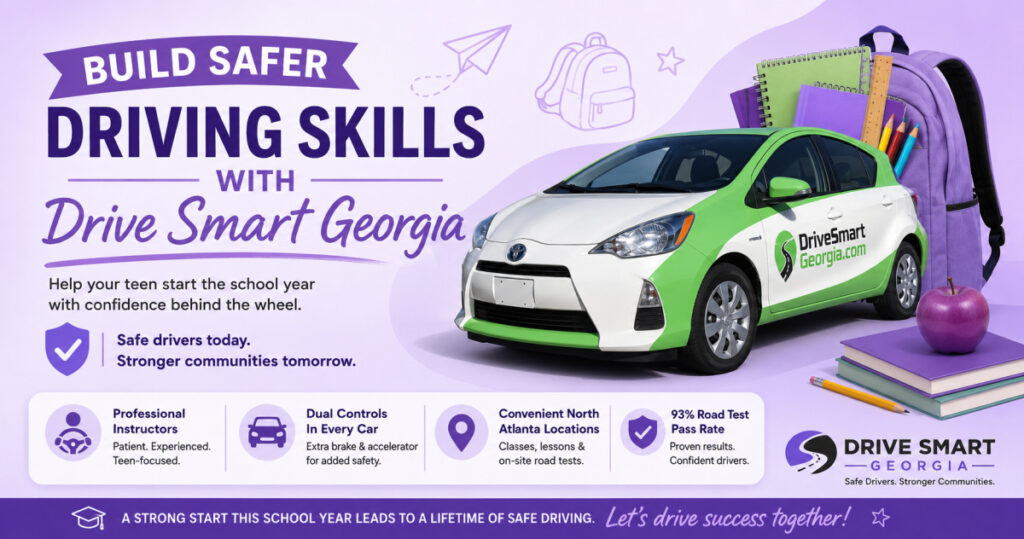
The beginning of the school year is an ideal time to strengthen your teen’s driving skills. Professional instruction can help new drivers improve observation, lane control, parking, turning, defensive driving, and decision-making in real traffic.
Drive Smart Georgia has helped more than 100,000 Georgia drivers become safer and more confident behind the wheel. We offer Joshua’s Law Driver’s Ed, professional driving lessons, road test preparation, and convenient on-site road testing at select North Atlanta locations.
Our professional instructors provide patient, personalized guidance in late-model training vehicles equipped with instructor-side controls for added safety.
Help your teen begin the school year with the skills and confidence needed to handle Georgia roads safely. Explore Drive Smart Georgia’s Driver’s Ed and driving lesson options today.
Drive Smart Georgia locations:
- Milton: 850 Mayfield Rd., Suite L-9, Milton, GA 30009. (770) 628-7540
- Johns Creek: 11380 Southbridge Pkwy., Alpharetta, GA 30022. (770) 232-0903
- Alpharetta: 5354 McGinnis Ferry Rd., Suite 226B, Alpharetta, GA 30005. (770) 232-0900
- Cumming: 1790 Peachtree Pkwy., Suite 202, Cumming, Ga. (770) 239-4294
- Suwanee: 970 Peachtree Industrial Blvd., Suwanee, GA 30024. (770) 741-0455
- Roswell: 590 W. Crossville Rd., Suite 204, Roswell, GA 30075. (770) 741-0405
Related articles:
- Georgia Class D License Requirements Explained
- What is a Georgia Driver’s Ed scholarship?
- 10 Safe Driving Habits for Teens Before Driving Alone
- Defensive Driving Tips That Could Help Prevent Crashes