How to Stay Safe While Driving in Heavy Traffic in Georgia
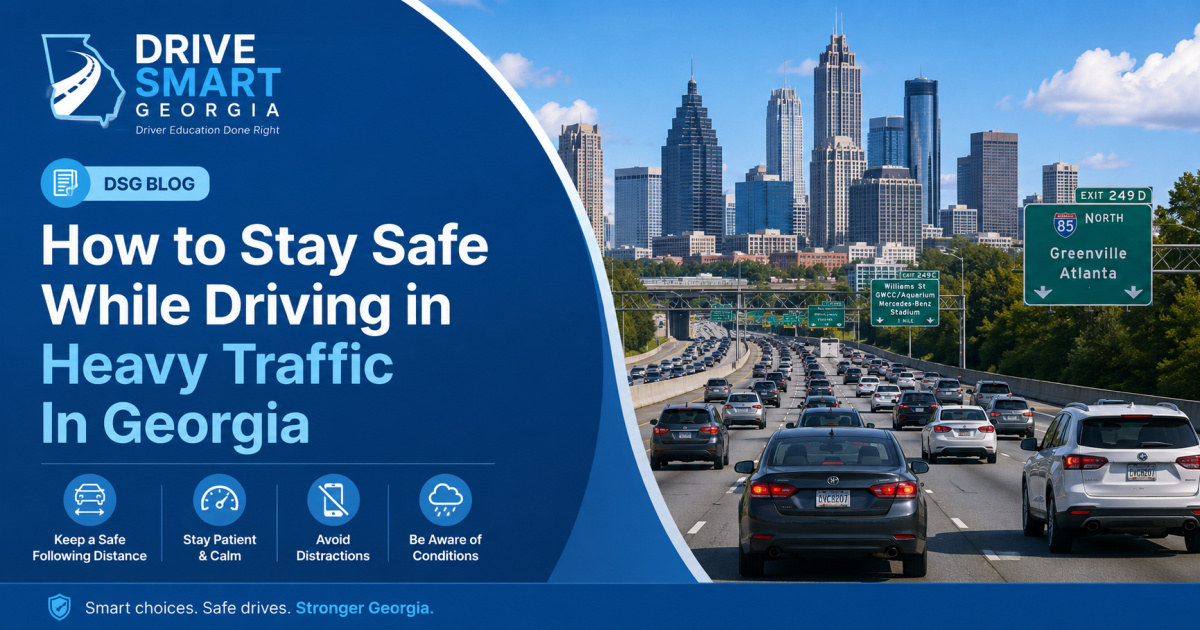
Heavy traffic is a fact of life for many Georgia drivers. Whether you’re navigating I-285 during rush hour, merging onto GA-400, traveling through busy Atlanta suburbs, or simply dealing with crowded roads around schools and shopping areas, congestion can make driving more stressful and demanding.
For new and teen drivers, heavy traffic can be especially challenging. Cars may stop suddenly, drivers may change lanes without much warning, and a moment of distraction can quickly create a dangerous situation.
Learning how to stay safe while driving in heavy traffic is an important part of becoming a confident, responsible driver. The goal isn’t to move through congestion as quickly as possible. It’s to stay alert, maintain enough space, make predictable decisions, and give yourself time to respond when traffic changes.
Here are practical ways Georgia drivers can stay safer when roads get crowded.
Why Heavy Traffic Can Be Challenging for New Drivers
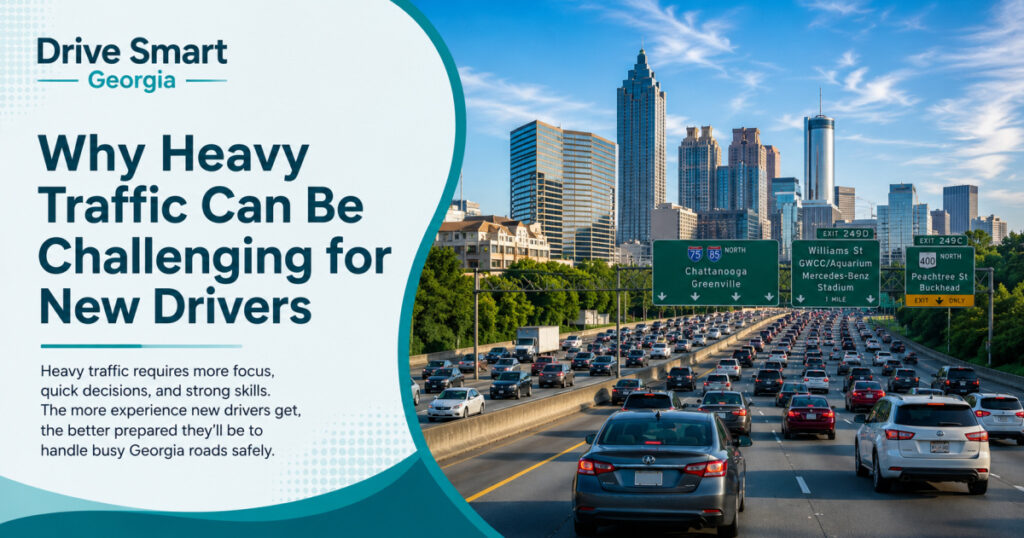
Heavy traffic requires drivers to process a lot of information at once.
Georgia drivers may need to monitor:
- Vehicles directly ahead of you
- Cars approaching from behind
- Vehicles in neighboring lanes
- Brake lights farther ahead
- Motorcycles and bicycles
- Pedestrians
- Traffic signals and signs
- Entrance and exit ramps
- Drivers trying to merge
- Emergency or roadside vehicles
For experienced drivers, some of these observations may become automatic. Newer drivers are still developing those visual-search and decision-making skills.
That is one reason supervised driving practice and professional driving instruction can be so valuable. The more experience teens gain in gradually more complex traffic situations, the better prepared they can become to recognize hazards and make safe decisions.
17 ways to Stay Safe While Driving in Heavy Traffic in Georgia
 1. Leave More Space Between Your Vehicle and the Car Ahead
 1. Leave More Space Between Your Vehicle and the Car Ahead
One of the most important heavy traffic driving safety tips is also one of the simplest: don’t follow too closely.
In stop-and-go traffic, it can be tempting to stay close to the vehicle ahead, so another driver doesn’t enter the gap. That small space, however, gives you less time to react if traffic suddenly slows or stops.
Instead, maintain a safe following distance appropriate for the conditions.
Look beyond the bumper directly ahead of you, too. Watch several vehicles farther down the road. If you see brake lights appearing ahead, you can begin preparing to slow before the driver immediately in front of you reacts.
Creating additional space can also make driving feel less stressful because you have more room to respond gradually instead of constantly braking at the last second.
3. Look Farther Down the Road
Safe drivers don’t focus exclusively on the vehicle immediately in front of them.
Keep your eyes moving and scan the traffic farther ahead.
Look for:
- Brake lights
- Traffic signals changing
- Lane closures
- Construction
- Vehicles merging
- Disabled vehicles
- Emergency vehicles
- Pedestrians near the roadway
- Traffic that appears to be slowing
Looking farther ahead gives you more time to recognize changing conditions and adjust your speed smoothly.
This is especially valuable on Georgia interstates, where traffic can change from highway speed to a slowdown surprisingly quickly.
3. Avoid Constant Lane Changes
When another lane appears to be moving faster, switching lanes can be tempting. Then the lane you just left starts moving, so you switch again.
This kind of constant lane changing usually creates more work for the driver and increases the number of potential conflicts with other vehicles.
In congested traffic, it is often safer to select an appropriate lane and remain there unless you have a reason to move.
Before changing lanes:
- Check your mirrors, signal early, check your blind spot, evaluate the available space, and move smoothly when it is safe.
- Never assume another driver will automatically make room for you.
4. Expect Traffic to Stop Suddenly
Heavy traffic frequently creates a pattern of acceleration followed by sudden braking. Instead of accelerating aggressively every time traffic begins moving, try to keep your speed smooth and controlled.
Watch what is happening several vehicles ahead and anticipate when traffic may begin slowing again.
Smooth acceleration and braking can help:
- Increase your reaction time
- Reduce abrupt stops
- Maintain a safer space cushion
- Make your actions more predictable to drivers behind you
- Reduce stress in stop-and-go conditions
A safe driver is always thinking about what might happen next.
5. Keep Your Phone Out of Your Hands
Heavy traffic is not the time to check a text, scroll through notifications, change a playlist, or pick up your phone.
Georgia’s Hands-Free Law applies to drivers of all ages and license types. Drivers may not physically hold or support a wireless telecommunications device while operating a vehicle. Georgia law also prohibits drivers from writing, sending, or reading text-based communications and from watching, recording, or broadcasting video while driving.
Before you start driving: Set your destination, choose your music or audio, adjust your temperature controls, and put your phone somewhere you will not be tempted to reach for it.
Even hands-free technology should never take your attention away from safely operating the vehicle.
6. Make Your Driving Predictable
One of the best ways to stay safe around other drivers is to make your intentions clear. Use your turn signal before changing lanes or turning. Avoid sudden acceleration, abrupt braking, and last-second lane changes whenever possible. Predictability helps other drivers understand what you plan to do.
In crowded traffic, safe driving is not about surprising another driver or forcing your way into an opening. It is about communicating clearly and making controlled decisions.
7. Watch Carefully When Traffic Merges
Merging is one of the most stressful situations for many teen drivers. Georgia highways have numerous entrance ramps, exit lanes, lane reductions, and busy interchanges where multiple streams of traffic come together.
When another lane merges with yours: Stay alert, maintain control of your speed, avoid blocking another vehicle unnecessarily, and leave enough space for traffic to merge when conditions allow.
If you are the one entering a highway, use the acceleration lane to prepare to match the flow of traffic as safely as possible. Check mirrors and blind spots, signal your intention, and identify an appropriate opening before merging.
Avoid stopping at the end of an acceleration lane unless traffic conditions require you to stop.
8. Check Your Mirrors Frequently
Traffic behind and beside you matters almost as much as traffic ahead. Develop the habit of checking your mirrors periodically so you maintain awareness of your surroundings.
Knowing where other vehicles are can help you respond more effectively if you need to slow down, change lanes, avoid a hazard, or move for an emergency vehicle.
Mirror checks should be brief. Your primary visual attention still belongs on the road ahead.
9. Be Extra Careful Around Distracted Drivers
You may be doing everything correctly and still encounter another driver who is not paying attention.
Georgia DDS advises drivers to watch for warning signs of distracted motorists, including vehicles drifting within or across lanes and vehicles traveling at inconsistent speeds. DDS recommends giving distracted drivers plenty of room and using extra caution when passing them.
Rather than trying to confront, teach a lesson to, or compete with an unsafe driver, increase the space between your vehicles whenever you can safely do so. Your goal is to remove yourself from the potential problem.
10. Stay Calm Around Aggressive Drivers
Heavy traffic can frustrate drivers. You may encounter someone who follows too closely, rapidly changes lanes, honks, speeds, or behaves impatiently.
Do not respond with aggressive behavior of your own.
Avoid:
- Speeding up to prevent someone from passing
- Following another vehicle closely
- Making angry gestures
- Shouting at another driver
- Competing for a lane
- Braking suddenly to retaliate
Give aggressive drivers space and concentrate on your own driving.
For teen drivers especially, it is important to understand that being “right” in a traffic disagreement is never more important than avoiding a crash.
11. Know Georgia’s Keep-Right Rules
On multi-lane Georgia roads, drivers should understand the state’s rules regarding the left lane.
Georgia’s “Keep Right, Except to Pass” requirements generally require slower-moving drivers to move out of the left passing lane when faster traffic approaches, although there are exceptions for circumstances such as congestion, hazards, weather conditions, left turns, and other situations.
Heavy traffic itself can be one of those situations where normal traffic conditions affect which lane drivers need to use.
The larger lesson for teens is simple: understand the purpose of each lane, obey traffic laws and signs, and avoid treating the left lane as a place to compete with faster drivers.
12. Be Prepared for Emergency and Roadside Vehicles
Heavy traffic does not eliminate your responsibility to watch for emergency personnel and roadside workers.
Georgia’s Move Over Law requires motorists approaching qualifying emergency, sanitation, or utility service vehicles stopped along the roadway to move into the next lane when safely possible. If drivers cannot safely move over, they should slow below the speed limit and be prepared to stop.
In congested traffic, moving over may require additional planning because surrounding lanes can already be crowded. Watch far ahead, signal early, and never make a sudden or unsafe lane change simply because you notice a roadside vehicle at the last moment.
13. Leave Extra Time for the Trip
Running late can make ordinary traffic feel much more stressful.
A driver who is worried about arriving late may be more tempted to:
- Follow too closely
- Speed
- Make unnecessary lane changes
- Rush through intersections
- Become frustrated
- Take chances while merging
Leaving earlier won’t eliminate traffic, but it can eliminate some of the pressure associated with it.
For teen drivers heading to school, work, sports, or activities, planning extra travel time is a simple safety habit worth developing early.
14. Pay Close Attention at Intersections
Congestion isn’t limited to highways.
Busy intersections can become especially complicated when:
- Multiple turn lanes are present
- Traffic backs up through a signal
- Pedestrians are crossing
- Drivers attempt last-second turns
- Vehicles block your view
- Traffic signals change while cars are still clearing the intersection
Don’t enter an intersection unless you reasonably have space to clear it. Watch for pedestrians and cyclists and never assume another driver will obey a traffic signal simply because you have the right-of-way.
15. Reduce Distractions Before the Car Starts Moving
Safe heavy-traffic driving begins before you leave the parking space.
Georgia DDS recommends preparing for the trip before driving, including planning your route and adjusting mirrors ahead of time.
Before driving, consider taking a few seconds to:
- Adjust your seat
- Adjust your mirrors
- Fasten your seat belt
- Enter your destination
- Check the general route
- Set climate controls
- Choose music or audio
- Secure loose objects
- Make sure passengers are ready
Once the car begins moving, driving deserves your full attention.
16. Increase Caution During Rain and Poor Visibility
Georgia drivers frequently encounter sudden heavy rain, and congestion can become even more difficult when visibility drops. When conditions worsen, increase your following distance, reduce speed as appropriate, use your headlights, avoid sudden steering or braking, and allow even more time for other drivers to react.
Remember that the posted speed limit represents the maximum speed under appropriate conditions – not a requirement to maintain that speed when road, weather, or traffic conditions make it unsafe.
17. Don’t Drive When You Are Too Tired to Focus
Heavy traffic requires concentration. If a driver is exhausted, reaction time and decision-making can suffer. Teen schedules can be especially busy with school, homework, sports, jobs, activities, and early mornings.
Parents should encourage teens to recognize when they are too tired to drive safely.
If you are struggling to stay alert, driving through congested traffic is not the time to try to push through fatigue.
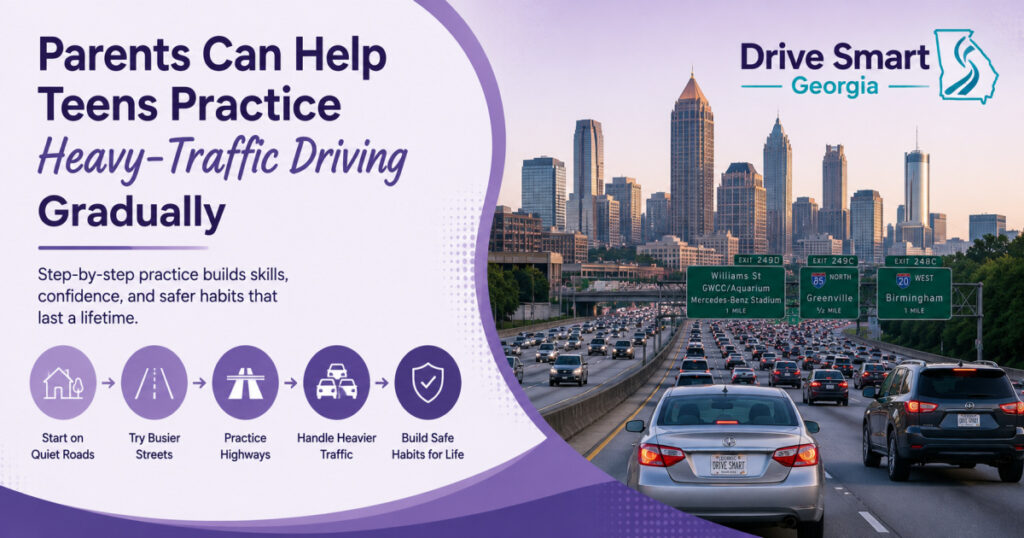
A new driver should not necessarily begin practice in the most congested conditions available.
Instead, parents can gradually increase the complexity of supervised practice.
For example, a teen might progress from quieter neighborhood roads to busier suburban roads, then moderate traffic, multilane roads, highway merging, and eventually heavier traffic when their skills are ready.
During practice, focus on specific skills such as:
- Maintaining following distance
- Scanning farther ahead
- Mirror checks
- Smooth braking
- Lane positioning
- Merging
- Identifying escape routes
- Managing distractions
- Recognizing potential hazards
Gradual exposure can help teens develop skills without overwhelming them.
Professional Driving Lessons Can Help Prepare Teens for Georgia Traffic
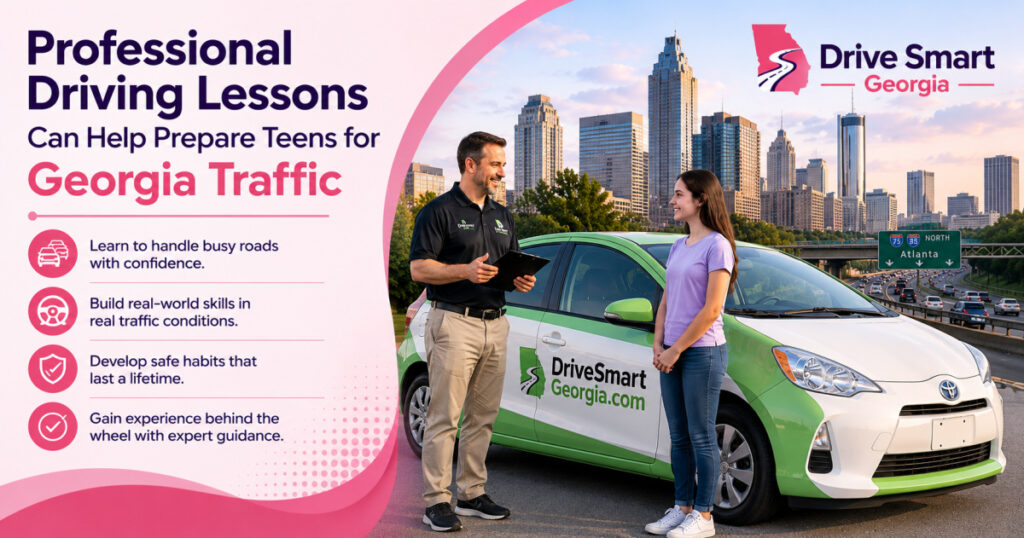
Parent-supervised practice is an essential part of learning to drive, but professional driving instruction can provide another valuable source of training and feedback.
A trained driving instructor can help a teen practice skills such as traffic scanning, space management, lane positioning, speed control, merging, intersection safety, and defensive driving. Professional instruction also gives teens an opportunity to receive objective feedback about habits they may not realize they are developing.
At Drive Smart Georgia, our professional driving instructors work with students to build practical skills they can use long after they earn their driver’s license. The goal isn’t simply to prepare a teen for a road test. It’s to help develop safer driving habits for the real-world situations they will encounter every day.
Frequently Asked Questions About Driving in Heavy Traffic
in Georgia
What is the safest way to drive in heavy traffic?
Maintain a safe following distance, scan well ahead, control your speed, minimize unnecessary lane changes, avoid distractions, and expect traffic conditions to change quickly.
Should I constantly change lanes when another lane is moving faster?
Usually, no. Frequent lane changes create additional interactions with surrounding vehicles. Choose an appropriate lane and change lanes when there is a clear reason and a safe opportunity.
How can a new driver become more comfortable in traffic?
Practice gradually. Begin with lower-traffic environments and progress toward increasingly complex roads as driving skills improve. Supervised parent practice and professional driving lessons can both help.
What should I do if another driver is following me too closely?
Stay calm and avoid retaliatory braking. When it is safe and appropriate, create an opportunity for the other vehicle to pass or increase the distance between yourself and the situation.
Can I hold my phone while stopped in traffic in Georgia?
Georgia’s Hands-Free Law generally prohibits drivers from physically holding or supporting a wireless telecommunications device while operating a motor vehicle. The safest habit is to put your phone away before driving and wait until you are safely parked before using it.
Build Safer Driving Skills for Georgia Roads
Heavy traffic can test even experienced drivers, but good driving habits can make congested roads much easier to manage. Maintain space. Look ahead. Avoid distractions. Make predictable decisions. Stay patient.
For new drivers, those habits don’t develop overnight. They develop through education, practice, feedback, and repetition.
Drive Smart Georgia offers Driver’s Ed and professional behind-the-wheel driving lessons designed to help teens strengthen the skills they need for real-world driving situations. Plus, all our vehicles feature dual controls for added safety, especially on Georgia’s busy highways.
With the right training and plenty of practice, teens can learn to approach Georgia traffic with greater skill, awareness, and confidence.
Drive Smart Georgia locations:
- Milton: 850 Mayfield Rd., Suite L-9, Milton, GA 30009. (770) 628-7540
- Johns Creek: 11380 Southbridge Pkwy., Alpharetta, GA 30022. (770) 232-0903
- Alpharetta: 5354 McGinnis Ferry Rd., Suite 226B, Alpharetta, GA 30005. (770) 232-0900
- Cumming: 1790 Peachtree Pkwy., Suite 202, Cumming, Ga. (770) 239-4294
- Suwanee: 970 Peachtree Industrial Blvd., Suwanee, GA 30024. (770) 741-0455
- Roswell: 590 W. Crossville Rd., Suite 204, Roswell, GA 30075. (770) 741-0405
Related articles:
- How to Build Your Teen’s Driving Confidence Safely
- Georgia Class D License Requirements Explained
- Night Driving Tips for Georgia Teen Drivers
- Joshua’s Law FAQs: Answers to Parents’ Most Common Questions