Why Driver’s Ed Is About More Than Passing the Road Test
For many teens, getting a driver’s license feels like the ultimate goal. They study for the permit test, practice their parking, work on turns and lane changes, and count down the days until they can take the road test.
Parents may be focused on that milestone, too. After all, passing the road test means fewer rides to school, sports, work, and activities – and a little more independence for everyone.
But Driver’s Ed is about much more than passing the road test.
The road test is one brief evaluation on one particular day. Driving is something your teen may do almost every day for decades.
Good Driver’s Ed prepares teens for much more than the skills an examiner can evaluate during a short road test. It helps young drivers develop safe habits, recognize hazards, make better decisions, manage distractions, understand risk, and become more confident behind the wheel.
Those are skills that matter long after the road test is over.
The Road Test Is a Milestone – not the Finish Line
Passing the Georgia road test is an exciting accomplishment. It shows that a teen can demonstrate important vehicle-control and roadway skills well enough to meet the state’s licensing standards.
But a driver cannot encounter every possible situation during a road test.
There may be no heavy rain. No aggressive driver may suddenly appear. Traffic may be relatively light. A pedestrian might not step toward a crosswalk. The teen may not have to merge into complicated traffic, react to an unexpected hazard, or drive after dark.
Real-world driving is much less predictable.
That is one reason parents should think of the road test as one milestone in the learning process rather than the end of driver training.
The bigger objective is to prepare a teen to make safe decisions when a parent, instructor, or examiner is no longer sitting beside them.
Driver’s Ed Helps Teens Build Safe Driving Habits Early
Experienced drivers perform many tasks almost automatically.
They check their mirrors. They scan intersections. They maintain space around their vehicle. They ease off the accelerator when conditions change. They notice a car waiting to pull out of a driveway before it becomes a problem.
New drivers haven’t developed those habits yet.
Driver’s Ed classes and driving lessons give teens an opportunity to learn about the rules of the road and then begin practicing correct techniques from the start.
That matters because driving behaviors that are repeated eventually become habits. If a teen repeatedly forgets to check a blind spot, follows other vehicles too closely, or waits until the last second to brake, those behaviors can become difficult to change.
Professional instruction can reinforce better routines, including:
- Scanning well ahead instead of staring directly in front of the vehicle
- Checking mirrors regularly
- Using turn signals consistently
- Maintaining a safe following distance
- Positioning the vehicle correctly within the lane
- Adjusting speed for traffic, weather, and road conditions
- Looking for pedestrians, cyclists, and other vulnerable road users
- Checking blind spots before changing lanes
- Keeping distractions under control
The goal isn’t simply to perform these actions correctly when an examiner is watching. The goal is to make them part of the teen’s normal driving routine.
Professional Driving Lessons Teach Teens to Look
for Hazards
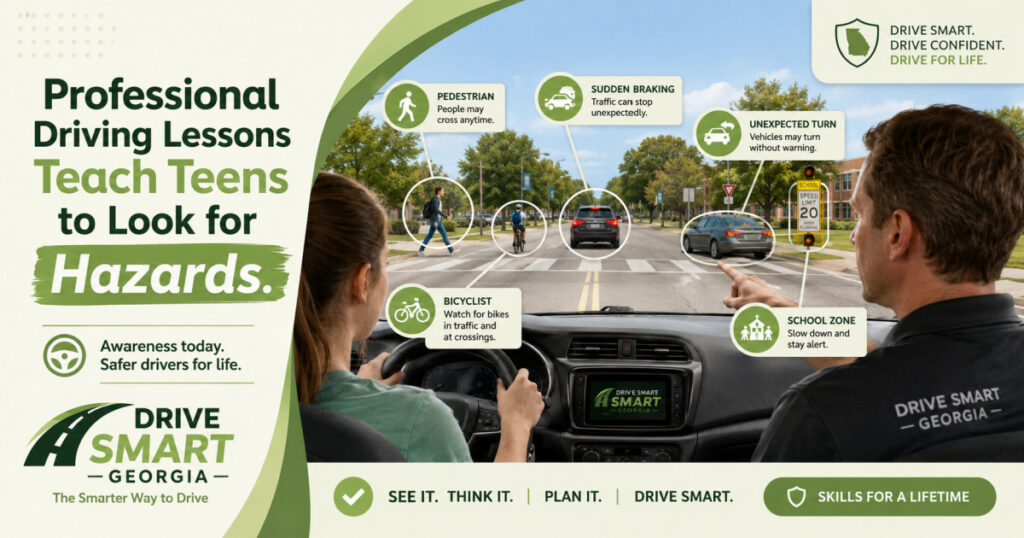
One of the biggest differences between an inexperienced driver and an experienced driver is often what they notice.
A new driver may focus primarily on staying in the lane and watching the car immediately ahead. An experienced driver is usually looking much farther ahead.
They may notice brake lights several vehicles away. They see a vehicle approaching an intersection too quickly. They notice a pedestrian standing near the curb or a delivery truck that could block visibility.
This process is often called hazard recognition.
Professional driving instructors can teach teens to scan continuously and identify situations that could become dangerous before they develop into emergencies.
Instead of only asking, “What is happening right now?,” teens begin learning to ask:
“What could happen next?”
That shift in thinking is an important part of becoming a defensive driver.
Driver’s Ed Teaches Defensive Driving – not Just
Vehicle Control
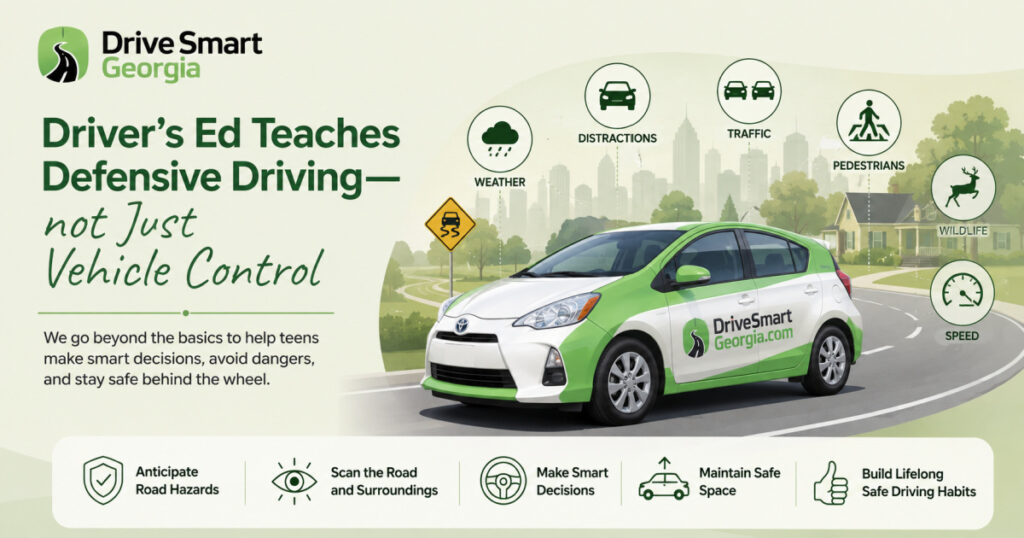
Learning how to operate a car is only one part of learning how to drive safely. A teen also must learn how to respond to everyone else on the road. Other drivers may speed, follow too closely, change lanes without signaling, run a traffic light, or simply make a mistake.
Defensive driving teaches teens not to assume that everyone around them will do exactly what they should.
Instead, young drivers learn to leave themselves time and space to react.
That can include maintaining extra following distance, avoiding lingering beside another vehicle, anticipating potential conflicts at intersections, adjusting speed before curves, and creating an escape route when traffic becomes crowded.
These skills may not receive much attention during a short road test, but they are extremely important during everyday driving.
Driver’s Ed Helps Teens Make Better Decisions
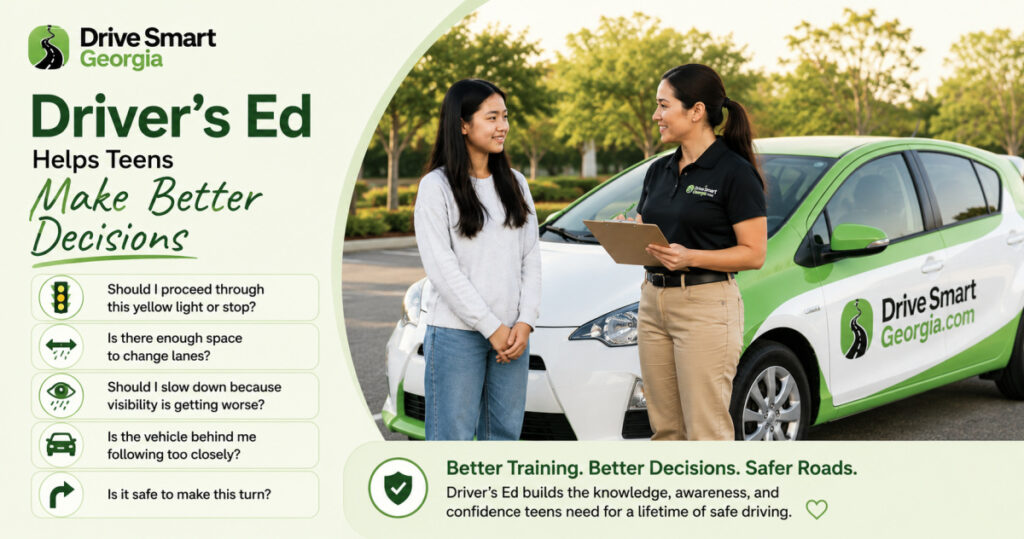
Driving requires constant decision-making. Should I proceed through this yellow light or stop? Is there enough space to change lanes? Should I slow down because visibility is getting worse? Is the vehicle behind me following too closely? Is it safe to make this turn?
New drivers have less experience to draw upon when answering these questions.
Professional instruction gives teens opportunities to work through different driving situations while an experienced instructor is beside them. Rather than simply telling a student what button to push or when to turn the steering wheel, a good instructor helps the teen understand why a particular decision is safer.
Over time, the teen begins developing judgment of their own. That’s important because once a teen starts driving independently, parents won’t be there to make those decisions for them.
Professional Instruction Gives Teens Objective Feedback
Learning to drive with a parent is extremely important, but the parent-teen dynamic can sometimes make driving practice stressful. A parent may know that something doesn’t feel right but have difficulty explaining exactly what the teen should do differently.
Teens may also interpret suggestions from Mom or Dad as criticism – even when the parent is simply trying to help. A professional driving instructor brings a different perspective. Instructors are trained to observe driving behavior, identify areas that need improvement, and provide specific feedback.
For example, instead of simply saying, “You’re too close,” an instructor can help a teen understand how to establish and maintain an appropriate following distance. Instead of saying, “Watch where you’re going,” the instructor can work on specific scanning techniques.
That objective feedback helps teens understand both what they need to improve and how to improve it. It can also give parents valuable insight into which skills need additional practice at home.
Driver’s Ed Can Help Build Confidence Behind the Wheel
Learning to drive can feel overwhelming. A new driver is simultaneously trying to control the vehicle, watch traffic, read signs, remember rules, check mirrors, follow directions, and anticipate what other drivers might do.
That is a lot to process. Structured Driver’s Ed allows teens to build those skills gradually.
As basic vehicle control becomes more natural, teens have more mental capacity available for scanning, decision-making, and hazard recognition. Professional driving lessons can also expose students to different situations in a controlled learning environment.
With practice and constructive feedback, teens can become more comfortable behind the wheel. However, there is an important distinction between confidence and overconfidence.
The best Driver’s Ed programs don’t simply make students feel confident. They help teens understand their limitations, recognize risk, and know when conditions require additional caution.
The goal is a driver who is confident enough to make decisions – but cautious enough to respect the responsibility that comes with driving.
Driver’s Ed Reinforces the Importance of
Managing Distractions

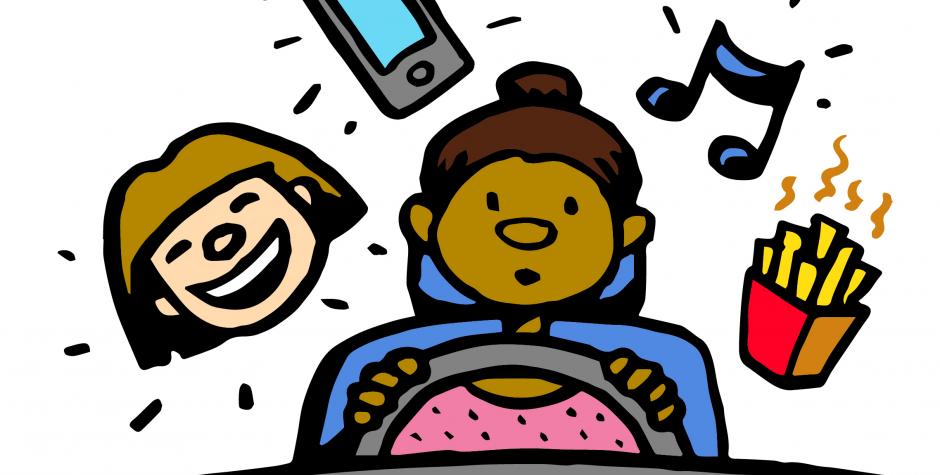
Today’s teen drivers face distractions everywhere. Phones may be the most obvious example, but distractions can also come from passengers, music, navigation systems, food, personal items, or simply looking away from the road.
Driver education gives instructors an opportunity to reinforce one of the most important habits a young driver can develop: Driving needs to be the priority whenever the vehicle is moving.
Teens can learn to prepare before they leave by adjusting mirrors, setting navigation, choosing music, putting away unnecessary items, and making sure their phone will not demand their attention. Developing those routines early can help teens avoid forming risky habits later.
Georgia’s Driver’s Ed Requirements Are Designed to Include Both Education and Experience
Georgia doesn’t treat learning to drive as something that happens during one road test.
Under Joshua’s Law, 16- and 17-year-olds seeking a Georgia Class D license must satisfy state-approved driver education requirements. Georgia DDS outlines approved options that include 30 hours of classroom or online instruction along with behind-the-wheel training requirements. Teens must also complete at least 40 hours of supervised driving experience, including six hours at night.
Georgia DDS also requires applicants for a Class D license to have held their learner’s permit for at least 12 months and one day before applying.
That combination is important.
Classroom Driver’s Ed or online Driver’s Ed provides the knowledge. Professional driving lessons can help teens apply that knowledge behind the wheel. Parent-supervised practice provides repetition and experience.
Together, these pieces help young drivers build skills over time instead of simply preparing for one test.
Parent Practice Is Still an Essential Part of Learning to Drive
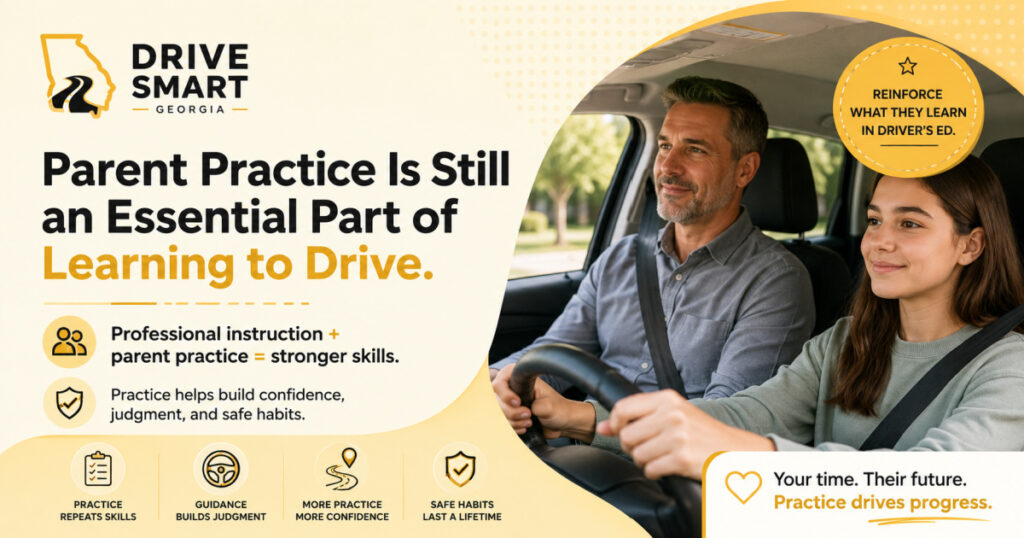
Professional Driver’s Ed doesn’t replace parents. The two work best together.
A professional instructor can introduce techniques, identify weaknesses, and provide structured instruction. Parents can then reinforce those skills during regular supervised practice.
For example, if an instructor notices that a teen needs more work judging gaps before turning left, parents can specifically include left turns during future practice drives.
If lane positioning needs improvement, the family can practice on a variety of familiar roads.
If the teen needs more nighttime experience, parents can gradually introduce supervised driving after dark. Rather than simply accumulating hours, parents can make those hours purposeful.
The more varied, thoughtful practice teens receive before driving alone, the more opportunities they have to encounter situations while an experienced adult is still beside them.
Passing the Road Test Doesn’t Mean a Teen
Has Finished Learning
One of the most important things families can remember is that a driver’s license represents permission to drive independently – not mastery of driving.
Experience continues to develop after licensing.
There will always be new situations:
- The first heavy rainstorm.
- The first unfamiliar highway.
- The first difficult merge.
- The first time navigating an unfamiliar area alone.
- The first unexpected road closure.
- The first time another driver behaves unpredictably.
Parents can continue talking about driving decisions and encouraging safe habits even after their teen earns a license.
Newly licensed drivers should also avoid assuming that passing the test means there is nothing left to learn.
Safe drivers keep learning throughout their lives.
The Real Measure of Driver’s Ed Comes After the Road Test
Of course, parents want their teens to pass the Georgia road test. A strong Driver’s Ed program should help students develop the skills they need to approach that test prepared and confident. However, the most meaningful results aren’t measured by parallel parking, turns, or a score on test day. They’re seen later.
- They’re seen when a teen automatically leaves extra following distance.
- Notices a potential hazard early.
- They slow down because conditions are getting worse.
- When they put their phone away before starting the car.
- They decide not to follow a friend who is speeding.
- When they remain calm instead of making a rushed decision.
Those are the moments that demonstrate what Driver’s Ed is really about.
Help Your Teen Build Skills for the Road Ahead
At Drive Smart Georgia, our goal is bigger than helping teens prepare for the road test.
We want young drivers to develop the knowledge, habits, confidence, and defensive driving skills they need long after earning their license.
Our Georgia Driver’s Ed programs combine classroom or online education options with professional behind-the-wheel training, giving teens an opportunity to learn from experienced driving instructors while parents continue reinforcing those skills through supervised practice.
Whether your teen is just beginning the licensing process or needs additional behind-the-wheel experience before driving independently, professional instruction can help identify areas that need work and build safer driving habits.
The road test may last only a short time. The skills your teen learns in Driver’s Ed can last a lifetime.
Ready to help your teen become a safer, more confident driver?
Explore Drive Smart Georgia’s Driver’s Ed programs and professional driving lessons to find the training option that’s right for your teen.
Drive Smart Georgia locations:
- Milton: 850 Mayfield Rd., Suite L-9, Milton, GA 30009. (770) 628-7540
- Johns Creek: 11380 Southbridge Pkwy., Alpharetta, GA 30022. (770) 232-0903
- Alpharetta: 5354 McGinnis Ferry Rd., Suite 226B, Alpharetta, GA 30005. (770) 232-0900
- Cumming: 1790 Peachtree Pkwy., Suite 202, Cumming, Ga. (770) 239-4294
- Suwanee: 970 Peachtree Industrial Blvd., Suwanee, GA 30024. (770) 741-0455
- Roswell: 590 W. Crossville Rd., Suite 204, Roswell, GA 30075. (770) 741-0405
Related articles:
- How Parents Can Help Teens Become Safer Drivers
- Georgia Class D License Requirements Explained
- How to Pass the Georgia Learner’s Permit Test the First Time
- Joshua’s Law FAQs: Answers to Parents’ Most Common Questions