How to Build Your Teen’s Driving Confidence Safely
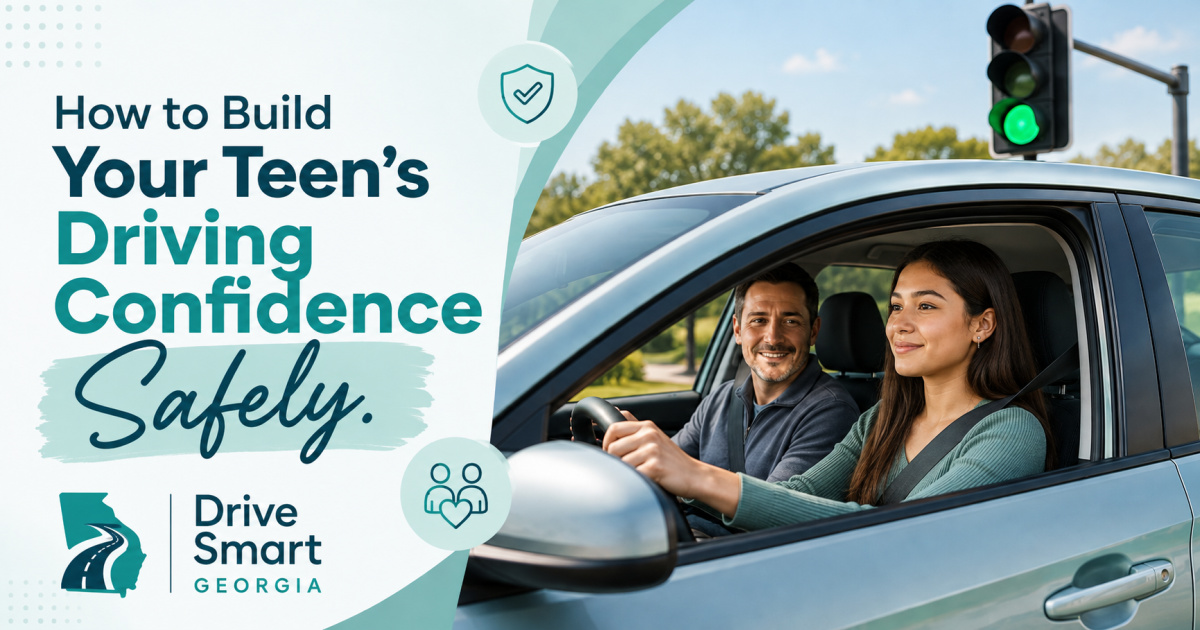
Learning to drive is a major milestone for teenagers – and often a stressful one for parents.
Some new drivers seem eager to get behind the wheel from the beginning. Others grip the steering wheel tightly, hesitate at intersections, worry about making mistakes, or become overwhelmed when traffic gets heavier.
Both reactions are normal. Teen driving confidence develops at different speeds.
The goal isn’t to make your teen feel fearless behind the wheel. A healthy amount of caution is important for a new driver. Instead, parents should focus on helping teens develop the skills, judgment, and experience that allow them to become calm, capable, and confident drivers.
If your teen is nervous about driving, these strategies can help you gradually build confidence while keeping safety the priority.
Why Teen Driving Confidence Matters
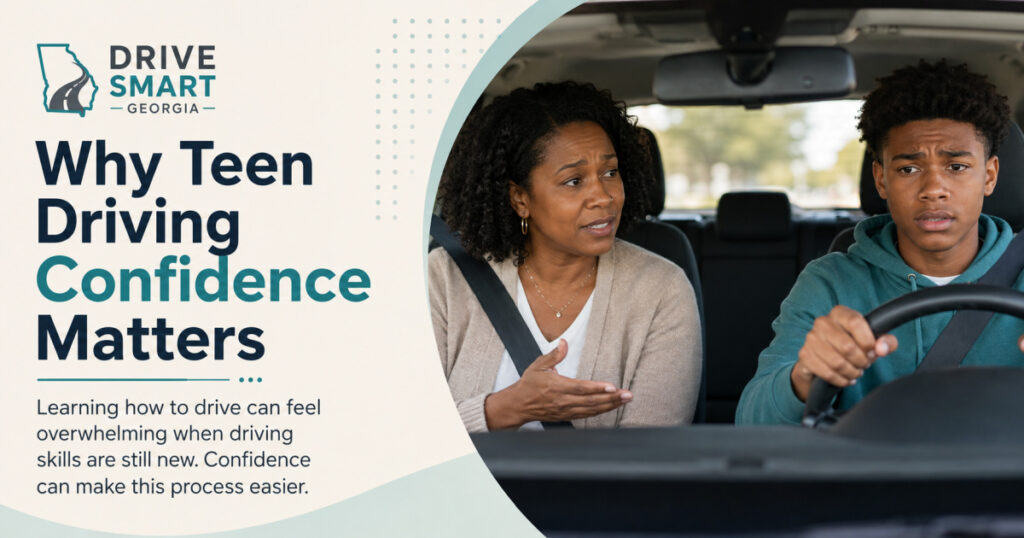
Driving requires a new driver to process a lot of information at once.
Your teen must control the vehicle while watching traffic signals, monitoring other vehicles, checking mirrors, maintaining an appropriate speed, staying in the correct lane, anticipating hazards, and making decisions – sometimes within seconds.
That can feel overwhelming when those skills are still new.
Confidence can make this process easier because an appropriately confident teen is more likely to remain calm, make deliberate decisions, and recover from small mistakes without panicking.
12 ways to build teen driver confidence safely
 1. Start With Easy, Familiar Driving Situations
 1. Start With Easy, Familiar Driving Situations
One of the best ways to build your teen’s driving confidence is to start somewhere manageable.
A brand-new driver probably doesn’t need to begin with a complicated multilane highway during rush hour. Starting in a stressful environment can make a nervous teen feel even more overwhelmed.
Instead, begin in low-pressure environments such as:
- An empty parking lot
- Quiet neighborhood streets
- Familiar roads near home
- Roads with lower speed limits
- Routes with simple intersections
Let your teen become comfortable with basic vehicle control before adding more complicated situations.
Practice starting, stopping, turning, maintaining lane position, checking mirrors, using turn signals, and controlling speed. Once those skills become more automatic, your teen will have more mental capacity available to watch traffic and make decisions.
2. Increase the Difficulty Gradually
Confidence grows through successful experiences. Once your teen is comfortable on quiet streets, gradually introduce more challenging driving environments instead of making a sudden jump from an empty parking lot to the interstate.
A progression might look something like this:
Stage 1: Parking lots and quiet residential streets
Stage 2: Familiar two-lane roads
Stage 3: Busier intersections and moderate traffic
Stage 4: Multilane roads and lane changes
Stage 5: Higher-speed roads and highways
Stage 6: Nighttime, rain, and other more demanding conditions
There is no need to follow an exact schedule. Some teens will progress more quickly than others.
Move forward when your teen consistently demonstrates control, awareness, and sound decision-making -not simply because a certain number of practice sessions have passed.
3. Practice Driving Regularly
Long gaps between driving sessions can make it harder for a nervous teen to develop momentum. Whenever possible, provide consistent practice.
Several manageable driving sessions may be more productive than an occasional marathon session that leaves everyone exhausted or frustrated.
Regular practice helps everyday driving skills begin to feel familiar. Tasks that initially require intense concentration – such as checking mirrors before changing lanes or smoothly controlling the accelerator and brake – can gradually become habits.
In Georgia, supervised practice also plays an important role in the licensing process.
Georgia’s Joshua’s Law requirements include at least 40 hours of supervised driving experience, including at least six hours at night, for 16- and 17-year-olds seeking a Class D license.
Those hours shouldn’t be viewed simply as a requirement to complete. They are an opportunity to expose teens gradually to the different situations they will eventually need to handle independently.
4. Give Calm, Specific Instructions
Parents naturally want to protect their teens, but constant warnings can make an already nervous driver even more anxious.
Imagine hearing all the below within a short time frame:
- “Slow down!”
- “Watch that car!”
- “Brake!”
- “Look over there!”
Even when the instructions are well-intentioned, too much input can overwhelm a beginning driver.
Whenever possible, give directions early and make them specific.
Instead of: “Watch out!”
Try: “The light ahead is turning yellow. Start slowing down.”
Instead of: “You’re too close!”
Try: “Give the vehicle ahead a little more space.”
Clear coaching teaches your teen what action to take and why. Your tone matters, too. Staying calm helps your teen stay focused on driving rather than worrying about your reaction.
5. Focus on One or Two Skills at a Time
Trying to correct everything during a single drive can become discouraging. If your teen is working on lane positioning, following distance, turns, speed control, parking, mirror checks, scanning, and braking all at once, it may seem like nothing they do is right.
Choose one or two priorities for each practice session.
For example:
Today’s focus: Smooth braking and following distance.
During another drive:
Today’s focus: Lane changes and blind-spot checks.
This gives your teen a clear goal and makes improvement easier to recognize. Over time, individual skills begin working together.
6. Point Out Progress, Not Just Mistakes
Correcting unsafe behavior is necessary, but feedback shouldn’t consist entirely of what went wrong.
Tell your teen when something improves.
For example:
- “You left much more space behind that car.”
- “That was a smoother stop.”
- “You checked your blind spot without me reminding you.”
- “You handled that busy intersection calmly.”
Specific feedback helps teens understand which behaviors they should repeat. It also builds confidence based on actual improvement, rather than empty reassurance.
7. Let Your Teen Make Decisions
Eventually, your teen needs to learn how to think independently behind the wheel.
If a parent gives instructions for every move –
- “Turn here.”
- “Brake now.”
- “Change lanes.”
- “Go.”
- “Slow down.”
…the teen may become good at following commands without becoming good at making driving decisions.
As your teen’s skills improve, begin asking questions instead.
- “What hazards do you see ahead?”
- “Is there enough room to change lanes?”
- “What do you think that driver might do?”
- “Where should you position the car before that turn?”
This encourages your teen to observe, evaluate, and decide. Those decision-making skills become especially important when your teen eventually drives without you in the passenger seat.
8. Practice the Situations That Make Your Teen Nervous
Avoiding a difficult driving situation may temporarily reduce anxiety, but it doesn’t necessarily build confidence. Once your teen has the foundational skills to handle a situation safely, practice it gradually.
For example, if your teen is nervous about lane changes, begin on a road with light traffic.
Practice the sequence:
- Check the mirrors.
- Signal.
- Check the blind spot.
- Identify a safe opening.
- Change lanes smoothly.
Repeat the process until it becomes familiar. Then gradually practice in somewhat busier environments.
The same approach can work for parking, left turns, roundabouts, highways, nighttime driving, or other situations your teen finds intimidating.
The objective isn’t to force your teen into a frightening situation. It’s to break challenging skills into manageable steps.
9. Teach Your Teen That Mistakes Are Part of Learning
New drivers will make mistakes. They may turn too widely, brake harder than necessary, miss a turn, forget a signal, or choose the wrong lane. The important question is what they learn from the experience.
After a drive, discuss significant mistakes without turning the conversation into a long list of everything that went wrong.
Try asking:
- “What went well?”
- “What felt difficult?”
- “What would you do differently next time?”
- “What should we practice again?”
Teaching teens to evaluate their own driving helps develop self-awareness – a skill they will need long after the learner’s permit stage ends.
10. Practice in Different Driving Conditions
A teen who has only driven the same route to school on sunny afternoons may feel confident on that particular route – but still be unprepared for unfamiliar situations.
Before your teen begins driving independently, gradually provide experience with different environments and conditions when it is safe and appropriate to do so.
That can include:
- Residential streets
- Busy commercial roads
- Multilane roads
- Highway driving
- Parking lots
- Different types of intersections
- Unfamiliar routes
- Night driving
- Light rain
- Heavier traffic
Georgia requires supervised nighttime practice as part of the 40-hour requirement, with at least six hours completed at night.
Variety helps teens learn that good driving principles apply even when the surroundings change.
11. Don’t Rush the Road Test
It can be tempting to treat the road test as the finish line. It isn’t.
Passing a driving test demonstrates that your teen met the required standard during the test. It doesn’t mean your teen has encountered every difficult situation they will face on the road.
In Georgia, teens must hold a valid learner’s permit for at least one year and one day before receiving a Class D provisional license, in addition to satisfying applicable Joshua’s Law and other licensing requirements.
Use that learning period wisely.
If your teen reaches the minimum eligibility date but still struggles with essential driving skills, additional practice can be more valuable than rushing to schedule a road test.
Being eligible to test and being ready to drive independently are not always the same thing.
12. Consider Professional Driving Lessons
Parents are essential to the learning process, but professional driving instruction can provide something different. A professional driving instructor regularly works with new drivers and can identify specific skills that need improvement.
Professional lessons can also give teens experience receiving instruction from someone other than a parent. For some families, this removes some of the emotion that can develop during parent-teen practice.
Georgia driver education includes both theoretical and practical components, and behind-the-wheel instruction is one method teens can use as part of meeting the state’s driver education requirements.
Professional instruction can help teens work on areas such as:
- Vehicle control
- Lane positioning
- Following distance
- Intersections
- Lane changes
- Parking
- Hazard recognition
- Defensive driving
- Decision-making
- Road test preparation
It can also give parents objective feedback about where their teen is progressing and what still needs work.
Professional Driving Lessons and Parent Practice
Work Best Together
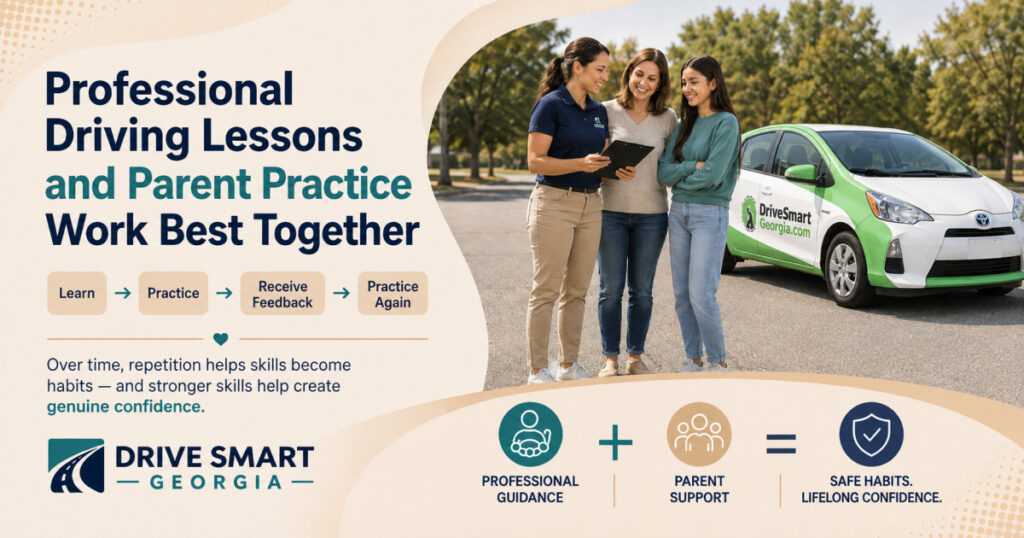
Driving lessons shouldn’t replace parent practice. Instead, they can complement it. A professional instructor may introduce a technique during a lesson. Then the teen can reinforce that skill during supervised driving with a parent.
At the next lesson, the instructor can evaluate the teen’s progress and introduce more advanced situations.
This creates a useful cycle:
Learn → Practice → Receive Feedback → Practice Again
Over time, repetition helps skills become habits – and stronger skills help create genuine confidence.
How Parents Can Tell When Driving Confidence Is Improving
Confidence isn’t simply your teen saying, “I’m ready.” Look for behavior behind the wheel.
Your teen may be becoming more confident when they:
- Start driving without appearing excessively tense
- Control the vehicle smoothly
- Scan the road without constant reminders
- Check mirrors and blind spots consistently
- Maintain appropriate following distance
- Handle intersections calmly
- Make safe lane changes independently
- Adjust to changing traffic conditions
- Recognize potential hazards
- Recover calmly from small mistakes
- Ask fewer basic questions while still asking when uncertain
- Make safe decisions without constant coaching
The ultimate goal is not a teenager who believes they are a great driver. It is a teenager who demonstrates safe driving habits consistently.
What If Your Teen Is Still Nervous About Driving?
Don’t automatically assume nervousness means your teen cannot become a good driver. Some teens simply need more repetition.
If confidence stalls, identify the situations causing the most difficulty and return to a more manageable version of them. For example, if heavy traffic is overwhelming, practice the same skills during a quieter time of day. Once your teen becomes more comfortable, gradually increase the complexity.
Professional instruction can also be especially helpful when a parent and teen repeatedly struggle with the same skill. Sometimes hearing a different explanation – or practicing with an experienced instructor – helps something finally click.
Help Your Teen Build Confidence for the Road Ahead
Learning to drive safely takes more than completing a checklist or passing a road test. It takes education, practice, feedback, repetition, and time.
Parents can help by creating a gradual learning process that gives teens plenty of opportunities to practice without pushing them faster than their skills can support.
And remember: the safest confidence comes from competence.
At Drive Smart Georgia, our professional driving instructors help teens build practical skills, safer driving habits, and confidence behind the wheel. Our Driver’s Ed programs and professional driving lessons give students structured instruction they can reinforce through supervised practice with their parents.
Whether your teen is just starting to drive or needs additional help preparing to drive independently, the goal is the same: Build strong skills today so your teen can make safer decisions for years to come.
Drive Smart Georgia locations:
- Milton: 850 Mayfield Rd., Suite L-9, Milton, GA 30009. (770) 628-7540
- Johns Creek: 11380 Southbridge Pkwy., Alpharetta, GA 30022. (770) 232-0903
- Alpharetta: 5354 McGinnis Ferry Rd., Suite 226B, Alpharetta, GA 30005. (770) 232-0900
- Cumming: 1790 Peachtree Pkwy., Suite 202, Cumming, Ga. (770) 239-4294
- Suwanee: 970 Peachtree Industrial Blvd., Suwanee, GA 30024. (770) 741-0455
- Roswell: 590 W. Crossville Rd., Suite 204, Roswell, GA 30075. (770) 741-0405
Related articles:
- In-person vs. Online Driver’s Ed in Georgia: Which Option Is Best for Your Teen?
- Georgia Class D License Requirements Explained
- Who Should Take a Defensive Driving Course in Georgia?
- Joshua’s Law FAQs: Answers to Parents’ Most Common Questions