How to Practice Driving with Your Teen Without Creating Stress

Teaching your teenager to drive can be exciting. It can also test the patience of even the calmest parent. One minute, you’re explaining how to make a smooth turn. The next, you’re gripping the passenger-side door handle while reminding your teen to slow down, check the mirror, stay centered in the lane and watch the car ahead – all at the same time.
For a new driver, that flood of instructions can quickly become overwhelming. For parents, watching a brand-new driver make mistakes in real traffic can be stressful too.
The good news is that practicing driving with your teen doesn’t have to turn every trip into a tense experience. With a little planning, clear communication and realistic expectations, parents can make driving practice calmer, more productive and safer for everyone involved.
Here are some of the best ways to practice driving with your teen without creating unnecessary stress.
Why Can Parent-Teen Driving Practice Become So Stressful?
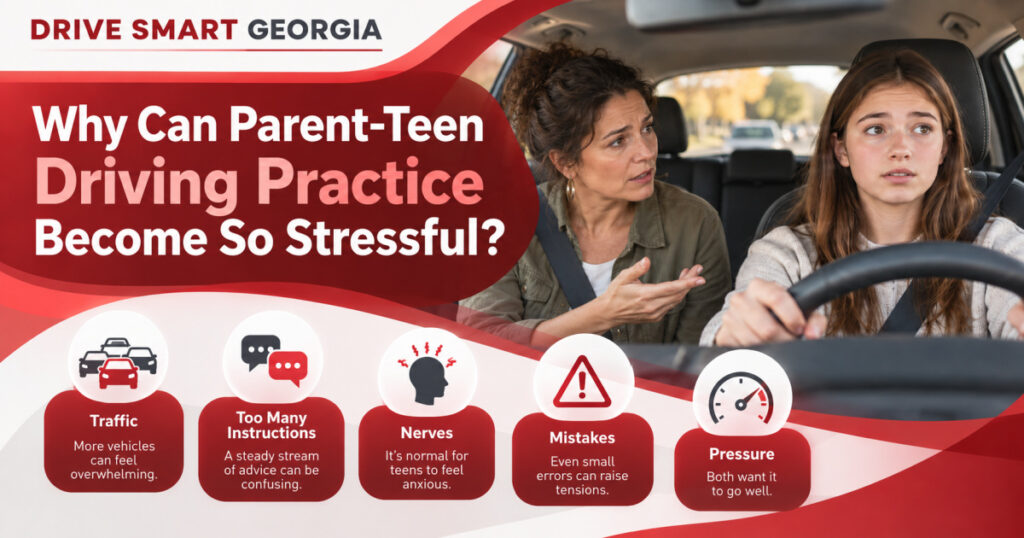
Driving is automatic for experienced adults. You probably don’t consciously think about every mirror check, brake application, lane position or steering adjustment you make. A new driver does.
Your teen is trying to process many things simultaneously:
- Vehicle speed
- Lane position
- Traffic signals
- Road signs
- Other vehicles
- Pedestrians
- Mirrors
- Blind spots
- Following distance
- Steering
- Braking
- Acceleration
- Directions from you
That is a significant amount of information for an inexperienced driver to process.
The Georgia Department of Driver Services (DDS) emphasizes that safely operating a vehicle involves much more than simply learning how to steer. Drivers must learn to evaluate risks, make decisions and anticipate the actions of others.
That’s one reason patience and repetition are so important. A mistake that seems obvious to an experienced driver may involve a skill your teen hasn’t practiced enough yet.
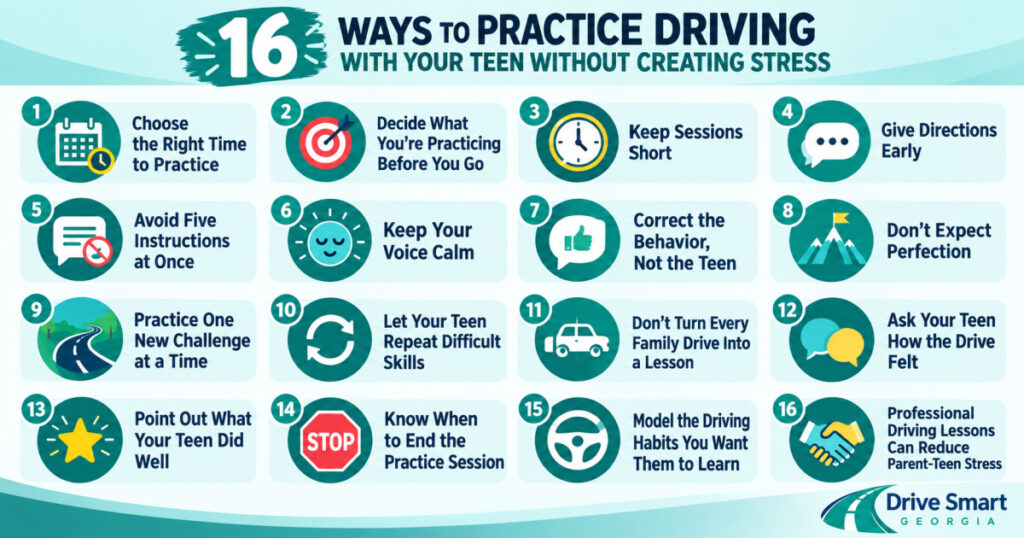
16 Ways to Practice Driving with Your Teen
Without Creating Stress
1. Choose the Right Time to Practice Driving
One of the easiest ways to reduce stress is to choose the right time for practice. Don’t squeeze a driving lesson into an already hectic day.
Avoid practicing when either you or your teen is:
- Tired
- Hungry
- Upset
- Running late
- Distracted
- Already stressed
Instead, choose a time when neither of you needs to rush. Early practice sessions should also occur in relatively easy driving conditions. As your teen develops confidence and skill, gradually introduce more challenging situations.
The Georgia DDS Parent/Teen Driving Guide recommends a progressive approach that moves new drivers from easier environments into increasingly complicated ones, including parking lots, neighborhoods, light traffic, highways and city driving. Start easy and add difficulty gradually.
Your teen shouldn’t have to master everything during the first few drives.
2. Decide What You’re Practicing Before You Leave
Driving around without a plan can lead to parents pointing out every mistake they notice. That can become overwhelming very quickly. Instead, decide on one or two skills before starting.
For example:
Today’s focus might be:
- Smooth stops
- Right and left turns
- Lane positioning
Another session might focus on:
- Mirror checks
- Changing lanes
- Maintaining a safe following distance
Later, you might practice:
- Busier intersections
- Highway merging
- Night driving
Having a specific goal makes the session feel more like purposeful practice and less like an hour-long critique.
3. Keep Early Driving Practice Sessions Short
More practice isn’t always better if everyone is exhausted by the end.
A new driver has to concentrate intensely, especially during the first several weeks behind the wheel. Consider starting with shorter sessions and gradually increasing their length as your teen becomes more comfortable.
A productive 20- or 30-minute session may be far more valuable than an hour-long drive that ends with both of you frustrated.
Remember: learning to drive is a process. There will be plenty of opportunities to practice.
4. Give Directions Early
Imagine being a new driver and hearing when you’re already approaching the intersection:
“Turn right here!”
Now your teen must brake, signal, check mirrors, identify the correct lane and prepare for the turn within seconds. Stress goes up immediately.
Instead, give instructions well in advance.
For example:
“At the next traffic light, we’re going to turn right.”
That gives your teen time to process the instruction and prepare. Whenever possible, use the same calm, predictable language from one practice session to another.
5. Avoid Giving Five Instructions at Once
Parents often notice several things happening simultaneously.
You might say:
“Slow down, move over, check your mirror, watch that car and don’t forget your turn signal.”
Your teen may hear all five instructions but not know which one deserves immediate attention.
Prioritize. Give the most important instruction first and allow your teen time to respond.
Short instructions such as these are easier to process:
“Ease off the accelerator.”
“Check your mirror.”
“Increase your following distance.”
“Stay centered in your lane.”
Clear instructions help your teen focus on the driving task rather than trying to decipher a lengthy explanation while the vehicle is moving.
6. Keep Your Voice Calm
Your tone matters. If your voice suddenly gets louder every time your teen makes a mistake, your teen may begin associating driving practice with anxiety.
That doesn’t mean you shouldn’t intervene when safety requires it. It means routine coaching should remain as calm and specific as possible.
Instead of:
“You’re WAY too close!”
Try:
“Increase your following distance.”
Instead of:
“What are you doing?”
Try:
“Ease off the accelerator and gently apply the brake.”
Specific instructions tell your teen what action to take. Emotional reactions usually don’t.
7. Correct the Driving Behavior, Not the Teen
There’s a major difference between saying:
“You never pay attention.”
and:
“Remember to check your blind spot before changing lanes.”
One sounds personal. The other addresses a specific driving behavior that can be improved.
When correcting mistakes, focus on:
What happened → Why it matters → What to do next time.
For example:
“You started braking pretty late at that light. Next time, look farther ahead so you can begin slowing sooner.”
That turns a mistake into a learning opportunity.
8. Don’t Expect Perfection
Your teen is going to make mistakes. That’s the purpose of supervised practice.
No teenager gets behind the wheel for the first time already knowing how to smoothly brake, judge gaps, maintain perfect lane position, merge confidently and anticipate traffic. Skills improve through repetition.
Georgia’s licensing requirements reflect the importance of experience. For a Georgia Class D license, applicable teen drivers must accumulate at least 40 hours of supervised driving experience, including at least six hours at night.
Think of those hours as skill-building time rather than simply a requirement to check off a list.
9. Practice One New Challenge at a Time
Progress should be gradual. Once your teen can comfortably control the vehicle in a quiet environment, introduce a slightly more challenging situation.
A progression might look something like this:
Empty parking lot → Quiet neighborhood → Residential roads → Light traffic → Multi-lane roads → Busier intersections → Highway → Heavy traffic → Night driving
You don’t necessarily have to follow that exact order. Every teenager develops at a different pace. The important part is avoiding a sudden jump from very easy driving to an environment your teen isn’t ready to handle.
The DDS Parent/Teen Driving Guide similarly encourages parents to progress through increasingly complex driving environments as skills develop.
10. Let Your Teen Repeat Difficult Skills
If your teen struggles with a particular maneuver, repetition can help.
Maybe it’s:
- Right turns
- Left turns
- Parking
- Lane changes
- Maintaining speed
- Smooth braking
- Merging
- Checking blind spots
Find a safe environment where your teen can practice that skill multiple times. Repeating a maneuver allows the brain to spend less energy figuring out the physical mechanics and more energy observing the overall driving environment.
Eventually, many basic vehicle-control skills begin to feel much more natural.
11. Don’t Turn Every Family Drive into a Lesson
Once a teen has a learner’s permit, it’s tempting to have them drive everywhere. That can certainly provide valuable practice, but your teen may occasionally want to ride somewhere without receiving 25 minutes of driving feedback. Parents may need a break too.
It’s okay to distinguish between:
Practice drives: We’re intentionally working on driving skills.
and
Regular family trips: Someone else is driving and we’re simply going somewhere.
Creating that separation can help prevent driving instruction from becoming a constant source of tension.
12. Ask Your Teen How the Drive Felt
After parking the vehicle, don’t immediately provide a long list of everything your teen did wrong.
Start by asking:
“How did that drive feel?”
You may discover that your teen already knows exactly where the problems occurred.
You can also ask:
“What felt easier today?”
“Did anything feel difficult?”
“What would you like to practice again?”
“Were there things you think went well?”
Developing a driver’s ability to recognize strengths and weaknesses is an important part of becoming more independent behind the wheel.
13. Point Out What Your Teen Did Well
Corrections are necessary, but if every comment is negative, teens may feel as though they’re constantly failing. When your teen does something well, acknowledge it.
For example:
“That was a really smooth stop.”
“Good job checking your blind spot.”
“You handled that intersection well.”
“Your lane positioning was much better today.”
Positive feedback reinforces good driving behaviors and lets your teen know which habits should be repeated.
14. Know When to End the Practice Session
Sometimes a driving session simply isn’t going well. Maybe your teen is frustrated. Perhaps you’re frustrated. Maybe concentration is slipping. Continuing another 45 minutes isn’t necessarily going to improve anything.
Find a safe place to stop and try again another day. Ending a practice session doesn’t mean your teen failed.Learning to drive involves hundreds of individual skills and decisions. Some days will be easier than others.
15. Parents Should Model the Driving Habits They Want Teens to Learn
Teenagers notice how their parents drive. If you tell your teen to make complete stops, maintain safe following distances and put the phone away – but don’t follow those habits yourself – the message becomes confusing.
The Georgia DDS Parent/Teen Driving Guide emphasizes the importance of parents modeling safe driving behavior as teens develop their own habits. Your everyday driving provides another form of instruction.
Demonstrate the habits you want your teen to develop.
16. Professional Driving Lessons Can Reduce Parent-Teen Stress
Parents play an essential role in helping teenagers gain experience. However, parents don’t have to provide every piece of driving instruction themselves.
Professional driving lessons and parent practice can serve different purposes. A professional driving instructor can introduce techniques, identify weaknesses and help students practice skills using a structured teaching approach.
Parents can then reinforce those skills through additional supervised practice. This approach can also change the dynamic inside the family car.
Instead of trying to be your teen’s only instructor, you can concentrate more on helping your teen practice skills that have already been introduced professionally.
Learn → Practice → Receive Feedback → Practice Again
That cycle can help skills gradually become habits.
Professional Driving Lessons + Parent Practice
Work Best Together

At Drive Smart Georgia, we believe professional instruction and parent practice complement each other.
During professional lessons, a trained instructor can work with students on important driving skills and evaluate areas that may need additional practice. Between lessons, parents can provide repetition and real-world experience.
That means a student might learn a skill during a professional lesson, practice it several times with a parent and then receive additional feedback during the next professional lesson.
This combination can help parents feel less pressure to teach everything themselves. It also gives teens experience learning from more than one perspective.
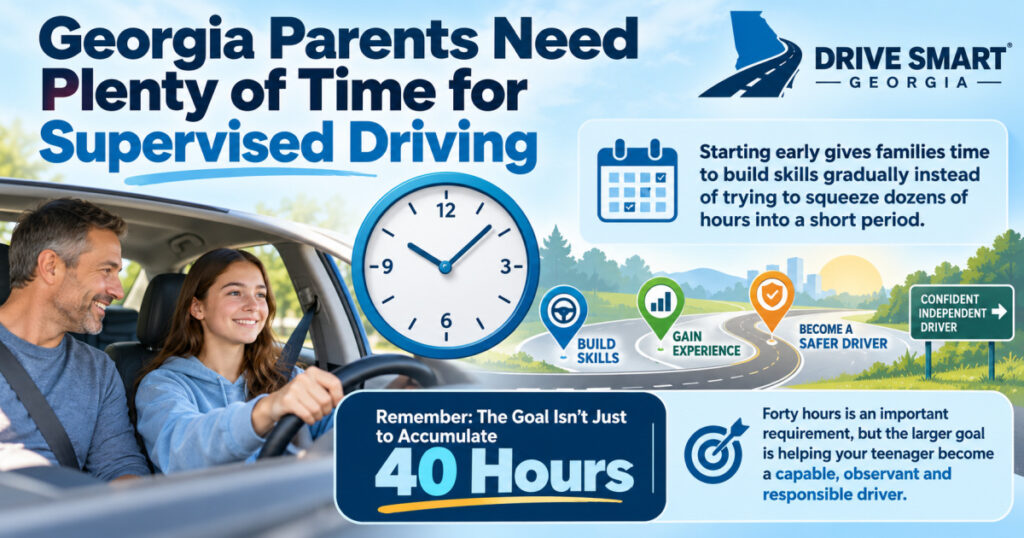
Georgia Parents Need Plenty of Time for Supervised Driving
Parents shouldn’t wait until the weeks immediately before the road test to begin accumulating supervised driving experience.
Georgia requires applicable teen drivers to complete at least 40 hours of supervised driving, including six hours at night, before obtaining a Class D license.
Georgia DDS also requires teens seeking a Class D license at ages 16 or 17 to meet approved driver-education requirements. Depending on the approved method selected, those requirements can include classroom or approved online instruction and either behind-the-wheel instruction from a certified school or completion of the approved Parent/Teen Driving Guide.
Starting early gives families time to build skills gradually instead of trying to squeeze dozens of hours into a short period.
Remember: The Goal Isn’t Just to Accumulate 40 Hours
Forty hours is an important requirement, but the larger goal is helping your teenager become a capable, observant and responsible driver.
Two teens can spend the same number of hours behind the wheel and have very different levels of experience.
Try to give your teen opportunities to encounter a variety of appropriate driving situations as skills progress, including:
- Residential streets
- Multi-lane roads
- Intersections
- Different speed limits
- Parking lots
- Light traffic
- Heavier traffic
- Highway driving
- Night driving
- Different weather conditions when appropriate
Experience should become more varied as competence improves.
Frequently Asked Questions About Practicing Driving
with Your Teen
How can I stay calm while teaching my teenager to drive?
Plan practice sessions when you aren’t rushed, begin in lower-stress environments, keep instructions short and focus on one or two skills at a time. If either of you becomes overly frustrated, safely end the session and practice another day.
How long should a teen driving practice session be?
There’s no single perfect length. Early sessions can be relatively short because new drivers must concentrate intensely. Increase the length of sessions as your teen develops stamina, confidence and skill.
What should parents practice first with a new teen driver?
Start with fundamental vehicle-control skills in a low-risk environment. These may include smooth acceleration, braking, steering, stopping, turns, lane position and consistent mirror use before progressing into more complicated traffic situations.
How many hours does a Georgia teen need to practice driving?
Georgia requires applicable teen drivers to complete 40 hours of supervised driving experience, including at least six hours at night, before obtaining a Class D driver’s license.
Who can supervise a teen driver in Georgia?
Georgia DDS states that supervised driving must take place with an individual who is at least 21 years old, holds an unexpired Class C driver’s license, sits next to the driver and is capable of exercising control of the vehicle if necessary.
What if my teen gets nervous when practicing driving?
Reduce the difficulty of the driving environment, shorten the practice session and concentrate on skills your teen can already perform successfully. Gradually add new challenges as confidence and competence improve.
Should parents practice between professional driving lessons?
Yes. Additional supervised practice can help teens repeat and reinforce skills introduced during professional instruction. Rather than viewing professional lessons and parent practice as competing approaches, think of them as complementary parts of learning to drive.
Less Stress Can Lead to Better Practice
Learning to drive is a major milestone for teenagers – and for their parents.
There will probably be nervous moments. Yes, there will be mistakes. There may even be a few drives when everyone is relieved to finally pull into the driveway. That’s normal.
The goal isn’t to create a perfect teenage driver overnight. It’s to gradually help your teen develop the judgment, habits and experience needed to drive safely and independently.
Keep practice sessions purposeful. Give clear instructions. Introduce challenges gradually. Recognize improvement. Plus, remember that professional driving lessons can take some of the instructional pressure off parents while providing teens with additional coaching.
At Drive Smart Georgia, our professional instructors work with teen drivers to build the skills they need behind the wheel, while parents provide the repetition and supervised practice that helps those skills become lasting habits.
Together, professional instruction and parent practice can make the road to independent driving calmer, more productive and a lot less stressful.
Drive Smart Georgia locations:
- Milton: 850 Mayfield Rd., Suite L-9, Milton, GA 30009. (770) 628-7540
- Johns Creek: 11380 Southbridge Pkwy., Alpharetta, GA 30022. (770) 232-0903
- Alpharetta: 5354 McGinnis Ferry Rd., Suite 226B, Alpharetta, GA 30005. (770) 232-0900
- Cumming: 1790 Peachtree Pkwy., Suite 202, Cumming, Ga. (770) 239-4294
- Suwanee: 970 Peachtree Industrial Blvd., Suwanee, GA 30024. (770) 741-0455
- Roswell: 590 W. Crossville Rd., Suite 204, Roswell, GA 30075. (770) 741-0405
Related articles:
- Driving School vs. Parent-taught Practice in Georgia
- What Happens During In-car Driving Lessons at Drive Smart Georgia?
- Joshua’s Law FAQs: Answers to Parents’ Most Common Questions
- How to Overcome Driving Anxiety