Everything Parents Need to Know About Georgia’s Teenage Driver Laws

Watching your teen learn to drive is an exciting milestone, but it also comes with plenty of questions. When can they get a learner’s permit? How much driving practice do they need? What exactly is Joshua’s Law? And once they earn a license, when can they drive alone?
Understanding Georgia’s teenage driver laws can make the process much easier for both parents and teens.
Georgia uses a graduated driver licensing system designed to give young drivers more experience before they receive unrestricted driving privileges. That means teens move through several stages – from a learner’s permit to a provisional license and eventually a full Class C license.
Here’s what Georgia parents need to know about the rules, requirements, and restrictions that apply to teenage drivers in 2026.
How Georgia’s Teenage Driver Laws Work
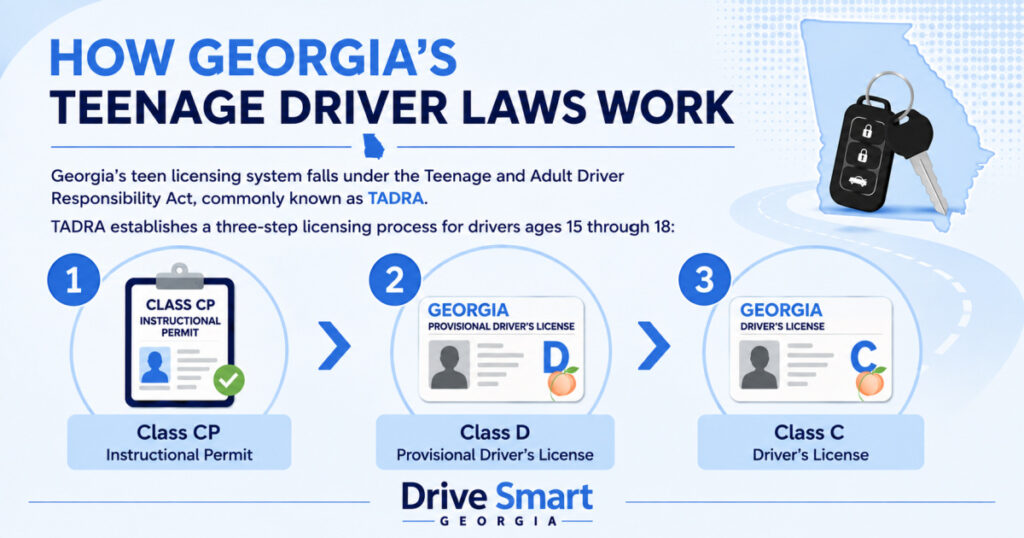
Georgia’s teen licensing system falls under the Teenage and Adult Driver Responsibility Act, commonly known as TADRA.
TADRA establishes a three-step licensing process for drivers ages 15 through 18:
- Class CP Instructional Permit
- Class D Provisional Driver’s License
- Class C Driver’s License
The goal is simple: allow teens to develop driving skills gradually before receiving full driving privileges.
Georgia DDS describes TADRA as a graduated licensing system intended to give young drivers structured education and driving experience while placing additional restrictions on newly licensed drivers.
Step 1: Getting a Georgia Learner’s Permit at Age 15
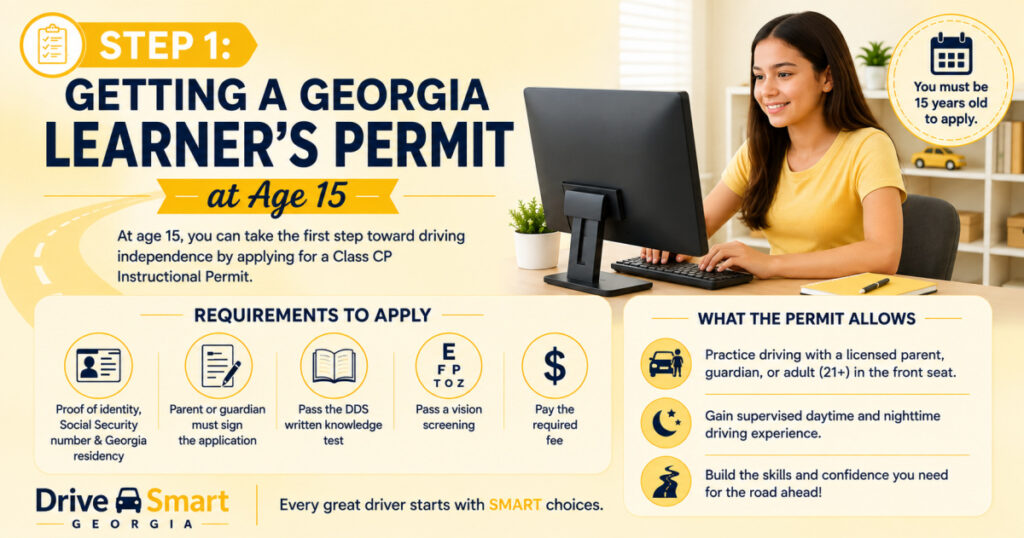
The first step for most Georgia teen drivers is obtaining a Class CP Instructional Permit, commonly called a learner’s permit.
A teen must be at least 15 years old to apply.
To receive a Georgia learner’s permit, the applicant must meet DDS documentation requirements and pass:
- A vision exam
- A road signs knowledge test
- A road rules knowledge test
Applicants under 18 must also meet Georgia’s school enrollment requirements and have a parent, guardian, responsible adult, or other authorized individual sign the application.
Once the permit is issued, the teen cannot drive alone.
A permit holder may drive only when accompanied by someone who is:
- At least 21 years old
- Licensed to drive a Class C vehicle
- Seated beside the teen driver
- Fit and capable of taking control of the vehicle if necessary
These restrictions apply whenever the teen is driving with a permit.
Your Teen Must Hold the Permit for One Year and One Day
One of the most important Georgia teen driving rules for parents to remember is the one-year-and-one-day requirement.
Before a 16- or 17-year-old can receive a Class D provisional license, the teen generally must hold a valid learner’s permit for at least: 12 months and one day.
That waiting period gives families time to practice driving under many different conditions instead of rushing from the permit test directly to independent driving.
For example, a teen who receives a permit on their 15th birthday normally cannot become eligible for a Class D license until at least one year and one day later, assuming all other requirements have been completed.
What Is Joshua’s Law in Georgia?
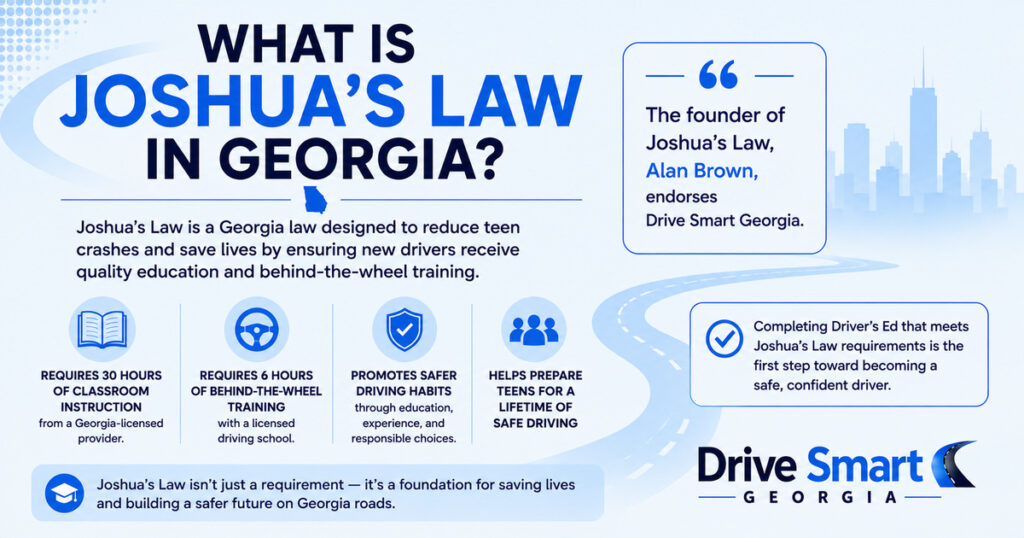
Joshua’s Law is one of the most important parts of Georgia’s teenage driver laws.
For 16- and 17-year-olds seeking a Class D license, Georgia requires approved driver education. Current DDS guidance provides several approved ways of satisfying the requirement, including classroom or approved online instruction combined with either professional behind-the-wheel instruction or parent-taught training.
One common path is:
- 30 hours of approved Driver’s Ed
- 6 hours of behind-the-wheel instruction with a certified driving school
- 40 hours of supervised driving with a parent or guardian
Of those 40 supervised hours, at least 6 hours must be completed at night.
At Drive Smart Georgia, families can combine Joshua’s Law Driver’s Ed with professional behind-the-wheel training, so teens gain experience with a trained instructor in addition to practicing with their parents.
The 40 Hours of Supervised Driving Matter
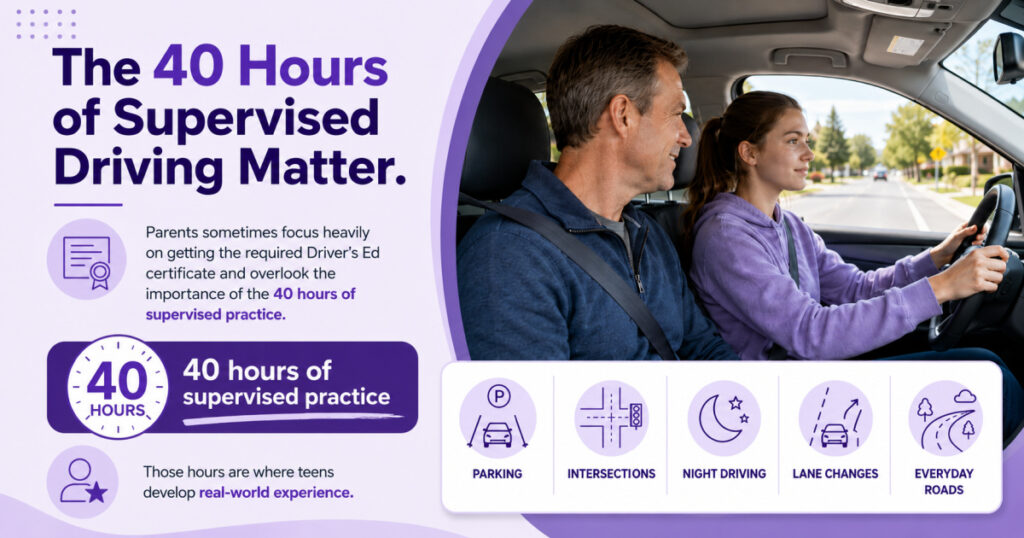
Parents sometimes focus heavily on getting the required Driver’s Ed certificate and overlook the importance of the 40 hours of supervised practice.
Those hours are where teens develop real-world experience.
Practice should include more than driving around the same neighborhood. Gradually expose your teen to situations such as:
- Residential streets
- Multi-lane roads
- Intersections
- Lane changes
- Parking
- Turning
- Moderate traffic
- Rain
- Night driving
- Highway or higher-speed driving when the teen is ready
Georgia requires at least 6 of the 40 supervised hours to take place at night. DDS states that a driving log is not required, but a parent, guardian, or authorized driver education instructor must attest that the required supervised driving has been completed when the teen applies for a Class D license.
Even so, keeping your own practice log can be a helpful way to make sure your teen gets varied experience.
Step 2: Getting a Georgia Class D License
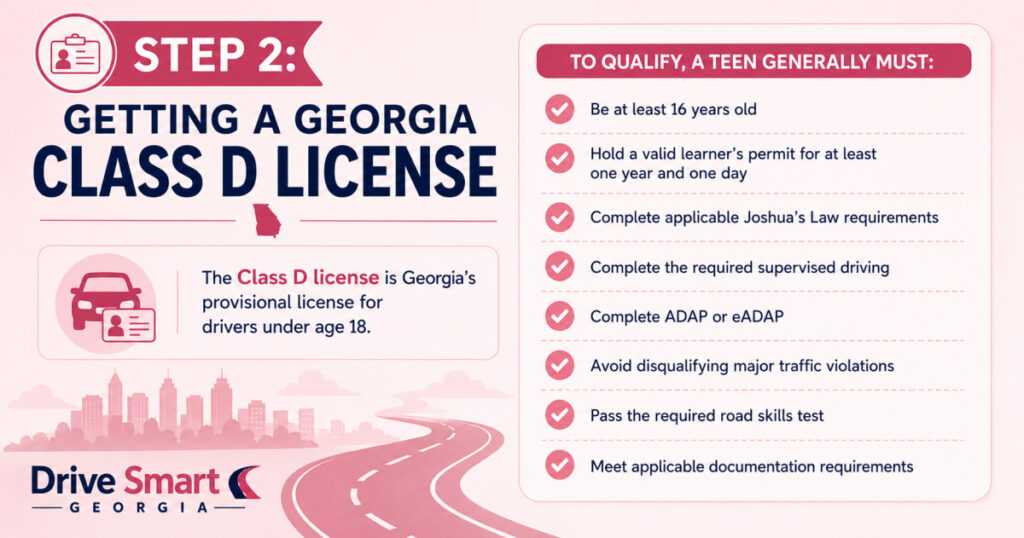
The Class D license is Georgia’s provisional license for drivers under age 18.
To qualify, a teen generally must:
- Be at least 16 years old
- Hold a valid learner’s permit for at least one year and one day
- Complete applicable Joshua’s Law requirements
- Complete the required supervised driving
- Complete ADAP or eADAP
- Avoid disqualifying major traffic violations
- Pass the required road skills test
- Meet applicable documentation requirements
The road test evaluates whether the teen can safely control the vehicle and demonstrate essential driving skills.
Passing the test is a major milestone – but a Class D license still comes with important restrictions.
Georgia Class D Curfew: Midnight to 5 A.M.
One of the most important rules for newly licensed teens is Georgia’s nighttime driving restriction.
A driver with a Class D license may not drive between 12:00 midnight and 5:00 a.m.
Georgia DDS specifically states that there are no exceptions to this restriction.
That means parents should not assume the restriction disappears because a teen is traveling to or from work, school, sports, or another activity.
Parents should help teens plan ahead so they are home well before midnight.
Georgia’s Class D Passenger Restrictions
Passenger restrictions are another important part of Georgia’s teenage driver laws.
They become less restrictive as the teen gains more experience.
First 6 Months
During the first six months after receiving a Class D license, only immediate family members may ride in the vehicle.
Second 6 Months
During the next six months, the driver may have one passenger under age 21 who is not an immediate family member.
After the First Year
After holding the Class D license for one year, the teen may have up to three passengers under 21 who are not immediate family members.
These restrictions are based on how long the driver has held the Class D license—not simply the driver’s age.
That distinction is important. Turning 18 does not automatically remove Class D restrictions if the driver has not yet upgraded to a Class C license.
Georgia’s Hands-Free Law Applies to Teen Drivers Too
Parents should also make sure teens understand Georgia’s Hands-Free Law.
Georgia drivers cannot physically hold or support a phone with their body while driving. Drivers also cannot read or write texts, emails, social media posts, or other internet content while on the road.
The safest habit for a new driver is simple: set the phone up before moving and leave it alone until the vehicle is safely parked.
Georgia traffic-safety data shows that young drivers are disproportionately represented in distracted-driving incidents, making distraction prevention especially important for families with new drivers.
School Enrollment Requirements for Georgia Teen Drivers
Georgia also connects licensing privileges for minors with education requirements.
Drivers under age 18 applying for a permit or license must provide acceptable documentation such as a Certificate of School Enrollment or another qualifying document.
Depending on the teen’s situation, acceptable alternatives may include a high school diploma, GED, proof of enrollment in certain educational programs, or appropriate homeschool documentation.
Because documentation requirements can change or vary based on individual circumstances, parents should review the current Georgia DDS checklist before visiting a Customer Service Center.
Step 3: Moving From a Class D to a Class C License
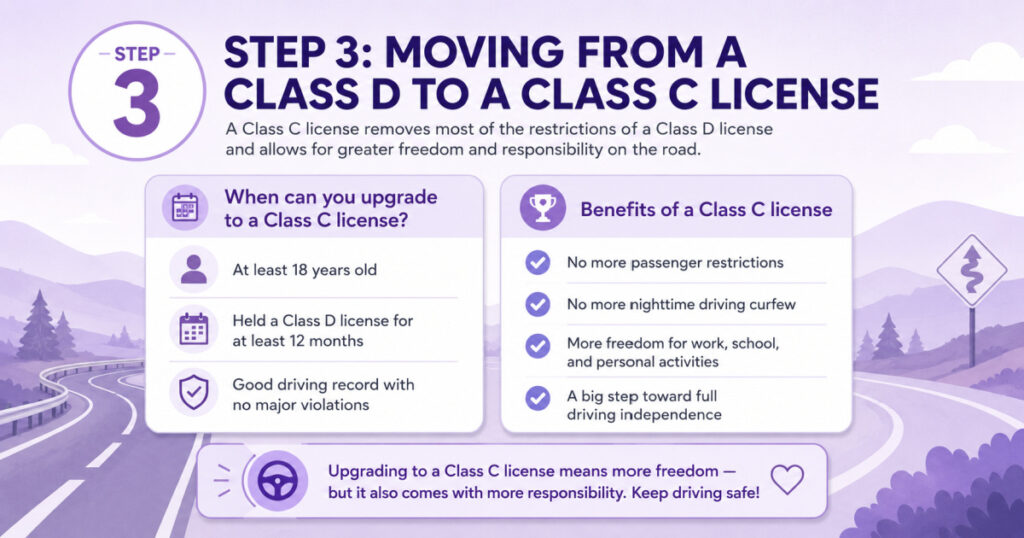
Once a driver reaches age 18, they may become eligible for a regular Class C Georgia driver’s license.
Class D drivers generally must also have avoided certain major traffic convictions during the 12 months before applying for the Class C license.
Parents should remind teens that turning 18 does not necessarily mean they can simply ignore their Class D restrictions.
Georgia DDS explains that the restrictions are tied to the license class, not just the driver’s age. An eligible driver who is 18 or older can apply to upgrade to a Class C license.
Parents Can Set Stricter Rules Than Georgia Law
Georgia’s teen driving laws establish minimum legal requirements. Parents can – and often should – set additional family rules based on their teen’s experience.
For example, you might establish:
- An earlier nighttime driving curfew
- No teen passengers during the first year
- No phone use of any kind while driving
- Limits on highway driving initially
- Required permission before driving somewhere unfamiliar
- Extra practice before driving in rain or heavy traffic
Driving privileges can increase gradually as your teen demonstrates good judgment, follows traffic laws, and becomes more confident.
The goal shouldn’t simply be to help a teen get a license.
It should be to help them become a safe, responsible, independent driver.
Professional Driver Training Can Help Prepare Your Teen
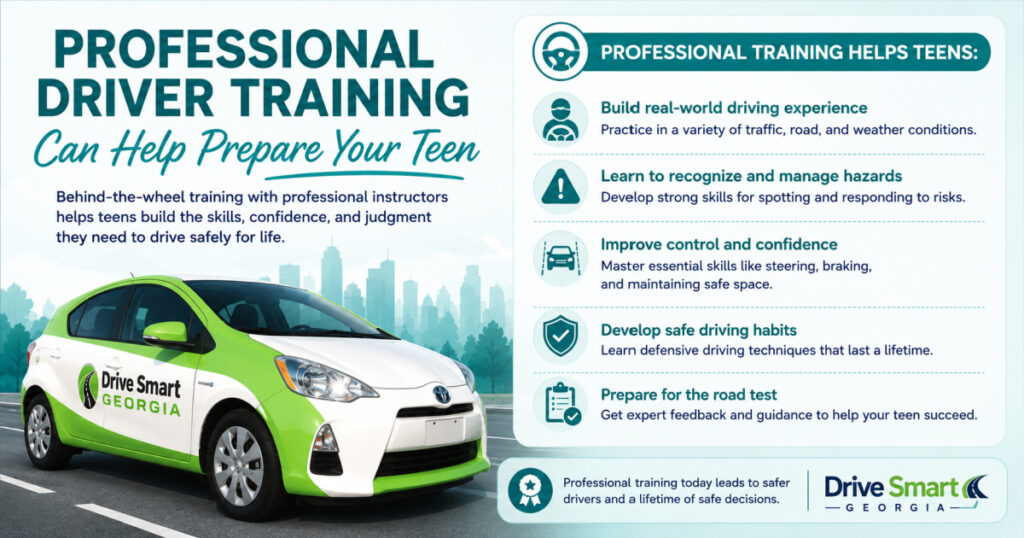
Parents play an essential role in teaching their teens to drive, but professional driving lessons can provide something different.
A trained instructor can objectively evaluate a teen’s skills, identify habits that need improvement, and provide structured practice in areas such as:
- Vehicle control
- Lane positioning
- Space management
- Intersections
- Parking
- Hazard recognition
- Defensive driving
- Road test preparation
At Drive Smart Georgia, we help Georgia teens and parents navigate the entire learning-to-drive process – from Joshua’s Law Driver’s Ed and professional driving lessons to road test preparation and convenient on-site road testing at select locations.
Combining professional instruction with consistent parent-supervised practice can give teens more opportunities to build the skills and confidence they need before driving independently.
Frequently Asked Questions About Georgia Teenage Driver Laws
What age can a teenager start driving in Georgia?
A teenager may apply for a Georgia Class CP learner’s permit beginning at age 15. The teen must pass the required DDS knowledge and vision testing and meet other eligibility requirements.
Can a 16-year-old drive alone in Georgia?
Yes, if the teen has obtained a Class D provisional license. A teen driving only with a learner’s permit must have a qualified licensed adult seated beside them.
How long must a teen have a permit in Georgia?
A 16- or 17-year-old generally must hold a learner’s permit for at least one year and one day before becoming eligible for a Class D license.
How many driving hours are required in Georgia?
Joshua’s Law requires qualifying 16- and 17-year-old Class D applicants to complete the required driver education pathway as well as 40 hours of supervised driving, including at least 6 hours at night.
What time is the Georgia teen driving curfew?
Drivers with a Class D provisional license cannot drive between 12:00 midnight and 5:00 a.m. Georgia DDS states there are no exceptions.
Help Your Teen Become a Safer Georgia Driver
Georgia’s teenage driver laws may seem complicated at first, but they are designed around one important idea: experience should come before independence.
Parents can help by understanding the rules, providing plenty of supervised practice, reinforcing safe driving habits, and making sure their teen is truly ready before progressing to the next licensing stage.
Drive Smart Georgia offers Joshua’s Law Driver’s Ed, professional driving lessons, road test preparation, and on-site road testing at select North Atlanta locations to help teens become safer and more confident behind the wheel.
Ready to help your teen take the next step? Explore Drive Smart Georgia’s Driver’s Ed and driving lesson options and start building safer driving skills today.
Drive Smart Georgia locations:
- Milton: 850 Mayfield Rd., Suite L-9, Milton, GA 30009. (770) 628-7540
- Johns Creek: 11380 Southbridge Pkwy., Alpharetta, GA 30022. (770) 232-0903
- Alpharetta: 5354 McGinnis Ferry Rd., Suite 226B, Alpharetta, GA 30005. (770) 232-0900
- Cumming: 1790 Peachtree Pkwy., Suite 202, Cumming, Ga. (770) 239-4294
- Suwanee: 970 Peachtree Industrial Blvd., Suwanee, GA 30024. (770) 741-0455
- Roswell: 590 W. Crossville Rd., Suite 204, Roswell, GA 30075. (770) 741-0405
Related articles:
- Back-to-School Driving Safety Tips for Georgia Teens
- What is a Georgia Driver’s Ed scholarship?
- Georgia Class D License Requirements Explained
- Defensive Driving Tips that Could Help Prevent Crashes