Driving School vs. Parent-Taught Practice in Georgia
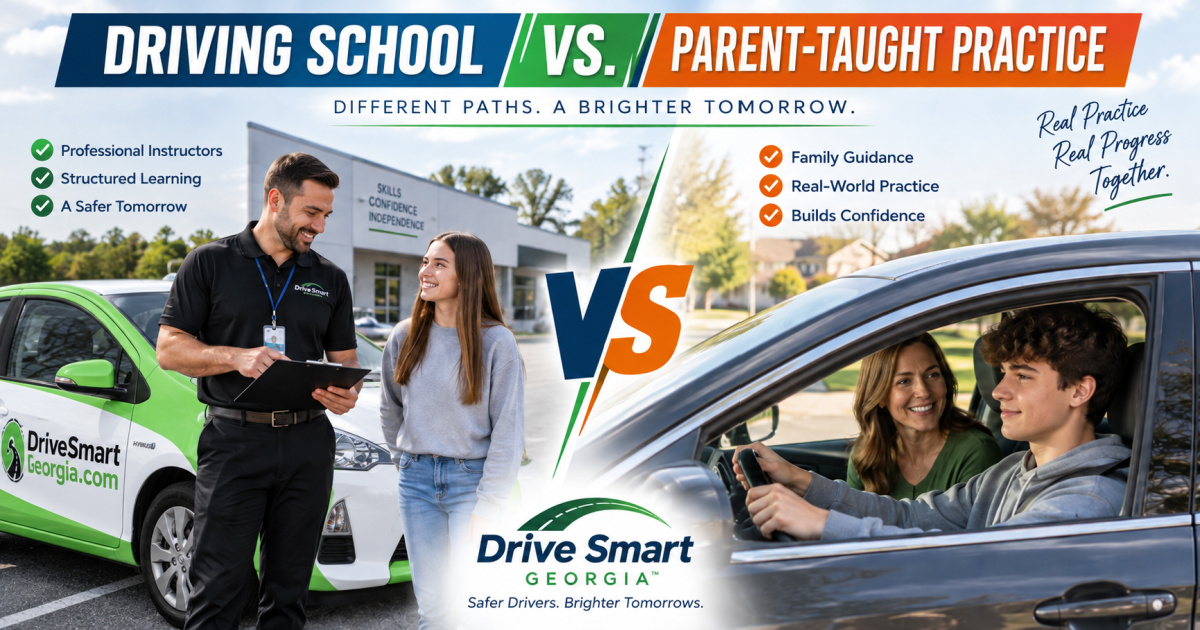
When a teenager gets a learner’s permit, one of the first questions many Georgia parents face is simple: Should we rely on parent-taught driving practice, enroll in professional driving lessons, or do both?
Parents play an essential role in helping teens become experienced drivers. They provide the repetition that new drivers need, expose teens to everyday situations, and reinforce good habits over many months.
Professional driving instructors serve a different purpose. They provide structured instruction, identify weaknesses that may be difficult for parents to recognize, teach specific driving techniques, and give teens experience learning from someone trained to work with beginning drivers.
So, when comparing driving school vs. parent-taught practice, it does not necessarily have to be one or the other. For many Georgia families, the strongest approach is to combine professional driving instruction with regular supervised practice at home.
Here’s how the two approaches differ – and how they can work together to help build a safer, more confident teen driver.
What Does Georgia Require for Teen Drivers?
Before comparing a professional driving school with parent-taught practice, it is important to understand Georgia’s driver education requirements.
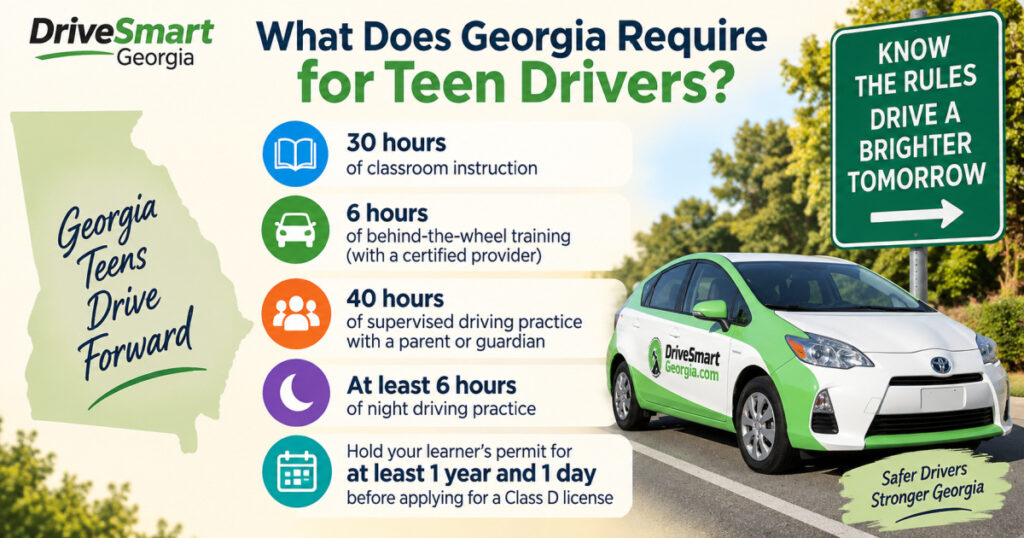
Under Georgia’s Joshua’s Law requirements, 16- and 17-year-olds seeking a Class D provisional license must complete an approved driver education program. Georgia provides several approved pathways.
One option combines:
- 30 hours of classroom instruction at a DDS-approved school
- 6 hours of behind-the-wheel training at a certified driving school
- 40 hours of supervised driving with a parent or guardian, including at least 6 hours at night
Georgia also permits qualifying teens to satisfy the behind-the-wheel portion through the DDS Parent/Teen Driving Guide rather than completing six hours with a professional instructor. Approved online driver education options are available as well.
Georgia DDS also requires teens applying for a Class D license to hold their learner’s permit for at least one year and one day before applying.
That means Georgia recognizes an important principle: learning to drive requires both education and experience.
The bigger question for parents is how to make that experience as productive as possible.
Driving School vs. Parent-Taught Practice:
What Is the Difference?
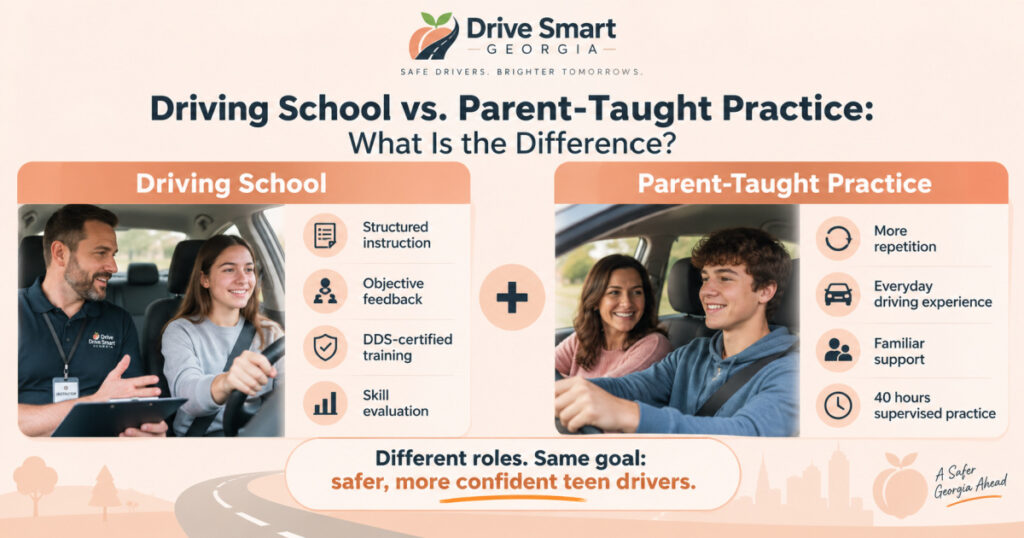
Professional instruction and parent practice may happen behind the wheel of a vehicle, but they serve different purposes.
A professional driving instructor is focused primarily on teaching and evaluating specific driving skills. Whereas, a parent or guardian is usually responsible for providing continued repetition and experience after those skills are introduced.
Think of professional lessons as focused coaching and parent practice as ongoing training.
A teen might learn a specific method for entering an intersection, changing lanes, controlling speed, parking, or scanning for hazards during a professional lesson. The parent can then give the teen opportunities to practice that technique repeatedly until it becomes more natural.
The cycle can look like this:
Learn → Practice → Receive Feedback → Practice Again
That repetition is where stronger driving habits begin to develop.
Advantages of a Professional Driving School
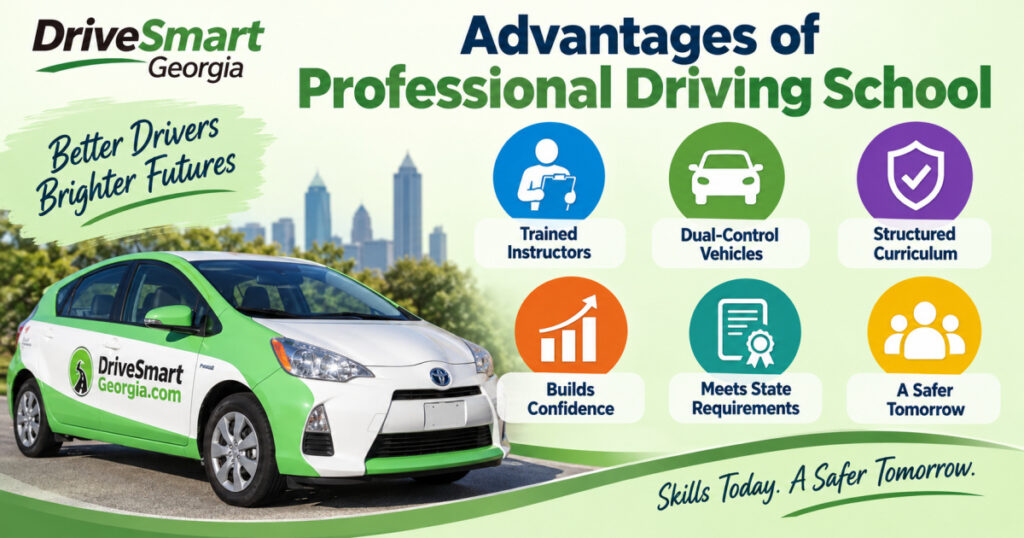
Parents can teach their teens a great deal about driving. However, professional instruction offers several advantages that may be difficult to duplicate during ordinary family practice.
1. Professional Instructors Teach Driving Every Day
Most parents have years – or even decades – of driving experience. However, being an experienced driver is different from being experienced at teaching someone how to drive.
Professional driving instructors regularly work with beginners. They understand which skills new drivers tend to struggle with and how to break those skills into manageable steps.
Instead of simply telling a teen to “slow down” or “watch the road,” an instructor can provide specific guidance about where to look, when to begin braking, how to position the vehicle, and what information the driver should be processing.
That specificity can make instruction easier for a teen to understand and repeat.
2. Instructors May Notice Habits Parents Miss
Experienced drivers perform many actions automatically. A parent may not consciously think about mirror checks, visual scanning, following distance, lane positioning, or how early they begin slowing for an intersection. Because those behaviors have become automatic, they may be harder to explain to a new driver.
A professional instructor is specifically watching the student.
That can make it easier to identify habits such as:
- Incomplete mirror checks
- Following too closely
- Braking too late
- Poor lane positioning
- Inconsistent speed control
- Turning too widely or sharply
- Failing to scan intersections
- Hesitating unnecessarily
- Rushing decisions
- Difficulty judging gaps in traffic
Correcting small habits early can help prevent them from becoming long-term driving habits.
3. Professional Lessons Provide Structure
Parent practice can sometimes become unstructured. A teen may repeatedly drive the same route – to school, the grocery store, practice, or a friend’s house. That repetition has value, but it does not necessarily expose the teen to the full range of situations they will eventually encounter.
Structured driving lessons can deliberately work on different skills.
Depending on the student’s ability, instruction may include:
- Residential streets
- Multi-lane roads
- Traffic signals
- Left and right turns
- Lane changes
- Parking
- Intersections
- Speed management
- Following distance
- Hazard recognition
- Higher-traffic environments
As skills improve, practice can gradually become more challenging.
4. Teens Sometimes Respond Differently to an Instructor
Teaching your own teen to drive can be stressful. Parents naturally want to keep their child safe, and teens may feel nervous when they know a parent is evaluating every move. That combination can occasionally create tension.
A professional instructor introduces a different dynamic. Because the instructor is not the teen’s parent, feedback may feel less personal. Teens may also be more willing to listen carefully when the person giving directions is a professional whose job is teaching new drivers.
That does not mean parents should step away from the process. Instead, professional instruction can give families a common set of techniques and expectations to reinforce during practice.
5. Professional Instruction Can Identify What to Practice Next
Parents sometimes ask:
“What should we work on between lessons?”
Professional instruction can help answer that question. After observing the student, an instructor can identify which skills are developing well and which need additional repetition.
For example, a teen may be comfortable driving on neighborhood streets but still need practice with:
- Busy intersections
- Lane changes
- Parking
- Speed consistency
- Turning from multi-lane roads
- Judging traffic gaps
Parents can then focus their supervised practice on those areas instead of simply accumulating driving hours.
Advantages of Parent-Taught Driving Practice
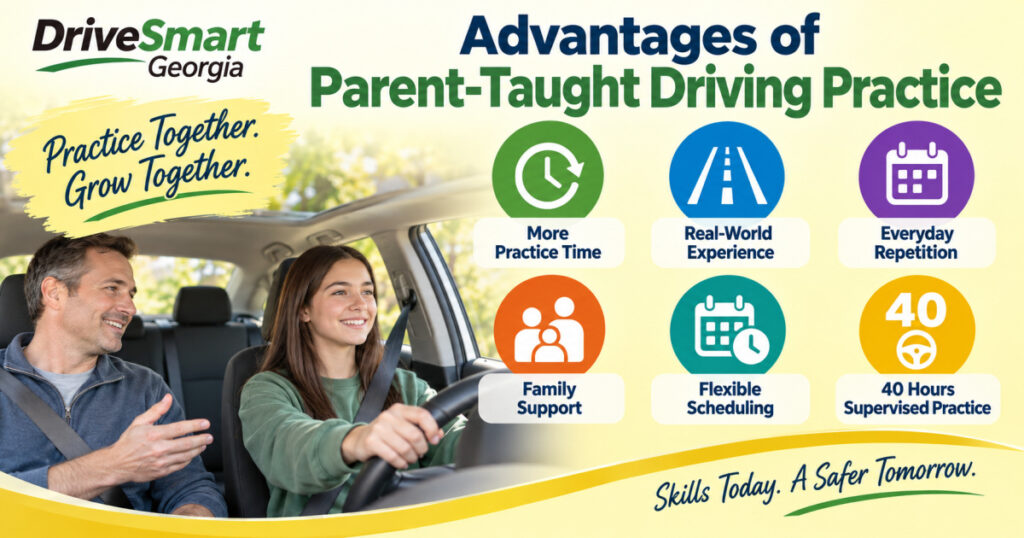
Professional driving lessons are valuable, but they cannot replace the experience teens gain from driving regularly with their families. Parents provide something especially important: time and repetition.
1. Parents Can Provide Much More Practice Time
Even an excellent professional driving lesson is only part of the learning process. New drivers need repeated opportunities to perform the same skills in different situations.
Georgia requires at least 40 hours of supervised driving experience, including six hours at night, for teens seeking a Class D license. Those hours give families an opportunity to practice over time.
Instead of trying to complete those hours quickly, parents can spread practice across weeks or months and expose their teen to gradually changing conditions.
2. Parents Can Turn Everyday Trips Into Practice
Driving practice does not always require a special trip. Once a teen has developed enough skill for the situation, routine family trips can become practice opportunities.
For example, a teen might drive:
- To school
- To an activity
- To the grocery store
- Through a familiar neighborhood
- To a restaurant
- On a longer family trip
Over time, the teen gets experience making real-world decisions rather than simply repeating an isolated exercise.
3. Parents Can Reinforce Skills Between Professional Lessons
One of the most effective uses of parent practice is reinforcing what the teen recently learned. Suppose an instructor works with a student on maintaining following distance and checking mirrors. During the next several parent practice sessions, the parent can continue reminding the teen about those same skills.
That combination creates repetition. The instructor introduces or refines the technique. The parent helps the teen practice it repeatedly.
4. Parents See Their Teen in Many Different Situations
Parents often spend more total time practicing with their teens than professional instructors do. That means they may notice patterns that appear only occasionally.
For example, a teen might drive well most of the time but struggle when:
- Traffic becomes heavier
- It gets dark
- A route is unfamiliar
- Several things happen at once
- Another driver behaves unpredictably
- The teen becomes tired or frustrated
Those observations can help parents identify areas where their teen needs more experience – or where an additional professional lesson could help.
Where Parent-Taught Practice Can Become Difficult
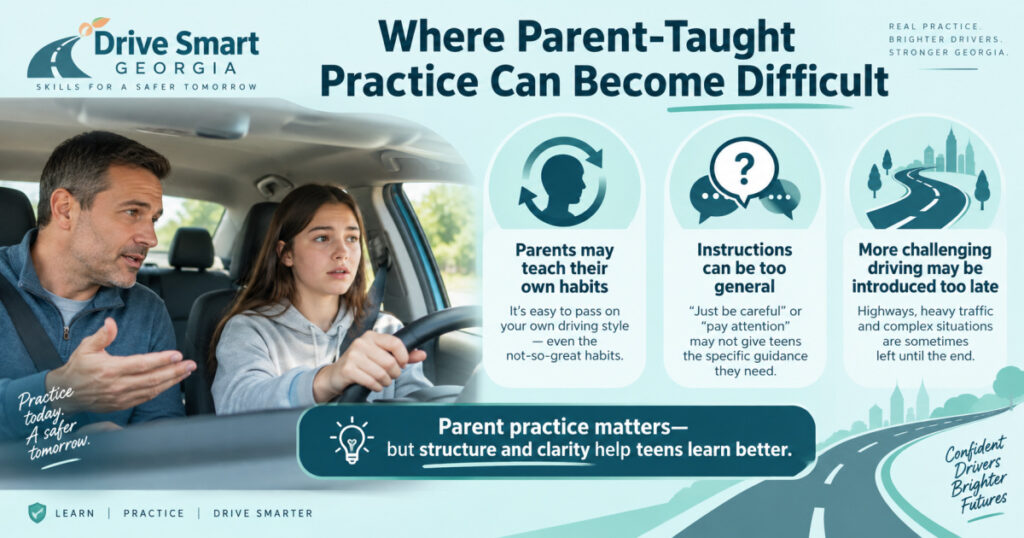
Parent instruction has tremendous value, but there are several common challenges.
Parents May Accidentally Teach Their Own Habits
Experienced drivers develop habits over the years. Some are helpful. Some are not.
A parent might unintentionally teach a teen to copy a behavior that has become routine rather than teaching the safest or most consistent technique.
Professional instructors can provide another perspective.
Instructions Can Become Too General
A parent may say:
“Watch out.”
“Slow down.”
“Move over.”
“Be careful.”
Those instructions make sense to an experienced driver, but a beginner may not know precisely what action is expected. More specific coaching helps the teen understand what to do, when to do it, and why.
Parents May Wait Too Long to Introduce More Challenging Driving
It is natural for parents to protect their teens, but continually practicing only on quiet neighborhood roads may not prepare a young driver for busier situations. Skill should build progressively.
A teen can start in lower-risk environments and gradually work toward more complicated conditions as competence improves.
Professional Driving Lessons and Parent Practice
Work Best Together
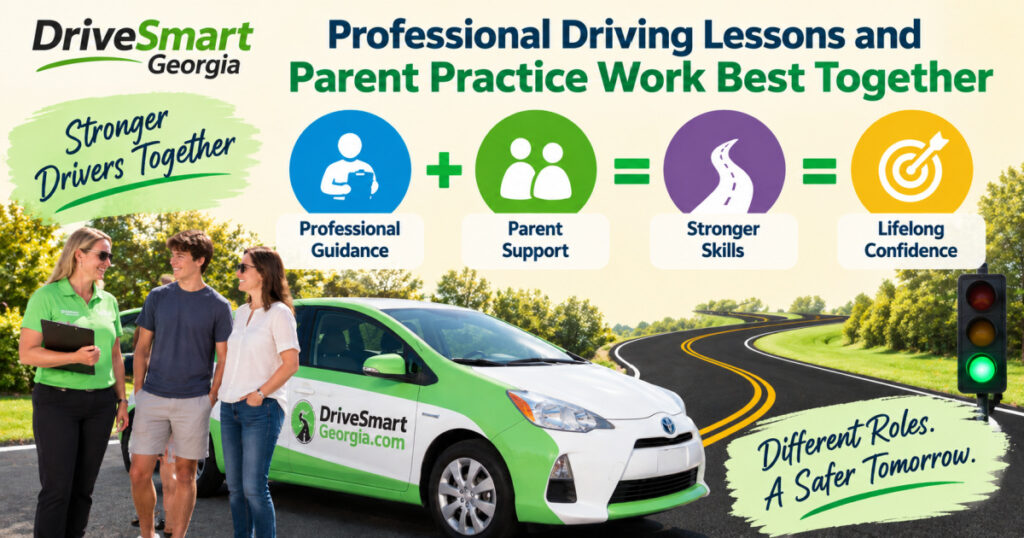
When families compare a driving school vs. parent-taught practice, the most useful question may not be:
Which one is better?
A better question is:
How can we use both effectively?
Professional driving lessons and parent practice have different strengths.
Professional instructors provide:
- Structured instruction
- Objective feedback
- Skill evaluation
- Experience teaching beginners
- Identification of weak areas
- Exposure to different driving situations
Parents provide:
- Repetition
- Frequent practice
- Familiar support
- Real-world experience
- Opportunities to practice between lessons
- Continued reinforcement over time
Together, they can create a more complete learning experience.
A Good Practice Routine Between Driving Lessons
Parents do not have to recreate a professional driving lesson. Instead, reinforce one or two skills at a time.
A practice session might focus on:
- Smooth acceleration and braking
- Mirror checks
- Proper turns
- Lane positioning
- Following distance
- Scanning intersections
- Speed control
- Lane changes
Once those skills become consistent, gradually introduce more complicated driving situations. Quality matters as much as quantity.
Forty hours spent repeating the same easy route does not provide the same experience as practice that gradually introduces new roads, situations, traffic levels, and decision-making challenges.
How Many Professional Driving Lessons Does a Teen Need?
There is no single number that is right for every student. Some teenagers progress quickly. Others need additional repetition before certain skills become comfortable.
Experience before professional lessons also varies considerably. One teen may arrive already comfortable controlling the vehicle on residential roads. Another may have barely driven before.
Parents should look at skill development rather than simply the number of hours completed.
Additional professional instruction may be worth considering when a teen continues to struggle with specific skills, becomes overwhelmed in more complicated traffic situations, or has developed habits that are difficult for a parent to correct.
Signs Professional Driving Lessons Could Help
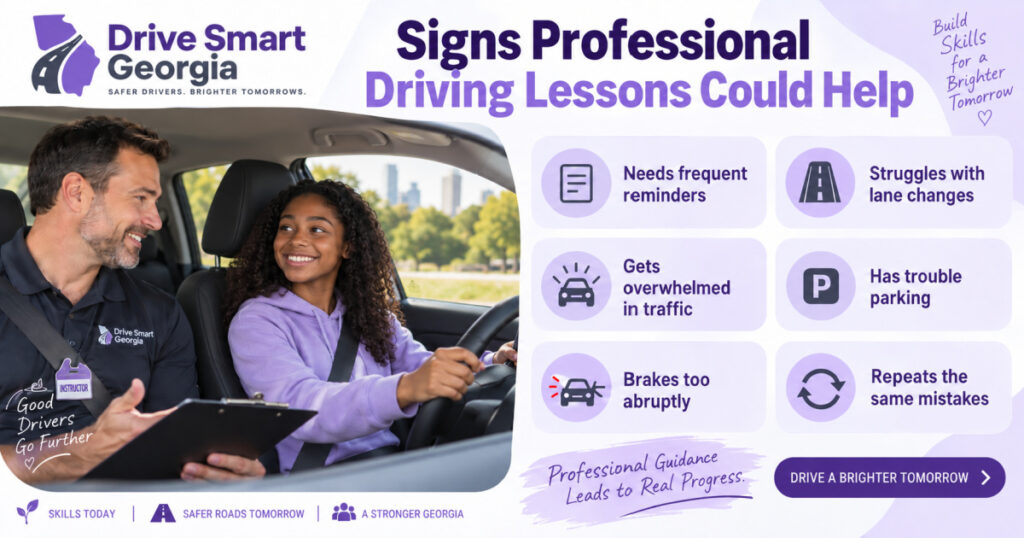
Parents may want additional instruction if their teen:
- Frequently needs reminders about basic driving procedures
- Has trouble judging speed or distance
- Struggles with lane changes
- Becomes overwhelmed in moderate or heavy traffic
- Has difficulty parking
- Brakes abruptly
- Has inconsistent lane positioning
- Misses important visual information
- Has trouble anticipating what other drivers may do
- Has practiced extensively but continues repeating the same mistakes
Professional lessons can help identify the cause of a problem instead of simply correcting the symptom.
Georgia Parents Should Focus on Competence,
Not Just Hours
Completing required driving hours is important, but a number on a practice log – or simply reaching the minimum requirement – does not automatically mean a teenager is fully prepared for independent driving.
The larger goal is competence.
- Can the teen consistently control the vehicle?
- Can they recognize potential hazards?
- Can they make safe decisions without constant reminders?
- Can they handle unfamiliar roads?
- Can they maintain attention when traffic becomes more complicated?
- Can they correct a minor mistake without panicking?
Those questions tell parents far more about readiness than the number of hours alone.
Start Professional Lessons Early Enough
to Practice Between Sessions
Families sometimes schedule driving lessons close together right before a road test. A better approach may be to begin earlier. Spacing lessons apart gives the student time to practice newly learned skills before returning for additional instruction.
For example:
Professional lesson → Parent practice → Professional feedback → More parent practice
That sequence gives teens the opportunity to build skills gradually rather than trying to absorb everything immediately before test day.
Driving School vs. Parent-Taught Practice:
You Don’t Have to Choose
Parents are an essential part of teaching teenagers to drive. Professional driving instructors can also play an important role. The two approaches are not competitors. They complement each other.
A professional instructor can teach techniques, evaluate performance, identify weaknesses, and establish good habits. Parents can then provide the repetition and real-world experience needed to make those skills more consistent.
At Drive Smart Georgia, our professional driving instructors work with students to build practical driving skills while parents continue reinforcing those skills between lessons.
Our goal is not simply to prepare teens for a road test. It is to help families develop safer, more capable drivers for the road ahead.
If your teen is ready to start professional driving lessons, select a Drive Smart Georgia location and book today.
Drive Smart Georgia locations:
- Milton: 850 Mayfield Rd., Suite L-9, Milton, GA 30009. (770) 628-7540
- Johns Creek: 11380 Southbridge Pkwy., Alpharetta, GA 30022. (770) 232-0903
- Alpharetta: 5354 McGinnis Ferry Rd., Suite 226B, Alpharetta, GA 30005. (770) 232-0900
- Cumming: 1790 Peachtree Pkwy., Suite 202, Cumming, Ga. (770) 239-4294
- Suwanee: 970 Peachtree Industrial Blvd., Suwanee, GA 30024. (770) 741-0455
- Roswell: 590 W. Crossville Rd., Suite 204, Roswell, GA 30075. (770) 741-0405
Related articles:
- Distracted Driving Dangers for Georgia Teen Drivers
- How to Build Your Teen’s Driving Confidence Safely
- Joshua’s Law FAQs: Answers to Parents’ Most Common Questions
- Georgia Class D License Requirements Explained