The Georgia Road Test Scoring Guide: What Examiners Evaluate
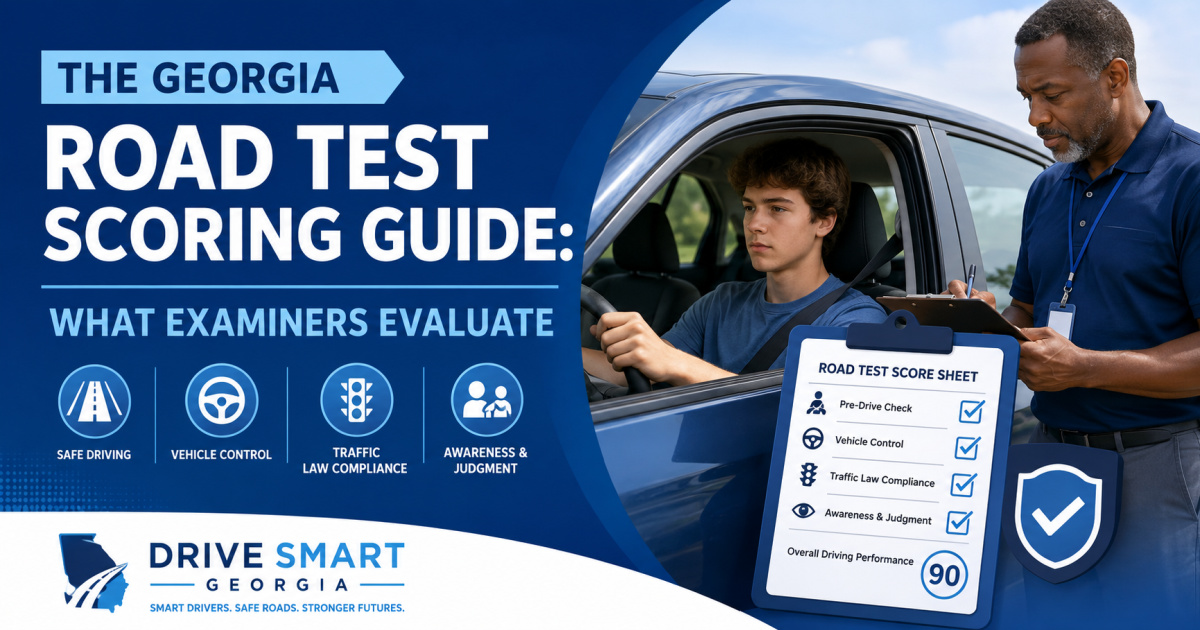
Taking the Georgia road test is an exciting milestone for teen drivers – and often a stressful one for both teens and their parents. After months of supervised driving practice, Driver’s Ed, and professional driving lessons, the road test is the final opportunity for a new driver to demonstrate that they can safely operate a vehicle on their own.
Understanding the Georgia road test scoring process can make the test feel much less intimidating.
Georgia road test examiners are not looking for perfection. They are evaluating whether a driver demonstrates the vehicle-control skills, awareness, judgment, and safe driving habits necessary to handle everyday traffic situations responsibly.
According to the Georgia Department of Driver Services (DDS), drivers taking a traditional Class C or Class D road test must earn a minimum score of 75% to pass. The examiner evaluates specific driving maneuvers along with the driver’s overall behavior behind the wheel.
So, what exactly does a Georgia road test examiner evaluate? This Georgia road test scoring guide explains some of the most important skills teens should practice before test day.
How Is the Georgia Road Test Scored?
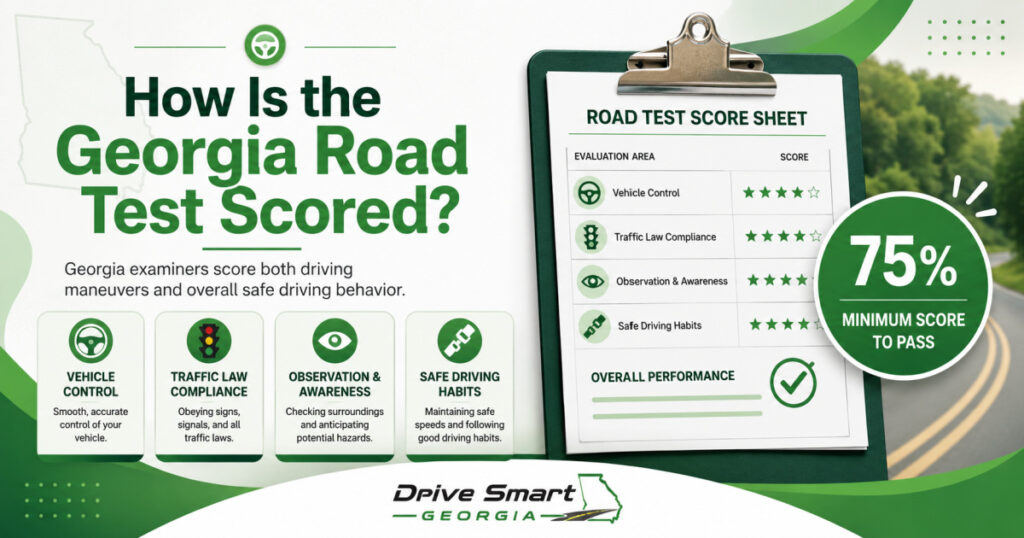
During the Georgia road skills test, the examiner evaluates how safely and confidently the applicant handles a variety of driving situations.
Drivers must receive a score of at least 75% to pass the Class C or Class D road test. After a traditional road test, the examiner can review the score sheet with the applicant and discuss the results.
The Georgia DDS identifies several specific skills that applicants may be expected to demonstrate, including:
- Parallel parking
- Straight-line backing
- Stopping at signs and traffic signals
- Performing a turnabout
- Approaching intersections and corners
- Yielding the right-of-way
- Turning properly
- Passing safely
- Maintaining an appropriate following distance
- Maintaining proper driving posture and vehicle control
The examiner is also paying attention to the driver’s overall awareness, decision-making, observation, and ability to follow traffic laws safely.
A teen who can perform an individual maneuver but consistently forgets to check mirrors, signal, yield, or observe surrounding traffic may not be demonstrating the overall driving habits necessary to pass.
That is why preparation should focus on becoming a safe, consistent driver, rather than simply memorizing a few road-test maneuvers.
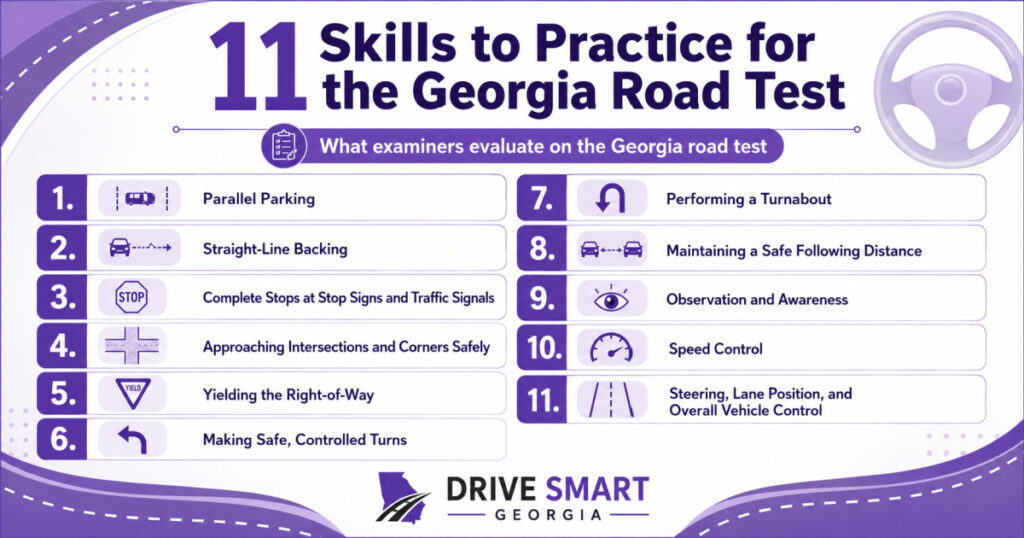
11 skills to Practice for the Georgia Road Test
1. Parallel Parking
Parallel parking is one of the most recognizable parts of the Georgia road test – and one of the skills that makes many new drivers nervous.
Georgia DDS guidance states that the applicant should park midway between the standards with the vehicle no more than 18 inches from the curb. The standard parallel-parking area used for the driver’s license test is approximately 22 feet long by 10 feet deep.
During practice, teens should work on more than simply getting the vehicle into the space.
They should practice:
- Controlling the vehicle at a slow speed
- Checking around the vehicle before backing
- Steering smoothly
- Understanding the vehicle’s size and position
- Making controlled adjustments
- Finishing in an appropriate position
The goal is not speed. A slow, controlled maneuver demonstrates much more confidence and vehicle control than rushing.
2. Straight-Line Backing
The Georgia road test also evaluates a driver’s ability to back the vehicle safely and under control.
DDS instructs applicants to back approximately 50 feet at a slow speed while keeping the vehicle as straight and smooth as possible. Drivers are expected to turn their head and look behind the vehicle while backing.
This requirement highlights an important road-test lesson: examiners want to see that drivers are actually observing their surroundings.
A teen should practice:
- Looking behind the vehicle before moving
- Turning to observe while backing
- Keeping the vehicle straight
- Using slow, controlled steering corrections
- Maintaining a safe speed
- Staying aware of boundaries and surroundings
Backup cameras and other driver-assistance technology can be useful tools in everyday driving, but DDS requires applicants to demonstrate that they can operate the vehicle without relying on advanced driver-assistance technology.
3. Complete Stops at Stop Signs and Traffic Signals
Rolling through a stop sign is a dangerous habit – and exactly the type of mistake teens should eliminate well before taking the road test.
When approaching a stop sign or traffic signal, DDS expects the driver to approach in the proper lane, stop before reaching the pedestrian crosswalk, and remain stopped until proceeding is safe.
Teens should develop a consistent routine:
Slow down → Stop completely → Observe → Proceed when safe.
During practice sessions, parents should watch for incomplete stops, stopping too far into intersections, or immediately accelerating without adequately checking for traffic and pedestrians.
The examiner should never have to wonder whether the driver actually stopped.
4. Approaching Intersections and Corners Safely
Intersections require drivers to process several pieces of information at the same time. They may need to watch traffic lights, signs, vehicles, pedestrians, bicyclists, lane markings, and approaching traffic – all within a few seconds.
Georgia DDS expects applicants to approach intersections and corners in the proper lane and look in both directions.
Before test day, teens should be comfortable:
- Scanning ahead
- Identifying traffic controls early
- Choosing the correct lane
- Reducing speed when appropriate
- Checking for pedestrians and bicyclists
- Looking left and right
- Anticipating the actions of other drivers
Good drivers do not simply react to what is directly in front of them. They continually scan for potential hazards.
5. Yielding the Right-of-Way
Knowing when to yield is another important part of safe driving. According to DDS, drivers must yield the right-of-way to pedestrians, motorists, bicyclists, and others who enter an intersection before them.
Right-of-way situations can sometimes make inexperienced drivers hesitate.
Practice should include:
- Four-way stops
- Unprotected left turns
- Crosswalks
- Yield signs
- Merging situations
- Intersections with pedestrians or bicyclists
Teens should understand that having the right-of-way does not eliminate the responsibility to prevent a crash. Safe driving requires awareness and judgment, not simply knowing who technically goes first.
6. Making Safe, Controlled Turns
Turns may seem basic, but they allow an examiner to evaluate several important driving skills at once. DDS expects applicants to move into the proper lane and signal an adequate distance before making a turn.
A well-executed turn involves several steps:
- Check mirrors and surrounding traffic
- Signal early enough to communicate your intention
- Move into or remain in the proper lane
- Reduce speed before the turn
- Look through the intersection
- Check for pedestrians and other road users
- Turn smoothly
- Enter the appropriate lane
- Accelerate gradually after completing the turn
Parents should pay particular attention to teens who turn too quickly, brake while already deep into the turn, drift into another lane, or forget to scan before turning.
7. Performing a Turnabout
Applicants may also need to demonstrate that they can safely reverse direction in a limited space. Georgia DDS includes a turnabout among its road-test expectations. Current DDS testing information states that applicants may use a two-, three-, or five-point turn, while the driver’s manual specifically references performing a three-point turn.
Regardless of the exact maneuver requested, the examiner wants to see controlled vehicle movement and awareness. Before each movement, teens should check the area around the vehicle rather than concentrating only on steering. Practice the maneuver slowly until the sequence feels familiar.
8. Maintaining a Safe Following Distance
Following another vehicle too closely reduces the time a driver must respond if traffic suddenly slows or stops. DDS specifically evaluates following distance during the road test and instructs drivers not to follow other vehicles too closely.
Instead of focusing on a precise physical distance between cars, teens should practice leaving enough space to identify changing traffic conditions and respond smoothly.
Additional space may be necessary when:
- Roads are wet
- Visibility is poor
- Traffic is moving quickly
- The vehicle ahead frequently brakes
- Driving behind a large truck or SUV
Adequate following distance is one of the simplest ways to give a new driver more time to make good decisions.
9. Observation and Awareness
One of the most important aspects of the Georgia road test is also one of the easiest for nervous teens to overlook: the examiner needs to see the driver observing the road.
Looking is a driving skill.
Teens should consistently check:
- Mirrors
- Blind spots
- Intersections
- Crosswalks
- Traffic signals
- Lane markings
- Vehicles entering the roadway
- Pedestrians and bicyclists
- Changing traffic conditions
This is especially important before changing lanes, turning, backing, pulling away from a curb, or entering an intersection.
A teen may know that they checked a mirror with their eyes, but a subtle glance can sometimes be difficult for someone else to recognize. Encourage deliberate, natural observation habits rather than exaggerated movements performed only for the test.
10. Speed Control
New drivers sometimes assume that driving well below the speed limit will make them appear safer. That is not necessarily the goal.
A safe driver selects a reasonable speed based on the posted speed limit, traffic, road conditions, visibility, and surrounding hazards. Teens should practice smoothly accelerating to an appropriate speed while avoiding both speeding and unnecessarily slow driving that could interfere with traffic.
The goal is controlled, predictable driving.
11. Steering, Lane Position, and Overall Vehicle Control
Examiners also observe whether the applicant appears consistently in control of the vehicle. DDS guidance emphasizes proper driving posture and keeping both hands on the steering wheel.
Before test day, teens should be comfortable:
- Keeping the vehicle centered in the lane
- Steering smoothly
- Maintaining steady speed
- Braking gradually
- Accelerating smoothly
- Navigating curves
- Making controlled turns
- Maintaining awareness while operating the vehicle
Jerky braking, excessive steering corrections, drifting within the lane, and inconsistent speed can all signal that a teen needs more practice.
What Mistakes Can Cause Problems on the
Georgia Road Test?
There is a difference between making a small mistake and demonstrating unsafe driving.
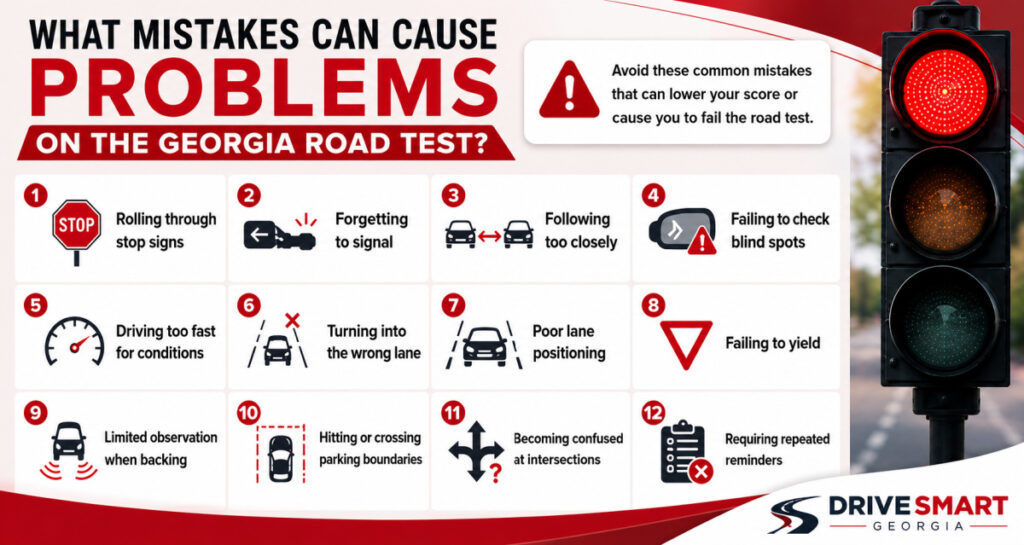
Common problems teens should work to eliminate before test day include:
- Rolling through stop signs
- Forgetting to signal
- Following too closely
- Failing to check blind spots
- Driving too fast for conditions
- Turning into the wrong lane
- Poor lane positioning
- Failing to yield
- Limited observation when backing
- Hitting or crossing parking boundaries
- Becoming confused at intersections
- Requiring repeated reminders about basic driving decisions
DDS also states that a road-test failure involving an accident or traffic violation can result in a 30-day waiting period before retesting. Other first road-test failures generally require waiting until the next day, while a second or subsequent failure requires a seven-day wait.
The safest strategy is to wait until the teen’s skills are consistent before scheduling the test.
Practice the Entire Drive – not Just Parallel Parking
One of the biggest road-test preparation mistakes is spending most of the practice time on parallel parking. Yes, parallel parking matters. But so do the dozens of decisions a driver makes while traveling between intersections.
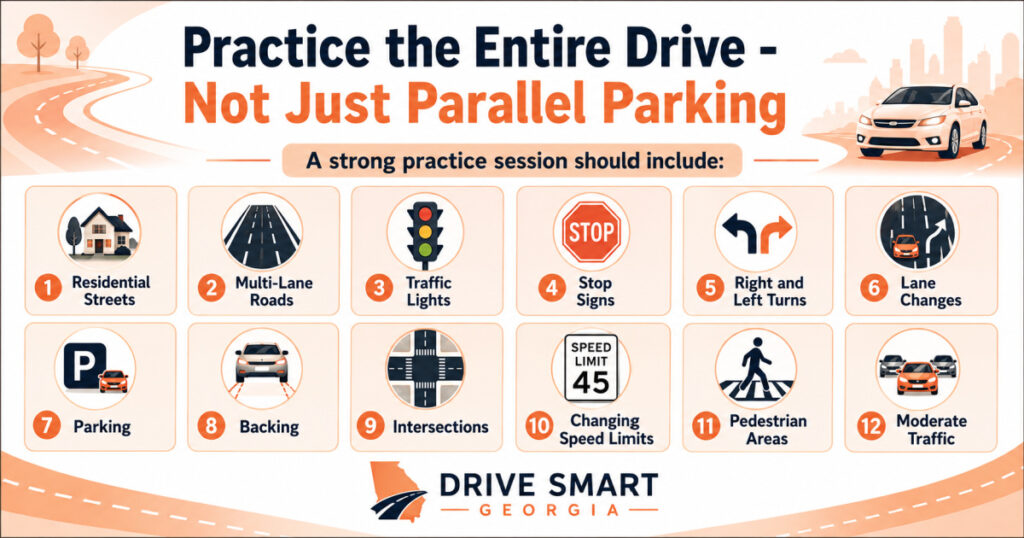
A strong practice session should include:
- Residential streets
- Multi-lane roads
- Traffic lights
- Stop signs
- Right and left turns
- Lane changes
- Parking
- Backing
- Intersections
- Changing speed limits
- Pedestrian areas
- Moderate traffic
Parents can also occasionally conduct a practice drive with minimal coaching. Give the teen directions, observe their decisions, and discuss the drive afterward. This can help determine whether the teen is truly driving independently or still relying heavily on prompts from the passenger seat.
Professional Driving Lessons Can Help Identify
Road-Test Weaknesses
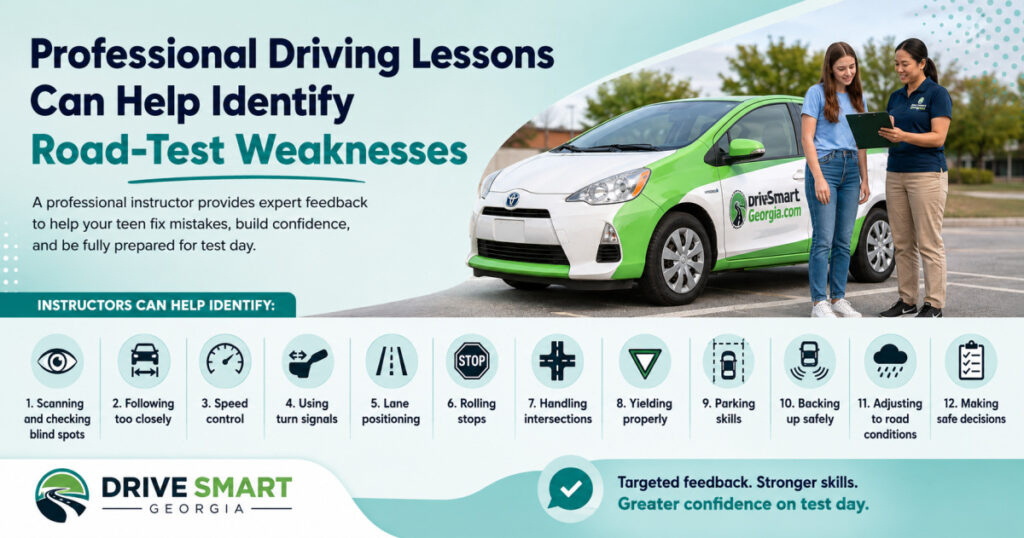
Parents play an essential role in helping teens gain supervised driving experience, but it can be difficult to objectively evaluate your own teen.
A professional driving instructor can identify habits that parents or teens may not notice, such as inconsistent mirror checks, incorrect lane positioning, hesitation at intersections, abrupt braking, or ineffective scanning.
Professional driving lessons also give teens experience receiving directions and feedback from someone other than a parent.
At Drive Smart Georgia, our instructors help students develop practical driving skills through professional instruction and behind-the-wheel experience. Families can combine professional lessons with consistent parent-supervised practice to reinforce what teens learn.
The goal should extend beyond passing the Georgia road test. It should be developing the habits and judgment necessary to drive safely after the examiner leaves the passenger seat.
Frequently Asked Questions About Georgia Road Test Scoring
What score do you need to pass the Georgia road test?
Georgia DDS requires a minimum score of 75% to pass a traditional Class C or Class D road test.
Does Georgia require parallel parking on the road test?
Parallel parking is one of the skills listed by Georgia DDS for the Road Skills Test. Drivers are expected to park between the standards and within the required distance from the curb.
How far do you have to back up during the Georgia road test?
Georgia DDS instructs applicants to back approximately 50 feet slowly, smoothly, and as straight as possible while looking behind the vehicle.
Can you use a backup camera during the Georgia road test?
Vehicles may contain advanced driver-assistance technology, but DDS states that applicants must demonstrate their ability to operate the vehicle without relying on that technology.
What happens after you pass the Georgia road test?
Passing the road test is an important step toward earning a driver’s license, but teens must still satisfy all applicable Georgia licensing requirements. Families should review current DDS requirements before test day to ensure that the teen has the required documentation and has completed all applicable Class D licensing requirements.
Prepare for More Than a Passing Score
Understanding Georgia road test scoring can help teens know what to expect, but the best preparation is not memorizing a scoring sheet. It is becoming a better driver.
Practice until checking mirrors becomes automatic. Practice until complete stops feel natural. Practice until a teen can recognize the correct lane without being reminded. Practice parking, backing, intersections, turns, following distance, and hazard awareness until those skills are consistent.
A passing road-test score is important – but the skills behind that score matter much more.
When teens develop safe driving habits before test day, they are preparing not only for the Georgia road test, but for every drive that comes afterward.
Drive Smart Georgia locations:
- Milton: 850 Mayfield Rd., Suite L-9, Milton, GA 30009. (770) 628-7540
- Johns Creek: 11380 Southbridge Pkwy., Alpharetta, GA 30022. (770) 232-0903
- Alpharetta: 5354 McGinnis Ferry Rd., Suite 226B, Alpharetta, GA 30005. (770) 232-0900
- Cumming: 1790 Peachtree Pkwy., Suite 202, Cumming, Ga. (770) 239-4294
- Suwanee: 970 Peachtree Industrial Blvd., Suwanee, GA 30024. (770) 741-0455
- Roswell: 590 W. Crossville Rd., Suite 204, Roswell, GA 30075. (770) 741-0405
Related articles:
- How to Build Your Teen’s Driving Confidence Safely
- How to Pass the Georgia Learner’s Permit Test the First Time
- Joshua’s Law FAQs: Answers to Parents’ Most Common Questions
- The Ultimate Georgia Teen Driving Safety Checklist