What Happens After Your Teen Gets a Learner’s Permit in Georgia?
Getting a Georgia learner’s permit is an exciting milestone for a teen driver – and maybe a slightly nerve-racking one for parents. However, passing the permit test is only the beginning.
Once your teen receives a Georgia learner’s permit, the real learning starts. Over the months ahead, your teen will need to gain driving experience, complete Georgia’s Driver’s Ed requirements if they plan to earn a Class D license at age 16 or 17, practice with a parent or guardian, develop safe driving habits, and prepare for the Georgia road test.
11 steps to take after your teen get’s a learner’s permit
in Georgia
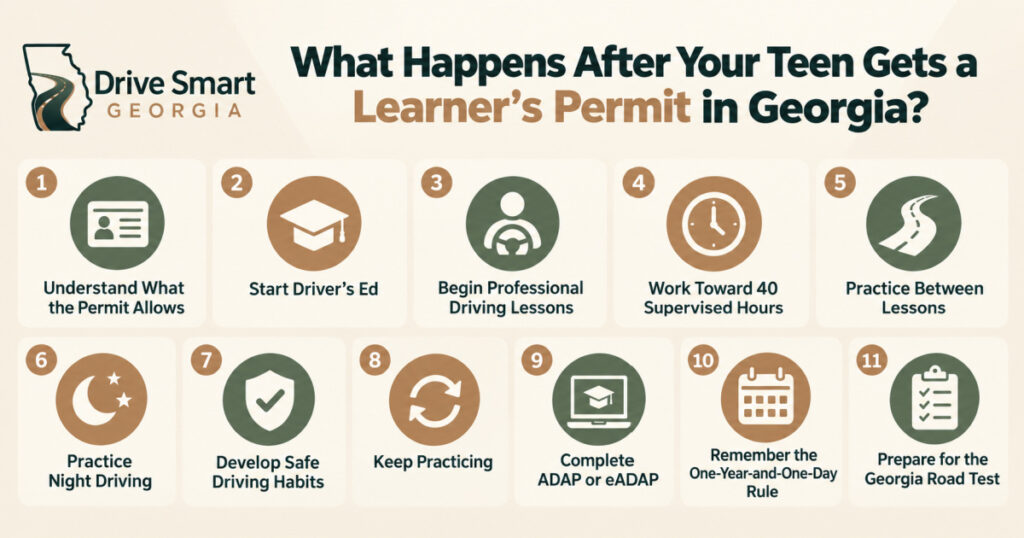
If you’re wondering what happens after your teen gets a learner’s permit in Georgia, here’s a step-by-step look at what comes next.
Step 1: Understand What a Georgia Learner’s Permit Allows
Georgia officially calls the learner’s permit a Class CP Instructional Permit.
A teen can receive a Georgia learner’s permit beginning at age 15 after meeting the state’s requirements and passing the required knowledge exams. However, having a learner’s permit does not mean your teen can drive alone.
According to the Georgia Department of Driver Services (DDS), a driver with a Class CP permit may drive only when accompanied by someone who:
- Is at least 21 years old
- Has a valid Class C driver’s license
- Is fit and capable of taking control of the vehicle
- Is sitting in the seat beside the teen driver
That restriction remains in place while your teen holds a learner’s permit.
Parents should think of the permit as permission to begin learning, not proof that a teen is ready to drive independently.
Step 2: Start Driver’s Ed
One of the most important next steps after getting a learner’s permit is completing an approved Georgia Driver’s Education course.
Under Joshua’s Law, teens who want to obtain a Georgia Class D provisional license at age 16 or 17 must satisfy Georgia’s Driver’s Ed requirements.
Georgia DDS recognizes several approved ways to meet these requirements. The traditional 30-and-6 option consists of:
- 30 hours of approved classroom or online Driver’s Ed
- 6 hours of behind-the-wheel instruction with a certified driving school
- 40 hours of supervised driving practice, including at least 6 hours at night
Georgia also allows approved parent-taught alternatives, so professional driving lessons are not the only method recognized by the state.
At Drive Smart Georgia, families can choose from in-person Driver’s Ed, live Zoom classes with a real instructor, or an approved self-paced online option, depending on the program selected.
And here’s something many parents don’t realize: your teen does not have to wait until receiving a learner’s permit to begin the classroom portion of Driver’s Ed.
In fact, teens can take Driver’s Ed before they get their permit. However, a learner’s permit is required before beginning behind-the-wheel driving instruction.
Step 3: Begin Professional Driving Lessons
Once your teen has a valid learner’s permit, behind-the-wheel instruction can begin.
Professional driving lessons provide something that parent practice alone may not always provide: structured instruction from someone trained to evaluate new drivers.
A professional driving instructor can work with your teen on skills such as:
- Steering and vehicle control
- Smooth acceleration and braking
- Proper lane positioning
- Turns and intersections
- Traffic signs and signals
- Lane changes
- Mirror and blind-spot checks
- Following distance
- Parking and backing
- Speed management
- Hazard recognition
- Defensive driving techniques
The goal should be much bigger than simply teaching enough skills to pass a road test.
Professional driving instruction can help teens build the judgment, awareness, and habits they will need when they eventually begin driving alone.
Step 4: Start Working Toward the 40 Hours of Supervised Driving
Professional lessons are important, but they are only part of the learning process.
Georgia requires teens pursuing a Class D license to complete at least 40 hours of supervised driving experience, including at least 6 hours at night.
That means parents or guardians play a major role after their teen receives a learner’s permit. Instead of trying to accumulate the hours as quickly as possible, spread practice across the months your teen holds the permit. Start with easier situations and gradually increase the difficulty as skills improve.
For example, your teen might progress from:
Quiet neighborhood streets → local roads → multi-lane roads → busier intersections → highways → heavier traffic → nighttime driving.
This gradual approach gives teens an opportunity to become comfortable with individual skills before adding more complicated driving situations.
Quality Matters as Much as the Number of Hours
Parents sometimes focus heavily on reaching the required 40 hours. However, 40 hours should be viewed as a minimum requirement – not necessarily the point at which every teen is automatically ready to drive alone.
Two teens can complete the same number of practice hours and have very different skill levels.
Use supervised driving time to help your teen experience different situations, including:
- Residential neighborhoods
- Two-lane roads
- Multi-lane roads
- Different speed limits
- Intersections
- Parking lots
- Light and moderate traffic
- Highway driving when appropriate
- Rain and other safe but varied weather conditions
- Day and nighttime driving
The more varied the supervised practice, the better prepared your teen may be to make safe decisions independently.
Step 5: Practice Between Professional Driving Lessons
One of the most effective ways to build driving skills is to combine professional instruction with regular parent practice.
A driving instructor may introduce or correct a skill during a lesson. Your teen can then practice that skill with you before the next lesson.
Think of the process as:
Learn → Practice → Receive Feedback → Practice Again
Repetition helps driving techniques become habits.
For example, if an instructor works with your teen on proper lane changes, spend some parent-practice sessions reinforcing the same sequence: check mirrors, signal, check the blind spot, evaluate traffic, and move smoothly when it is safe.
Professional lessons and parent practice have different roles, but they can work extremely well together.
Step 6: Practice Night Driving
Don’t leave nighttime practice until the last few weeks before the road test. Of Georgia’s required 40 hours of supervised driving, at least 6 hours must be completed at night.
Night driving introduces challenges teens may not experience during the day, including reduced visibility, glare from headlights, difficulty judging distance, and increased fatigue.
Start nighttime practice on familiar roads with lighter traffic.
As your teen becomes more comfortable, gradually introduce additional driving situations.
Remember: the goal is not simply to record six nighttime hours. The goal is to help your teen become capable of handling the different challenges that come with driving after dark.
Step 7: Help Your Teen Develop Safe Driving Habits Early
The permit period is when lifelong driving habits begin to form. Parents should reinforce safe habits from the very first practice drive rather than trying to correct poor habits just before the road test.
Encourage your teen to consistently:
- Buckle their seat belt before moving
- Adjust mirrors before driving
- Put the phone away
- Scan ahead for hazards
- Maintain a safe following distance
- Check mirrors regularly
- Check blind spots before changing lanes
- Obey speed limits
- Use turn signals
- Slow down for changing road conditions
- Avoid aggressive driving
- Stay focused on the driving environment
Parents should model these behaviors too. Teens notice how the adults around them drive. Telling your teen not to use a phone behind the wheel will be far more convincing if they see you doing the same thing.
Step 8: Keep Practicing Even When Your Teen Starts to Look Confident
One of the most challenging stages for parents can occur when their teen begins looking comfortable behind the wheel. Confidence can grow faster than experience.
A teen may become good at controlling the vehicle while still needing more experience with decision-making, scanning, judging traffic gaps, recognizing hazards, or responding to unexpected situations. Continue supervising practice even when basic vehicle control begins to look easy.
Try asking questions such as:
“What hazards do you see ahead?”
“Why are you slowing down here?”
“What is that vehicle beside you likely to do?”
“Where would you go if traffic suddenly stopped?”
These conversations can help your teen learn to think like a defensive driver, rather than simply operate a vehicle.
Step 9: Complete ADAP or eADAP
Another requirement parents sometimes overlook is Georgia’s Alcohol and Drug Awareness Program (ADAP).
Drivers under 18 must complete ADAP or eADAP before receiving a Georgia driver’s license. Many students complete ADAP through their school, while eADAP is available online through Georgia DDS.
Don’t wait until road-test week to determine whether your teen has completed this requirement. Confirm it ahead of time so a missing certificate doesn’t create an unnecessary delay when your teen becomes eligible for a license.
Step 10: Remember the One-Year-and-One-Day Rule
Passing Driver’s Ed quickly does not mean your teen can immediately take the road test. Georgia teens must hold their learner’s permit for at least one year and one day before they can obtain a Class D provisional license. They must also be at least 16 years old and meet the other Class D requirements. For example, if your teen receives a learner’s permit on October 10, 2026, the earliest they could satisfy the permit-holding requirement would be October 11, 2027.
That waiting period is valuable. Instead of treating it as time your teen must “get through,” use those months to build experience gradually.
Step 11: Begin Preparing for the Georgia Road Test
As your teen approaches the end of the permit period, start evaluating road-test readiness. The road test should not be the first time your teen is expected to demonstrate driving skills without constant coaching. Before testing, your teen should be able to safely perform normal driving tasks with minimal reminders.
Georgia DDS requires road-test appointments; walk-ins are not accepted for teen road tests. Applicants must meet the Class D requirements and bring the necessary documentation. The vehicle used for a DDS test must also meet DDS requirements, including proof of registration and insurance and passing the vehicle safety inspection.
Drive Smart Georgia also offers on-site road testing for eligible students, which can allow teens to test in a familiar environment and vehicle.
For Drive Smart Georgia’s on-site road test, teens ages 16–17 must meet eligibility requirements, including completing the required Driver’s Ed component and completing at least six hours of driving lessons with Drive Smart Georgia. Additional lessons can be purchased for nervous or less confident teen drivers.
What Happens After the Georgia Road Test?
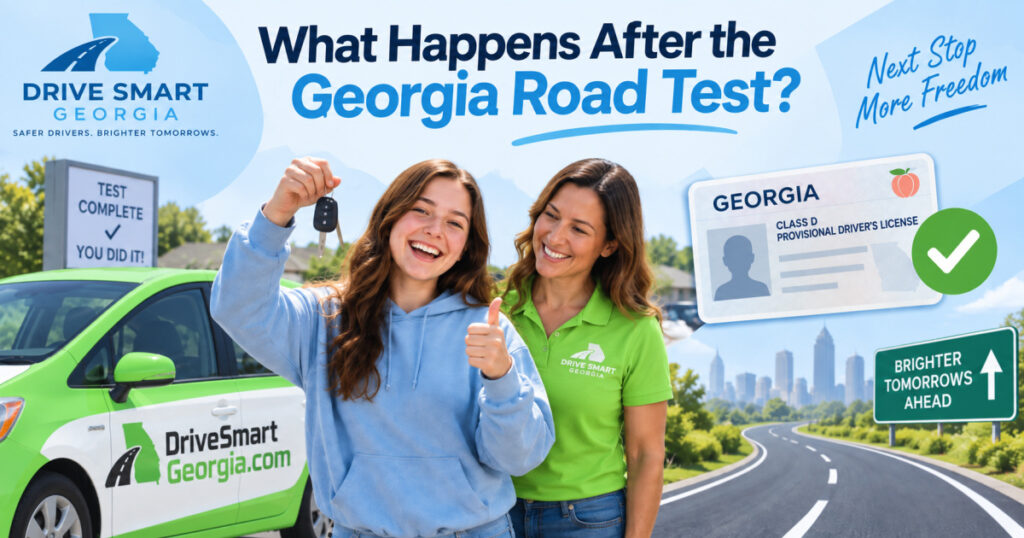
Passing the road test moves an eligible teen to the next stage of Georgia’s graduated licensing system: the Class D provisional license.
A Class D license provides much more independence than a learner’s permit – but it still has important restrictions.
Georgia currently requires Class D drivers to follow these restrictions:
- 12:00 a.m.–5:00 a.m.: No driving during these hours, with no exceptions.
- First six months: Only immediate family members may ride with the teen.
- Second six months: No more than one passenger under age 21 who is not an immediate family member.
- After one year: Up to three passengers under age 21 who are not immediate family members.
These restrictions are designed to give new drivers additional experience before they receive unrestricted driving privileges.
Frequently Asked Questions About What Happens After Getting a Learner’s Permit in Georgia
Can my teen drive alone with a Georgia learner’s permit?
No. A driver with a Georgia Class CP learner’s permit must be accompanied by a licensed Class C driver who is at least 21, capable of taking control of the vehicle, and sitting beside the teen.
How long does a teen have to hold a learner’s permit in Georgia?
A teen must hold a valid learner’s permit for at least one year and one day before becoming eligible for a Class D provisional license.
How many supervised driving hours are required in Georgia?
Georgia requires at least 40 hours of supervised driving experience, including at least 6 hours at night, for teens pursuing a Class D license.
Does my teen need professional driving lessons?
Georgia provides several approved methods for satisfying Joshua’s Law. One common option includes 30 hours of Driver’s Ed plus six hours of professional behind-the-wheel instruction and the required supervised practice. Georgia also recognizes approved parent-taught alternatives.
Professional lessons can still be extremely valuable because a trained instructor can provide structured instruction, objective feedback, and experience identifying skills that need improvement.
Can my teen take Driver’s Ed before getting a learner’s permit?
Yes. A teen can complete the classroom or online portion of Driver’s Ed before receiving a learner’s permit. A permit is required before beginning behind-the-wheel training.
When can my teen take the Georgia road test?
For a Class D license, your teen must be at least 16, have held a learner’s permit for at least one year and one day, and complete all applicable Georgia requirements before testing.
The Learner’s Permit Is Where the Real Learning Begins
Getting a learner’s permit may feel like the big milestone, but it is really the starting line. The months that follow give teens something no written test can provide: experience. Use that time wisely.
Combine quality Driver’s Ed, professional driving instruction, parent-supervised practice, nighttime driving, different road conditions, and repeated feedback to help your teen build skills gradually.
The goal should never be simply to accumulate 40 hours or pass the Georgia road test. The bigger goal is to prepare your teen for the day you are no longer sitting beside them.
Drive Smart Georgia has helped Georgia families prepare safer, more confident drivers since 2009. With in-person, live Zoom, and self-paced Driver’s Ed options, professional behind-the-wheel lessons, and convenient on-site road testing for eligible students, families can choose the training path that works best for their teen.
Ready for the next step? Explore Drive Smart Georgia’s Driver’s Ed programs and professional driving lessons to help your teen build the skills and confidence needed for the road ahead.
Drive Smart Georgia locations:
- Milton: 850 Mayfield Rd., Suite L-9, Milton, GA 30009. (770) 628-7540
- Johns Creek: 11380 Southbridge Pkwy., Alpharetta, GA 30022. (770) 232-0903
- Alpharetta: 5354 McGinnis Ferry Rd., Suite 226B, Alpharetta, GA 30005. (770) 232-0900
- Cumming: 1790 Peachtree Pkwy., Suite 202, Cumming, Ga. (770) 239-4294
- Suwanee: 970 Peachtree Industrial Blvd., Suwanee, GA 30024. (770) 741-0455
- Roswell: 590 W. Crossville Rd., Suite 204, Roswell, GA 30075. (770) 741-0405
Related articles:
- How to Build Your Teen’s Driving Confidence Safely
- How to Pass the Georgia Learner’s Permit Test the First Time
- Joshua’s Law FAQs: Answers to Parents’ Most Common Questions
- The Ultimate Georgia Teen Driving Safety Checklist