What Should Parents Practice with a Teen Driver in Georgia?
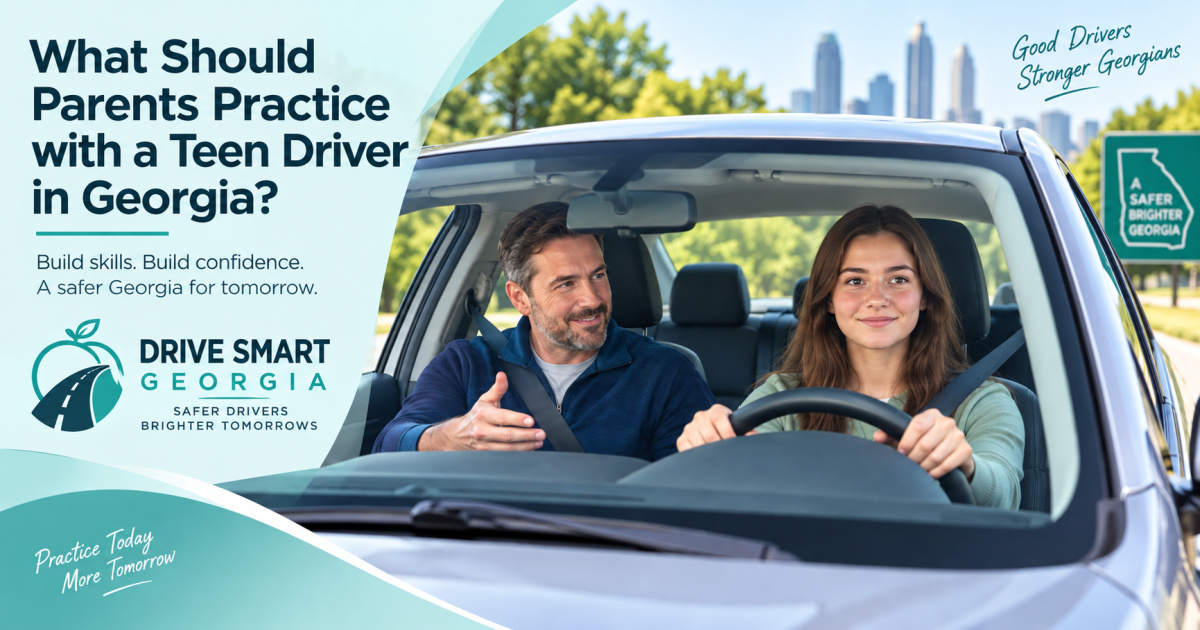
Learning to drive takes much more than memorizing traffic laws or practicing parallel parking a few times before the road test. For Georgia teens, becoming a safe driver requires consistent practice in a variety of real-world driving situations.
That means parents play an important role.
Georgia requires teen drivers to gain substantial supervised driving experience before earning a provisional Class D license. But simply accumulating hours behind the wheel isn’t enough. The quality and variety of those practice hours matter.
So, what should parents practice with a teen driver
in Georgia?
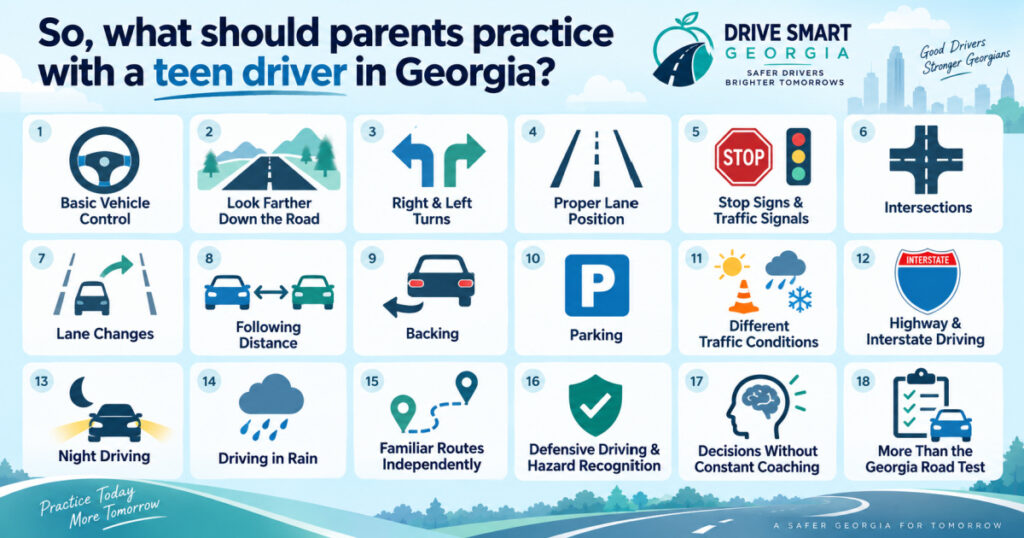
Parents should gradually help teens develop everything from basic vehicle control and turning to lane changes, intersections, parking, night driving, highway driving, and defensive driving skills. The goal isn’t simply to prepare a teen to pass the Georgia road test. It’s to help them develop the judgment and habits they’ll need when they’re eventually driving alone.
Here are some of the most important skills Georgia parents should practice with their teen drivers.
1. Start with Basic Vehicle Control
For a brand-new driver, even simple tasks require concentration. Before practicing in traffic, teens should become comfortable controlling the vehicle in a low-risk environment such as an empty parking lot.
Parents can practice:
- Adjusting the seat and mirrors
- Buckling the seat belt before starting the vehicle
- Using turn signals
- Smooth acceleration
- Smooth braking
- Steering control
- Maintaining a slow, consistent speed
- Stopping at a designated point
- Understanding vehicle controls
- Checking mirrors before moving
Don’t rush this stage.
A teen who is still struggling with steering or braking shouldn’t immediately be placed in complicated traffic situations. Basic vehicle control should begin feeling natural before adding more demanding driving tasks.
2. Practice Looking Farther Down the Road
New drivers often focus on the pavement immediately in front of the vehicle. Experienced drivers tend to look farther ahead so they can identify changing conditions earlier. Parents should encourage teens to continuously scan the road rather than staring at one location.
Ask your teen to identify potential hazards ahead, such as:
- A traffic light changing
- A vehicle waiting to turn
- A pedestrian approaching a crosswalk
- Brake lights several cars ahead
- A vehicle entering from a driveway
- Construction
- A cyclist
- A school bus
- An approaching intersection
The Georgia DDS Parent/Teen Driving Guide specifically emphasizes visual skills and looking ahead rather than fixating on one object.
Learning to recognize potential problems early gives a teen more time to respond safely.
3. Practice Right and Left Turns
Turns may seem simple to experienced drivers, but they’re one of the first places new drivers struggle with speed, steering, lane position, and observation. Practice both right and left turns from stopped and moving positions.
Remind your teen to:
- Check mirrors.
- Signal before the turn.
- Reduce speed appropriately.
- Look for pedestrians, cyclists, and approaching traffic.
- Enter the correct lane.
- Accelerate smoothly after completing the turn.
The Georgia DDS Parent/Teen Driving Guide recommends repeated practice with right and left turns while emphasizing signals, mirror checks, speed, steering control, and proper lane position.
Practice turns in quiet neighborhoods before progressing to busier intersections.
4. Practice Maintaining Proper Lane Position
Keeping the vehicle centered in the lane can be surprisingly difficult for an inexperienced driver. Some new drivers drift toward the center line. Others stay too close to the shoulder or parked cars.
Practice helping your teen recognize where the vehicle should be positioned within the lane.
Parents can gradually introduce:
- Residential streets
- Two-lane roads
- Multi-lane roads
- Curved roads
- Roads with narrow lanes
- Roads with parked vehicles
Encourage your teen to look farther ahead rather than directly over the hood. Looking ahead can help improve steering accuracy and lane positioning.
5. Practice Stopping at Signs and Traffic Signals
Stopping properly requires more than pressing the brake pedal. Your teen should learn to identify stop signs and traffic signals early enough to slow gradually.
Practice:
- Smooth braking
- Stopping completely
- Stopping before the crosswalk or stop line
- Looking left, right, and left again
- Yielding appropriately
- Watching pedestrians
- Proceeding only when the intersection is safe
These are also skills evaluated during Georgia’s road skills test. DDS expects drivers to approach in the proper lane, stop before a pedestrian crosswalk, and remain stopped until it is safe to proceed.
6. Practice Intersections
Intersections require teens to process several pieces of information at once. They may need to watch traffic lights, signs, pedestrians, turning vehicles, cross traffic, and vehicles approaching from behind.
Practice different types of intersections, including:
- Four-way stops
- Two-way stops
- Traffic lights
- Unprotected left turns
- Protected left-turn arrows
- Right turns on red when permitted
- Intersections with multiple lanes
- Roundabouts where available
Instead of immediately telling your teen what to do, occasionally ask:
“What are you seeing?”
That encourages the teen to identify hazards and make decisions rather than depending entirely on a parent’s instructions.
7. Practice Lane Changes
Lane changes combine several skills that need to happen in the correct sequence.
Your teen should learn to:
- Check traffic ahead.
- Check the rearview mirror.
- Check the side mirror.
- Signal.
- Check the blind spot.
- Maintain speed when appropriate.
- Move smoothly into the new lane.
- Cancel the signal if necessary.
Practice lane changes first on roads with lighter traffic. As your teen becomes more comfortable, gradually practice on busier multi-lane roads.
8. Practice Following Distance
Teens need enough space to react when traffic suddenly slows or stops. Teach your teen not to follow another vehicle too closely and to increase following distance when conditions become more challenging.
Additional space may be needed during:
- Rain
- Heavy traffic
- Night driving
- Reduced visibility
- Road construction
- Driving behind large vehicles
Parents can also teach teens to watch several vehicles ahead rather than focusing only on the car directly in front of them.
9. Practice Backing
Backing is another important skill for new drivers. Georgia’s road skills test includes backing approximately 50 feet slowly, smoothly, and as straight as possible. DDS instructs drivers to turn and look behind while backing rather than relying exclusively on mirrors.
Parents can practice:
- Backing straight
- Backing out of parking spaces
- Checking behind the vehicle before moving
- Controlling speed while reversing
- Steering while backing
Backup cameras can be helpful, but teens should still develop strong observation habits and understand what is happening around the entire vehicle.
10. Practice Parking
Don’t make parallel parking the only parking skill your teen practices.
Teens should become comfortable with:
- Pulling into parking spaces
- Backing out of parking spaces
- Parking between vehicles
- Parking on both sides of a parking aisle
- Parallel parking
- Parking on hills where appropriate
Parallel parking is specifically included on Georgia’s road skills test. DDS requires the vehicle to be positioned less than 18 inches from the curb during the test.
Practice parking gradually instead of waiting until the week before the road test.
11. Practice Driving in Different Traffic Conditions
A teen who has only driven around a quiet subdivision may have accumulated practice time without gaining enough real-world experience. Once basic skills are consistent, gradually introduce more complicated traffic.
Practice:
- Light traffic
- Moderate traffic
- Heavier traffic
- Multi-lane roads
- Busy intersections
- Shopping areas
- School zones
- Roads with frequent driveways
- Construction zones
The transition should be gradual. If your teen becomes overwhelmed, move back to an easier environment and continue building skills before trying again.
12. Practice Highway and Interstate Driving
Highway driving introduces higher speeds and more complicated merging situations. Before practicing on an interstate, teens should already demonstrate good speed control, lane positioning, mirror use, and lane-change skills. Begin during lighter traffic whenever possible.
Practice:
- Entering from an acceleration lane
- Matching the speed of traffic
- Finding a safe opening
- Merging smoothly
- Maintaining appropriate following distance
- Changing lanes
- Watching vehicles entering the highway
- Reading overhead signs
- Planning an exit early
- Exiting safely
Atlanta-area teens may eventually encounter everything from local highways to busy interstates. Building this experience gradually can help them become more prepared for independent driving.
13. Practice Night Driving
Driving after dark introduces challenges that teens won’t experience during daytime practice.
Georgia requires at least 40 hours of supervised driving experience, including at least six hours at night, as part of the requirements applicable to 16- and 17-year-olds working toward a Class D license.
Use those hours to practice meaningful night-driving skills.
Parents can work on:
- Using headlights correctly
- Reducing speed when visibility is limited
- Increasing following distance
- Watching for pedestrians and cyclists
- Dealing with glare from headlights
- Scanning beyond the area illuminated directly in front of the vehicle
- Driving on familiar roads after dark
- Recognizing hazards earlier
Start night practice on familiar streets before moving to more demanding roads.
14. Practice Driving in Rain
Your teen shouldn’t experience wet-road driving for the first time after getting a license. When conditions are appropriate for supervised practice, teach your teen how rain affects visibility and traction.
Practice:
- Reducing speed
- Increasing following distance
- Using headlights appropriately
- Braking earlier
- Making smooth steering movements
- Avoiding sudden acceleration
- Watching for standing water
Parents should avoid putting inexperienced drivers into severe or unsafe weather simply for the sake of gaining experience. The objective is gradual exposure – not unnecessary risk.
15. Practice Driving Familiar Routes Independently
As your teen progresses, have them take more responsibility for routine trips.
Instead of giving constant directions, ask your teen to drive a familiar route such as:
- Home to school
- Home to work
- Home to a sports practice
- Home to a frequently visited store
- A route to a relative’s house
Have the teen plan the route, identify turns, choose the correct lanes, and make driving decisions with less coaching.
This is an important transition from learning individual driving skills to managing an entire trip.
16. Practice Defensive Driving and Hazard Recognition
Safe driving isn’t just about controlling the vehicle. It’s also about anticipating what other road users might do.
Ask your teen questions while driving:
- What could that vehicle do next?
- Where could a pedestrian appear?
- Is someone waiting to pull out of that driveway?
- What escape route would you have if traffic suddenly stopped?
- Is another vehicle sitting in your blind spot?
- What is happening two or three vehicles ahead?
These conversations help teens develop judgment instead of simply reacting to situations after they happen.
17. Let Your Teen Make Decisions Without Constant Coaching
Early practice naturally requires a lot of instruction. Over time, however, parents should begin talking less.
If a teen only drives safely because a parent continually says, “Brake,” “Change lanes,” or “Watch that car,” they may not yet be ready to make those decisions independently.
As skills improve, allow your teen to identify situations and respond without immediate prompting. You can discuss mistakes after the situation has passed safely.
The goal is to gradually shift from:
Parent tells teen what to do → Teen recognizes what to do independently.
18. Don’t Practice Only What Is on the Georgia Road Test
Passing the road test matters, but it shouldn’t become the entire purpose of supervised driving.
Georgia’s road skills test evaluates several important abilities, including parallel parking, backing, stopping, turning, lane use, yielding, and general vehicle control. However, independent driving presents situations that can’t all be recreated during one road test.
A teen might pass the test and still need additional practice with:
- Heavy traffic
- Interstates
- Night driving
- Rain
- Complicated intersections
- Navigation
- Unexpected hazards
Parents should think beyond “Can my teen pass the test?”
A better question is:
“Can my teen safely handle this situation if I’m not sitting beside them?”
Professional Driving Lessons and Parent Practice
Work Best Together
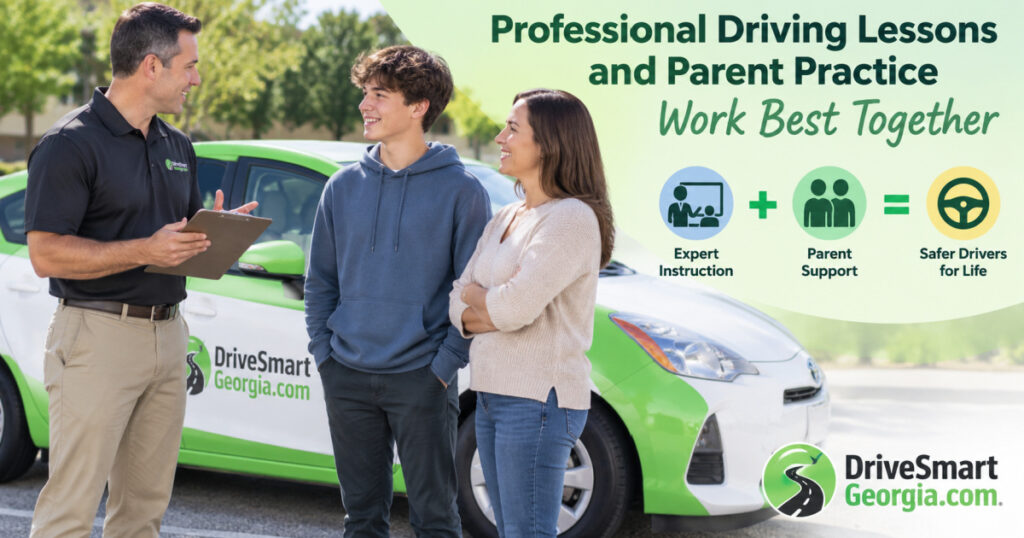
Parents provide something professional instructors can’t replicate: frequent practice over time.
Professional instructors provide something parents may find difficult to provide: structured instruction, objective feedback, and experience teaching new drivers.
The strongest approach combines both.
A professional driving instructor may identify habits that parents haven’t noticed, while parents can reinforce those skills during supervised practice between lessons.
Think of the process as:
Learn → Practice → Receive Feedback → Practice Again
At Drive Smart Georgia, professional driving lessons are designed to help teens develop safer driving habits, improve vehicle control, recognize hazards, and build confidence behind the wheel.
Parents can then reinforce those skills during regular supervised driving.
Georgia Parents Should Focus on Quality,
Not Just Practice Hours

Joshua’s Law requirements are important, but the number of hours behind the wheel shouldn’t be the only measure of progress.
Georgia DDS says teens working toward a Class D license must meet supervised-driving requirements, and a parent or guardian attests that the required training was completed.
Instead of simply trying to accumulate hours, make each practice drive productive.
One trip might focus on:
Turns and lane position.
Another might focus on:
Intersections and right-of-way.
Another might practice:
Lane changes and merging.
Later sessions can introduce night driving, busier traffic, highways, and more independent decision-making. That variety helps teens develop a broader range of driving skills.
Final Thoughts: Practice for Safe Driving,
Not Just the Road Test
Parents have an enormous opportunity to influence the kind of driver their teen becomes.
Start slowly. Build one skill at a time. Increase difficulty as your teen demonstrates consistent control and good judgment.
Practice vehicle control, turns, lane positioning, intersections, parking, backing, lane changes, highways, nighttime driving, bad-weather awareness, and defensive driving.
Most importantly, help your teen learn to recognize hazards and make safe decisions without constant help from the passenger seat.
The Georgia road test is an important milestone, but it’s only one day. The driving habits your teen develops during supervised practice can stay with them for years.
If your teen could benefit from additional instruction, Drive Smart Georgia offers professional driving lessons and Driver’s Ed programs designed to complement parent practice and help teens develop safer, more confident driving skills.
Ready to get started? Explore Drive Smart Georgia’s Driver’s Ed programs and professional driving lessons to find the right training option for your teen.
Drive Smart Georgia locations:
- Milton: 850 Mayfield Rd., Suite L-9, Milton, GA 30009. (770) 628-7540
- Johns Creek: 11380 Southbridge Pkwy., Alpharetta, GA 30022. (770) 232-0903
- Alpharetta: 5354 McGinnis Ferry Rd., Suite 226B, Alpharetta, GA 30005. (770) 232-0900
- Cumming: 1790 Peachtree Pkwy., Suite 202, Cumming, Ga. (770) 239-4294
- Suwanee: 970 Peachtree Industrial Blvd., Suwanee, GA 30024. (770) 741-0455
- Roswell: 590 W. Crossville Rd., Suite 204, Roswell, GA 30075. (770) 741-0405
Related articles:
- How to Build Your Teen’s Driving Confidence Safely
- How to Pass the Georgia Learner’s Permit Test the First Time
- Joshua’s Law FAQs: Answers to Parents’ Most Common Questions
- The Ultimate Georgia Teen Driving Safety Checklist