The Ultimate Georgia Teen Driving Safety Checklist
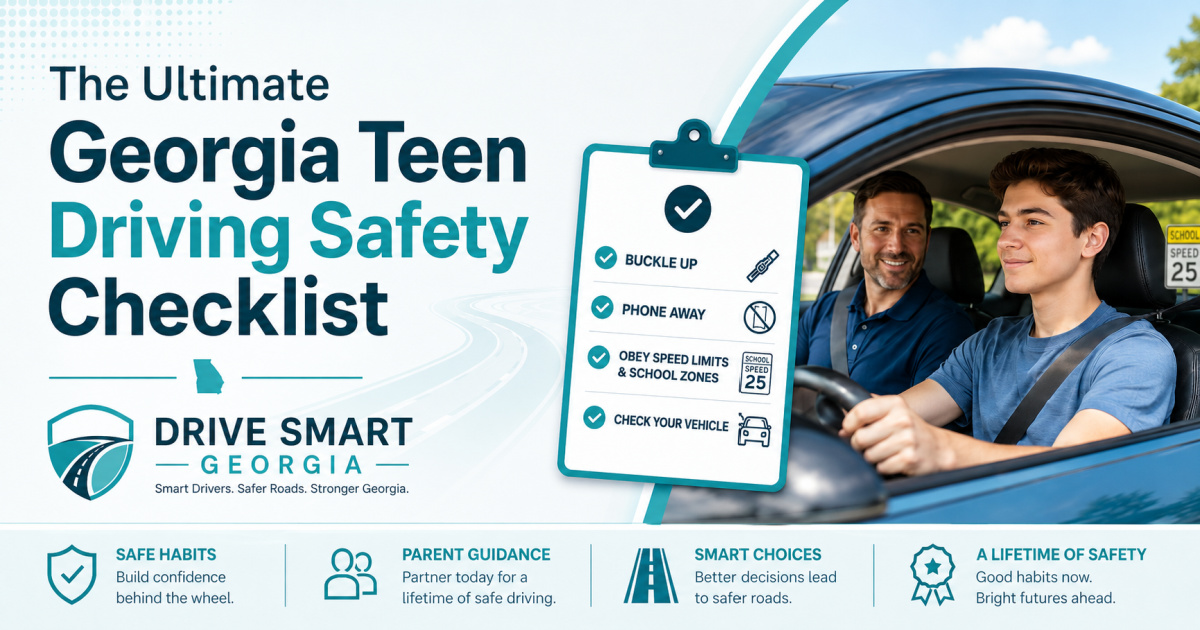
Learning to drive is one of the biggest milestones in a teenager’s life. It brings independence, new responsibilities, and plenty of excitement. It can also create understandable anxiety for parents who want their teens to be prepared for Georgia roads.
A license does not automatically make someone an experienced driver. Safe driving skills develop through education, supervised practice, professional instruction, and consistent reinforcement after the road test.
Use this Georgia teen driving safety checklist to help your new driver build safe habits, meet Georgia licensing requirements, and become more confident behind the wheel.
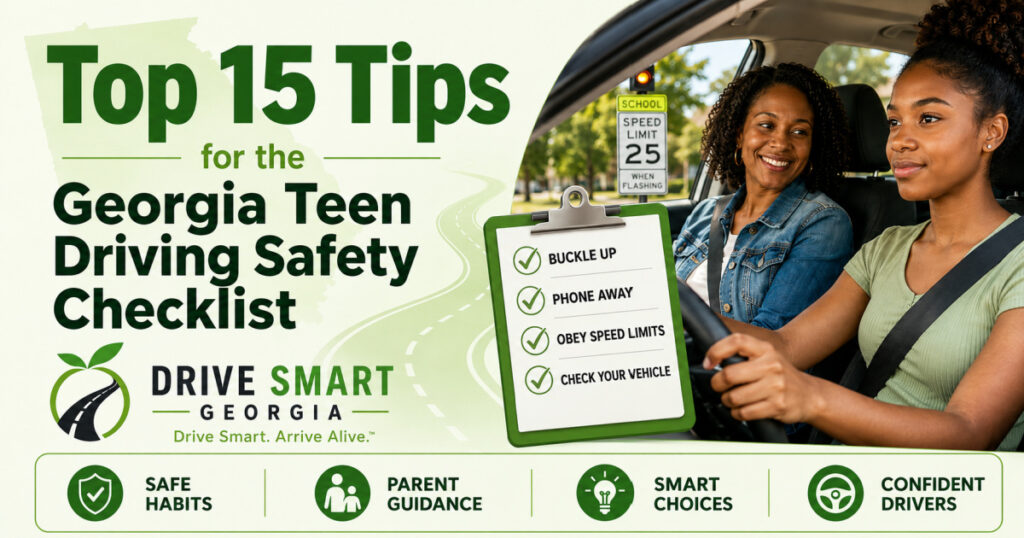
Top 15 Tips for the Georgia Teen Driving Safety Checklist
1. Understand Georgia’s Teen Licensing Requirements
Before teens begin driving independently, families should understand Georgia’s graduated licensing process under the Teenage and Adult Driver Responsibility Act, commonly called TADRA.
Georgia’s teen licensing process includes three stages:
Stage #1: A Class CP instructional permit
Stage #2: A Class D provisional license
Stage #3: A Class C driver’s license
A teenager may apply for a Georgia learner’s permit at age 15 after meeting the applicable documentation requirements and passing the vision and knowledge examinations. While driving with a permit, the teen must be accompanied by a licensed Class C driver who is at least 21, capable of controlling the vehicle, and seated beside the teen.
To qualify for a Class D provisional license at age 16 or 17, applicants must generally hold their instructional permit for at least one year and one day, complete Joshua’s Law requirements, complete ADAP or eADAP, and pass the road skills test.
2. Complete Joshua’s Law Driver’s Education
Joshua’s Law requires Georgia drivers ages 16 and 17 to complete approved driver education before obtaining a Class D license.
Depending on the approved training method selected, the requirements can include:
- 30 hours of classroom or approved online instruction
- Six hours of behind-the-wheel instruction with a certified driving school
- 40 hours of supervised driving with a parent or guardian
- At least six supervised hours completed at night
Professional driving lessons can give teens additional experience with lane control, intersections, parking, traffic awareness, defensive driving, and other skills that may be difficult to practice informally.
3. Follow All Class D License Restrictions
Passing the road test is exciting, but new drivers must continue following Georgia’s Class D license restrictions.
Class D drivers may not drive between midnight and 5:00 a.m. There are no exceptions to this restriction.
Passenger restrictions are introduced gradually:
- First six months: Only immediate family members may ride in the vehicle.
- Second six months: No more than one passenger under age 21 who is not an immediate family member.
- After one year: No more than three passengers under age 21 who are not immediate family members.
These rules help new drivers gain experience before handling the additional distractions associated with driving late at night or transporting several young passengers.
4. Put the Phone Away Before Driving
Phones should be silenced and stored before the vehicle starts moving. Teens should never read messages, send texts, record videos, scroll through social media, or otherwise handle a phone while driving.
Set the navigation system and choose music before leaving. When something needs immediate attention, the driver should pull into a safe parking area before using the phone.
Parents can reinforce this rule by modeling the same behavior. Teens notice when adults tell them to put away their phones but continue checking notifications behind the wheel.
5. Buckle Up Every Time
The driver and every passenger should be properly restrained before the vehicle moves – even on a short drive through the neighborhood.
Add “seat belts” to the family’s pre-drive routine. The teen should confirm that everyone is buckled before shifting into drive.
Parents should also explain that passengers are never permitted to share a seat belt, sit in a cargo area, or ride in a vehicle without an appropriate seating position and restraint.
6. Adjust the Vehicle Before Starting
A safe trip begins before the teen leaves the driveway.
The teen should:
- Adjust the seat for comfortable access to the pedals
- Position the steering wheel correctly
- Adjust all mirrors
- Fasten the seat belt
- Check the dashboard for warning lights
- Set navigation and climate controls
- Confirm that the path around the vehicle is clear
Completing these tasks before moving reduces unnecessary distractions while driving.
7. Practice Scanning and Hazard Awareness
New drivers sometimes focus only on the vehicle directly in front of them. Safer drivers look farther down the road and regularly check their mirrors, intersections, shoulders, and surrounding traffic.
Teach teens to watch for:
- Vehicles entering from side streets
- Brake lights several cars ahead
- Pedestrians near crosswalks
- Bicycles and e-bikes
- Motorcycles
- Road construction
- Animals near the roadway
- Vehicles backing out of driveways or parking spaces
Early hazard recognition gives the driver more time to slow down, change lanes safely, or stop.
8. Maintain a Safe Following Distance
Following too closely reduces reaction time and increases the likelihood of a rear-end crash.
Teens should leave a generous space cushion between their vehicle and the one ahead. They need even more distance in rain, darkness, heavy traffic, or other conditions that reduce visibility or traction.
Parents can practice this skill by asking the teen to identify a fixed roadside object. Once the vehicle ahead passes that object, the teen can count the seconds until their own vehicle reaches it. The goal is to maintain enough time and space to respond smoothly rather than braking suddenly.
9. Slow Down in School Zones and Neighborhoods
School zones, neighborhoods, and parking lots require extra attention. Children may enter the road unexpectedly, drivers may back out without seeing approaching traffic, and posted speeds may change based on location or time of day.
Teen drivers should:
- Obey reduced school-zone speed limits
- Watch crossing guards and flashing signs
- Stop for pedestrians in crosswalks
- Avoid passing vehicles stopped for pedestrians
- Check carefully around parked vehicles
- Expect children, bicycles, and scooters
Drivers must also know how to respond safely when approaching a stopped school bus and should review Georgia’s current school-bus laws as part of their driver education.
10. Practice Driving in Different Conditions
Driving the same familiar route repeatedly can build basic confidence, but it does not prepare a teen for every situation.
Supervised practice should gradually include:
- Residential streets
- Multi-lane roads
- Highways
- Downtown or business districts
- School traffic
- Parking lots and parking garages
- Night driving
- Rain and wet pavement
Introduce difficult conditions gradually. A new driver should master lower-risk environments before progressing to heavier traffic or more complex roads.
11. Avoid Driving While Tired
Drowsiness can affect concentration, judgment, reaction time, and awareness.
Teens should not drive when they are struggling to stay alert. If they become tired during a trip, they should pull over in a safe place and contact a parent or another trusted adult.
Parents can help by setting realistic expectations. A teen should never feel pressured to drive simply because it is inconvenient to arrange another ride.
12. Eliminate Distractions Inside the Vehicle
Phones are not the only source of distracted driving. Loud passengers, food, drinks, pets, makeup, music, and loose objects can all take attention away from the road.
Before driving, teens should secure bags and other items that might move around the vehicle. They should avoid eating, reaching into the back seat, adjusting controls repeatedly, or becoming involved in emotional conversations.
The driver’s attention must remain on driving.
13. Check the Vehicle Regularly
A safe driver needs a safe vehicle.
Parents and teens should regularly check:
- Tire pressure and tread
- Headlights, brake lights, and turn signals
- Windshield wipers
- Mirrors
- Brakes
- Fluid levels
- Fuel or battery charge
- Dashboard warning lights
The vehicle should also contain current registration and insurance information. Teens need to know what warning lights mean and who to contact if the vehicle develops a problem.
14. Know What to Do in an Emergency
Every new driver should know how to respond if something goes wrong.
Review what the teen should do after a minor crash, tire problem, vehicle breakdown, or severe-weather warning. Make sure the teen knows how to move to a safer location when possible, turn on the hazard lights, contact emergency services when necessary, and call a parent or guardian.
Emergency supplies may include a phone charger, flashlight, reflective warning equipment, basic first-aid supplies, and important contact information.
15. Continue Practicing After Getting a License
The learning process should not stop when a teen earns a Class D license.
Continue supervised practice on unfamiliar roads, in heavier traffic, and under different weather conditions. Parents can periodically ride with the new driver and provide calm, specific feedback.
Focus on one or two skills at a time rather than criticizing every small mistake. Positive coaching helps teens stay receptive and develop better judgment.
Build Safer Driving Skills with Drive Smart Georgia
A Georgia teen driving safety checklist is most effective when it is supported by education, practice, and professional instruction.
Drive Smart Georgia has helped more than 100,000 Georgia drivers become safer and more confident behind the wheel. We offer Joshua’s Law Driver’s Ed, professional driving lessons, defensive driving courses, and convenient on-site road testing at select North Atlanta locations.
Our DDS-certified instructors help teens practice essential skills in late-model training vehicles equipped with an additional brake and accelerator on the instructor’s side.
Whether your teen is preparing for a learner’s permit, completing Joshua’s Law, practicing for the Georgia road test, or gaining confidence after earning a license, continued training can make a lasting difference.
Help your teen become a safer, more prepared Georgia driver. Explore Drive Smart Georgia’s Driver’s Ed courses and professional driving lessons today.
Drive Smart Georgia locations:
- Milton: 850 Mayfield Rd., Suite L-9, Milton, GA 30009. (770) 628-7540
- Johns Creek: 11380 Southbridge Pkwy., Alpharetta, GA 30022. (770) 232-0903
- Alpharetta: 5354 McGinnis Ferry Rd., Suite 226B, Alpharetta, GA 30005. (770) 232-0900
- Cumming: 1790 Peachtree Pkwy., Suite 202, Cumming, Ga. (770) 239-4294
- Suwanee: 970 Peachtree Industrial Blvd., Suwanee, GA 30024. (770) 741-0455
- Roswell: 590 W. Crossville Rd., Suite 204, Roswell, GA 30075. (770) 741-0405
Related articles:
- Back-to-School Driving Safety Tips for Georgia Teens
- What is a Georgia Driver’s Ed scholarship?
- Georgia Class D License Requirements Explained
- Defensive Driving Tips that Could Help Prevent Crashes