Georgia Teen Driver Training Requirements: 30, 6 & 40 Hours
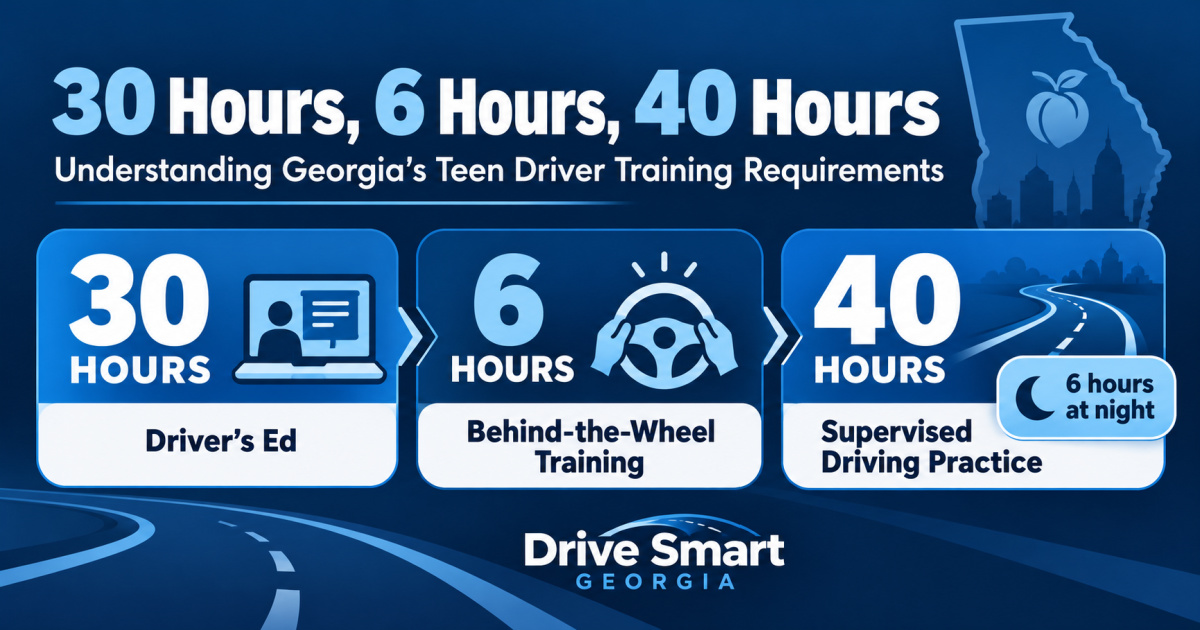
If you are the parent of a Georgia teen learning to drive, you have probably encountered three numbers repeatedly: 30 hours, 6 hours, and 40 hours. So, what exactly do those numbers mean?
Do the 40 hours include the six hours with a professional driving instructor? Does your teen have to complete all three requirements? How much of the driving must take place at night? And how does Joshua’s Law fit into the process?
Georgia’s teen driver training requirements can seem complicated at first, but they make much more sense when you break them into separate pieces.
For families choosing the traditional professional driver education route, think of the process this way:
- 30 hours = driver education instruction
- 6 hours = professional behind-the-wheel training
- 40 hours = supervised driving practice
Each serves a different purpose in helping a new driver prepare for the responsibilities of driving independently. Here is what Georgia parents and teens need to know.
What Are Georgia’s Teen Driver Training Requirements?
Georgia uses a graduated licensing system designed to give young drivers education and experience before they receive full driving privileges.
Under Joshua’s Law, teens who are 16 or 17 years old and applying for a Georgia Class D provisional license must satisfy Georgia’s driver education requirements. The Georgia Department of Driver Services (DDS) provides several approved methods for doing this.
The traditional driving-school method includes:
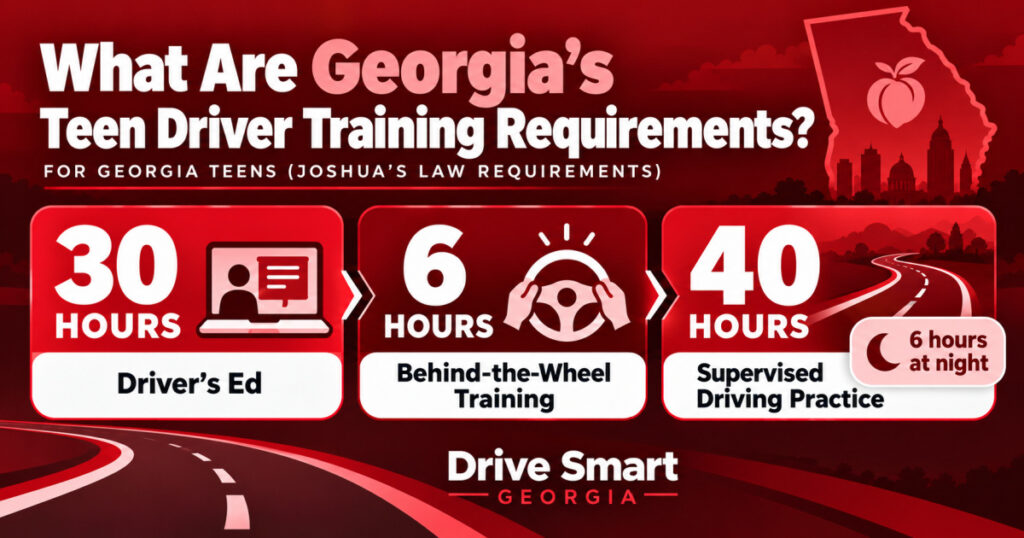
- 30 hours of classroom or approved driver education instruction
- 6 hours of behind-the-wheel instruction with a certified driving school
- 40 hours of supervised driving practice, including at least 6 hours at night
Georgia also permits approved alternatives that use the DDS Parent/Teen Driving Guide in place of the six-hour professional behind-the-wheel component.
That distinction is important. When parents hear “30/6,” they sometimes assume every Georgia teen must complete six hours with a professional instructor. Professional instruction is one approved route, but DDS provides multiple methods for satisfying Joshua’s Law.
For families who choose professional behind-the-wheel instruction, however, the 30 + 6 + 40 framework is an easy way to understand the training process.
What Are the 30 Hours of Driver’s Ed in Georgia?

The 30 hours are the educational portion of Georgia driver training.
DDS requires at least 30 hours of theoretical driver education for 16- and 17-year-olds seeking a Class D license. The instruction can be completed through an approved classroom course or an approved online program.
These 30 hours are different from actual driving practice. Driver’s Ed focuses on:
- Georgia traffic laws
- Road signs and pavement markings
- Right-of-way rules
- Safe following distances
- Defensive driving principles
- Managing intersections
- Sharing the road with other vehicles
- Driving in different traffic conditions
- Recognizing potential hazards
- Making safer decisions behind the wheel
The goal is not simply to memorize information long enough to pass a test. Good driver education helps a teen understand why safe-driving rules exist and how to apply them when real situations develop on the road.
At Drive Smart Georgia, families can choose from different ways to complete the educational portion of Driver’s Ed, including in-person classes, live Zoom instruction with a real teacher in real time, or an approved self-paced online option.
The best format often depends on your teen’s learning style, schedule, and preference for live instruction versus independent study.
What Are the 6 Hours of Behind-the-Wheel Training?
For families using the traditional “30 and 6” driver education method, the next number is six.
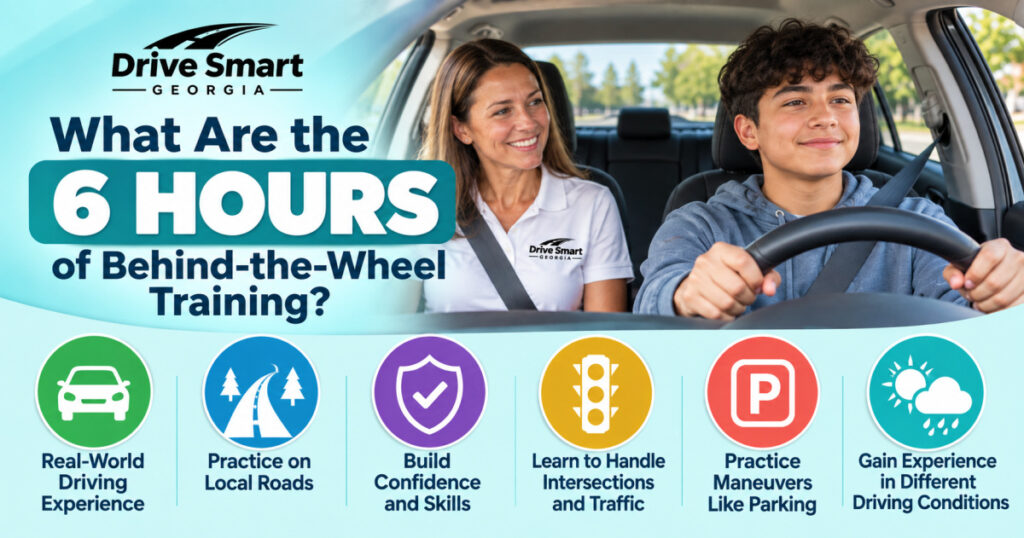
DDS describes a traditional 30-and-6 driver education course as at least 30 hours of Driver’s Ed instruction combined with six hours of behind-the-wheel training conducted by a DDS-certified instructor.
Those six hours provide something classroom instruction cannot: professional coaching while the teen is actually operating a vehicle. A professional instructor can observe how a student performs in real traffic and help identify habits that may be difficult for a parent or inexperienced driver to recognize.
Instruction may focus on skills such as:
- Smooth acceleration and braking
- Steering and vehicle control
- Lane positioning
- Turning
- Intersections
- Traffic signals
- Lane changes
- Following distance
- Speed management
- Parking
- Backing
- Scanning for hazards
- Decision-making in traffic
These lessons are about much more than preparing for a road test. The goal is to help the student develop safe, repeatable driving habits that can continue improving through additional practice.
Are Six Professional Driving Hours Enough?
Six hours of professional behind-the-wheel instruction fulfills the instructor-training portion of the traditional Joshua’s Law method, but it should not be confused with all the practice a teen needs.
That is where the 40-hour requirement becomes especially important. A teen can learn a skill with an instructor and then reinforce it repeatedly while practicing with a parent or other qualified supervising driver.
Think of professional instruction and parent-supervised practice as complementary:
Learn → Practice → Receive Feedback → Practice Again
Professional lessons can help establish techniques and identify weaknesses. Regular supervised driving gives teens the repetition necessary for those skills to become more natural.
What Are the 40 Hours of Supervised Driving in Georgia?
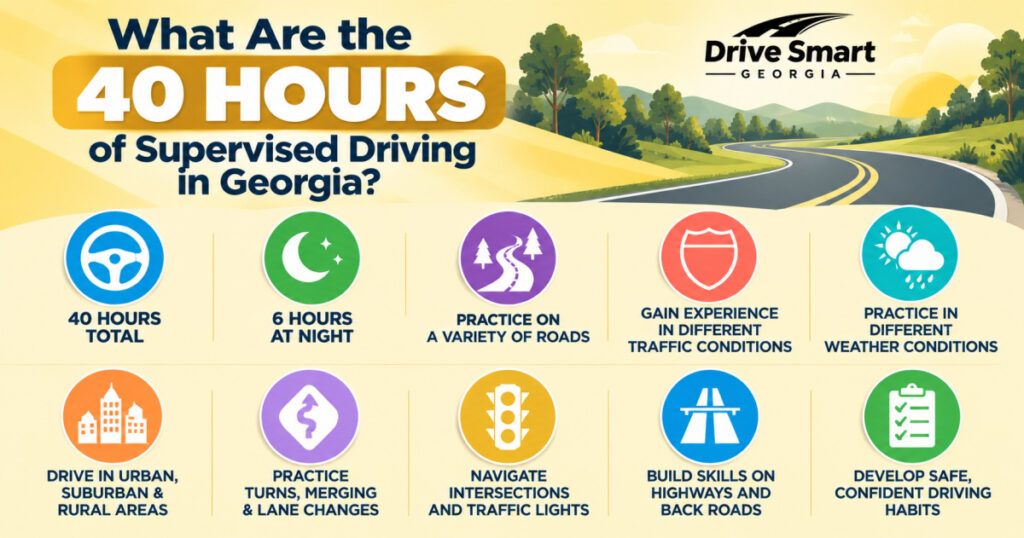
In addition to completing the applicable driver education requirements, Georgia teens seeking a Class D license must accumulate at least 40 hours of supervised driving experience. At least six of those 40 hours must take place at night. These hours give teens the opportunity to experience a wider variety of driving situations over time.
That is important because learning to operate a car and learning to manage real-world traffic are not the same thing. A teen may quickly learn how to steer, brake, and park. Becoming a safe driver also requires learning how to recognize risks, anticipate what other drivers might do, choose safe gaps in traffic, adjust to changing conditions, and make good decisions under pressure.
The Georgia DDS Parent/Teen Driving Guide emphasizes gaining experience across both lower-risk and higher-risk driving environments.
Parents should therefore try to make the 40 hours varied and purposeful, rather than simply accumulating time on the road.
Practice can gradually include:
- Quiet neighborhood streets
- Two-lane roads
- Multi-lane roads
- Intersections
- Traffic lights
- Turns
- Parking lots
- Parking and backing
- Lane changes
- Moderate traffic
- Heavier traffic
- Night driving
- Different weather conditions when appropriate
- Longer drives as the teen gains experience
The objective should be to build both hours and ability.
Do the Six Instructor Hours Count Toward the 40 Hours?
This is one of the most common points of confusion for Georgia parents.
Under the traditional driving-school method listed by Georgia DDS, the requirements identify six hours of professional behind-the-wheel training and 40 hours of supervised driving as separate components. DDS describes the 40 hours as supervised driving with a parent or guardian, including six hours at night.
For families following that route, it is safest to plan for the professional six-hour course in addition to the required supervised practice. Rather than viewing this as excessive, consider how differently the two types of driving time can benefit a new driver.
The professional instructor provides structured instruction and objective feedback. The parent provides repetition.
Together, they give a teen more opportunities to develop skills before driving independently.
Why Do Six of the 40 Hours Have to Be at Night?
Georgia requires at least six hours of the supervised driving requirement to occur at night.
Night driving presents conditions that teens may not encounter during daytime practice. Visibility is reduced. Distances and speeds can sometimes be harder for inexperienced drivers to judge. Headlights, glare, pedestrians, road markings, and changing lighting conditions can all require additional attention.
Parents should not wait until the end of the permit period to begin night practice. Instead, once a teen has demonstrated solid basic vehicle-control skills during daylight hours, parents can gradually introduce nighttime driving in easier environments before progressing to more complicated roads.
Does My Teen Need to Complete the Requirements Before Getting a Learner’s Permit?
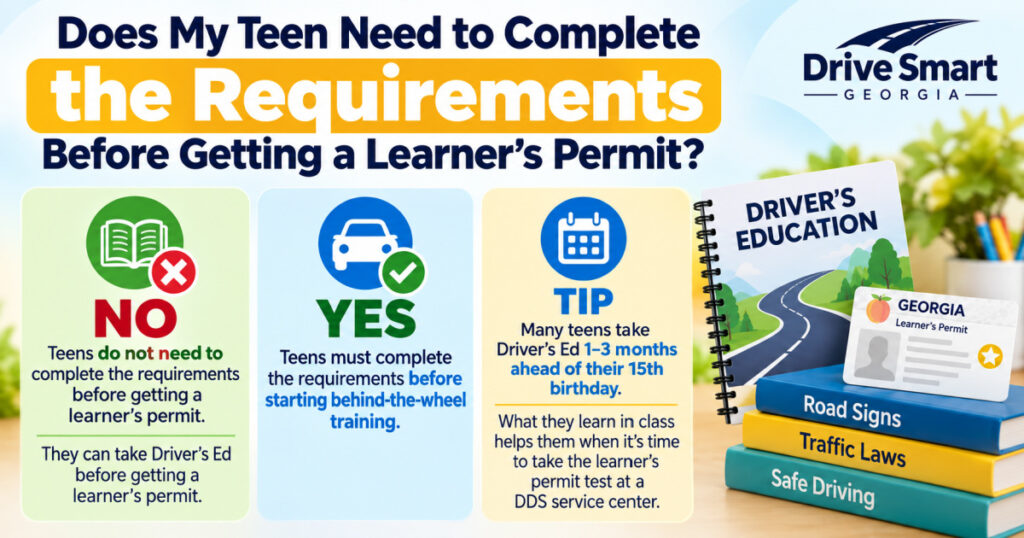
No. Georgia’s Joshua’s Law driver education requirements are associated with qualifying for a Class D provisional license, not obtaining the initial Class CP learner’s permit.
A Georgia teen can generally obtain an instructional permit beginning at age 15 after satisfying the applicable DDS requirements and passing the required knowledge tests.
Driver education can also begin before a teen receives a learner’s permit. That can be useful because the information taught during Driver’s Ed can help a student become more familiar with road rules, signs, and safe-driving principles before taking the Georgia learner’s permit knowledge test.
However, a teen must have the appropriate permit before beginning on-road driving.
Remember the “One Year and One Day” Rule
Completing 30 hours of education, professional training, and supervised practice does not automatically make a teen eligible to receive a Class D license.
A Georgia teen must also have held a valid Class CP learner’s permit for at least one year and one day before applying for a Class D provisional license. For example, completing Driver’s Ed quickly does not shorten the permit-holding period.
That time is valuable. Instead of thinking of the one-year-and-one-day period as a waiting period, parents can use it as an opportunity to gradually expose their teen to different roads, traffic levels, situations, and driving conditions.
What Else Does a Georgia Teen Need for a Class D License?
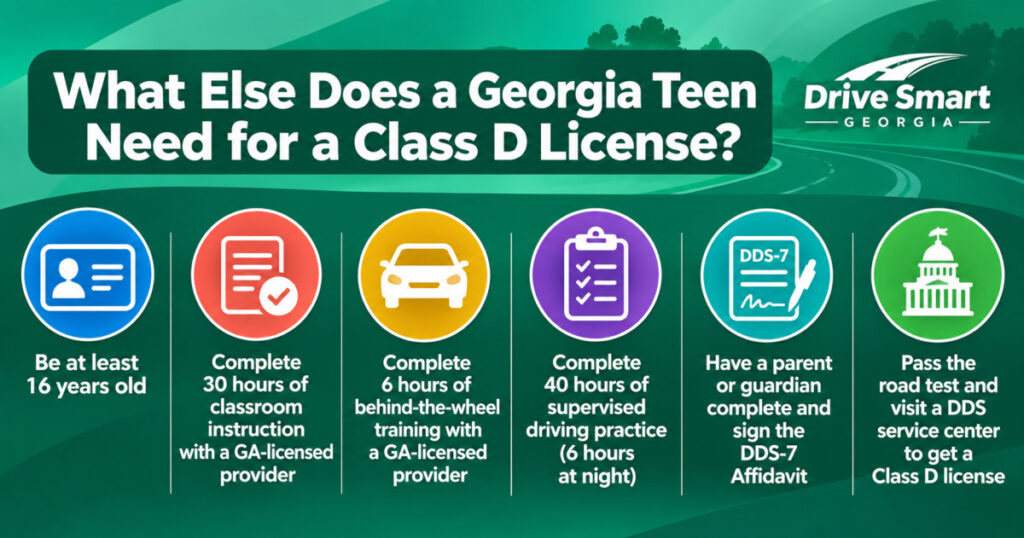
The 30, 6, and 40-hour requirements are important, but they are not the only requirements.
According to Georgia DDS, a teen applying for a Class D provisional license must also meet requirements that include:
- Being at least 16 years old
- Holding a Class CP permit for at least one year and one day
- Completing Joshua’s Law requirements
- Completing ADAP or eADAP
- Meeting applicable school-enrollment requirements
- Having no disqualifying major traffic violations
- Passing the required vision examination and road skills test
Parents should check the current Georgia DDS requirements before test day because documentation and licensing procedures can change.
What Is the DDS-7 Driving Experience Affidavit?
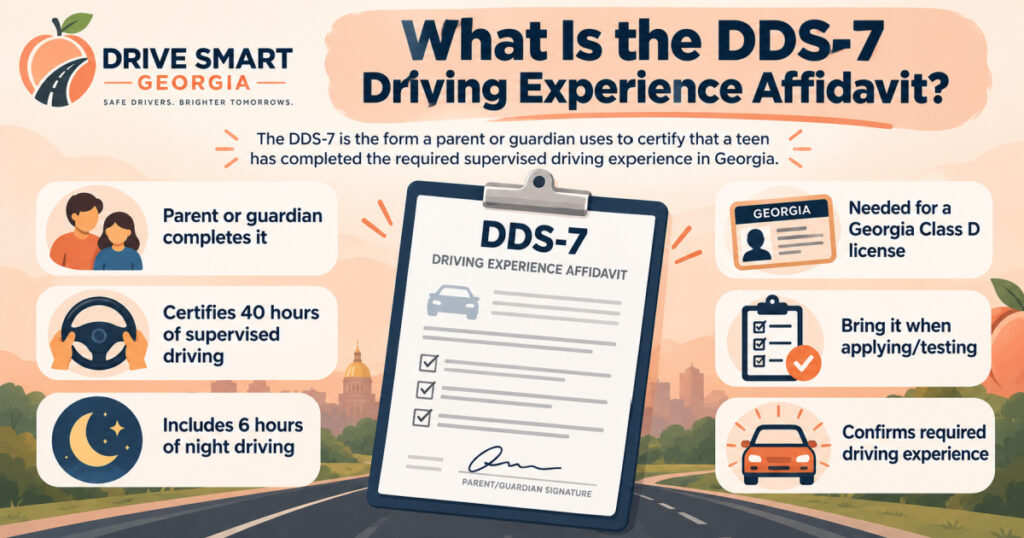
Georgia requires verification that the supervised driving requirements have been completed.
DDS materials explain that families using the applicable parent-supervised driving route certify completion of at least 40 hours of driving experience, including six hours at night, through the required driving-experience documentation.
Parents should keep track of practice consistently rather than trying to reconstruct the teen’s driving hours immediately before the road test.
A driving log can also be useful for more than documentation. It allows parents to see whether practice has been balanced. If almost every recorded drive took place on the same neighborhood roads, for example, the teen may benefit from more experience with intersections, lane changes, parking, moderate traffic, and other situations before test day.
30 Hours + 6 Hours + 40 Hours Serve Different Purposes
One of the biggest mistakes parents can make is treating Georgia’s teen driver training requirements as boxes that simply need to be checked. Each part of the traditional training model has a purpose.
30 Hours: Build Knowledge
Driver education teaches teens traffic laws, road rules, defensive-driving concepts, risk awareness, and decision-making principles.
6 Hours: Build Skills with Professional Guidance
Behind-the-wheel lessons give a certified instructor the opportunity to teach techniques, observe performance, correct mistakes, and identify areas that require more practice.
40 Hours: Build Experience Through Repetition
Supervised practice lets teens repeat skills across different roads, traffic levels, lighting conditions, and situations until their responses become more consistent.
Knowledge alone is not enough. Professional instruction alone is not enough. Practice without strong instruction can also allow poor habits to become established.
The strongest learning process combines education, professional guidance, and repeated supervised practice.
Don’t Rush to Complete the 40 Hours
Parents sometimes focus on reaching the required number as quickly as possible. A better approach is to spread practice across the permit period whenever possible.
Ten hours of driving the same familiar route provides a very different learning experience from ten hours involving different intersections, traffic conditions, parking situations, lane changes, and environments.
Instead of asking only:
“How many hours has my teen driven?”
also ask:
“What has my teen learned during those hours?”
Quality matters as much as quantity when developing a safe new driver.
Professional Driving Lessons and Parent Practice Work
Best Together
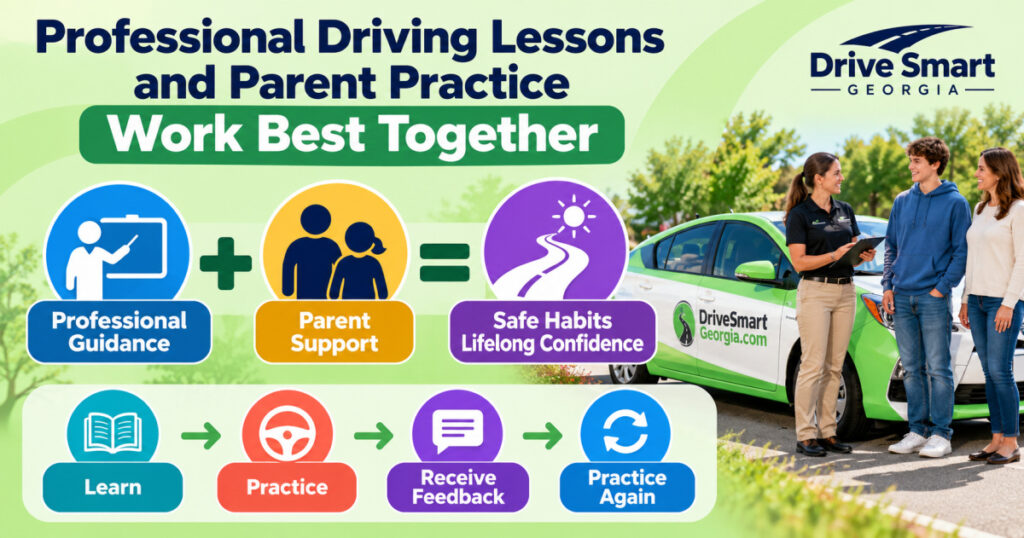
Parents play one of the most important roles in helping teens learn to drive. They provide the repetition and real-world experience that no short driving course can duplicate.
Professional instructors serve a different role. Because instructors work with new drivers regularly, they can identify weaknesses, teach specific techniques, and provide objective feedback that parents can use when planning future practice.
A helpful cycle is:
Professional Instruction → Parent Practice → Instructor Feedback → More Practice
This approach allows teens to learn a skill, repeat it outside the lesson, receive additional feedback, and continue improving.
What Happens After Your Teen Completes the Requirements?
Once your teen has satisfied the applicable training requirements, held the learner’s permit for at least one year and one day, completed the required supervised driving, and met the other DDS eligibility requirements, the next major step is the road test.
Passing the road test allows an eligible teen to move into Georgia’s Class D provisional license stage. Class D drivers still have restrictions. Georgia currently prohibits Class D drivers from driving between 12:00 a.m. and 5:00 a.m., and passenger restrictions gradually change during the first year the license is held.
That is because earning a driver’s license is not the end of learning. It is the beginning of driving more independently.
Understanding the Numbers Makes Georgia Driver
Training Easier
Georgia’s teen driver requirements become much easier to understand once parents separate the numbers.
For families choosing the traditional professional driver education route:
30 hours provide the education.
6 hours provide professional behind-the-wheel instruction.
40 hours provide supervised experience, including at least six hours at night.
The teen must hold the learner’s permit for one year and one day before becoming eligible for a Class D license.
Rather than viewing these requirements as hurdles to finish as quickly as possible, use them as a roadmap.
- The classroom builds knowledge.
- Professional instruction builds skills.
- Parent practice builds experience.
Together, they help prepare a teen for much more than passing the Georgia road test. They help build the judgment, confidence, and safe-driving habits needed for the road ahead.
At Drive Smart Georgia, our DDS-certified Driver’s Ed programs combine driver education with professional behind-the-wheel instruction to help Georgia teens build skills step by step. Families can choose options that fit their schedules and then reinforce those lessons through consistent practice at home.
Ready to get started? Select a Drive Smart Georgia location and find the Driver’s Ed option that works best for your teen.
Drive Smart Georgia locations:
- Milton: 850 Mayfield Rd., Suite L-9, Milton, GA 30009. (770) 628-7540
- Johns Creek: 11380 Southbridge Pkwy., Alpharetta, GA 30022. (770) 232-0903
- Alpharetta: 5354 McGinnis Ferry Rd., Suite 226B, Alpharetta, GA 30005. (770) 232-0900
- Cumming: 1790 Peachtree Pkwy., Suite 202, Cumming, Ga. (770) 239-4294
- Suwanee: 970 Peachtree Industrial Blvd., Suwanee, GA 30024. (770) 741-0455
- Roswell: 590 W. Crossville Rd., Suite 204, Roswell, GA 30075. (770) 741-0405
Related articles:
- Driver’s Ed Timeline: Class First, Permit Later
- In-person or Online Driver’s Ed: Which Option Is Best for Your Teen?
- What to expect during Driver’s Ed classes
- What to Expect During In-car Driving Lessons at Drive Smart Georgia